What Actually Makes a Good Set of Sheets
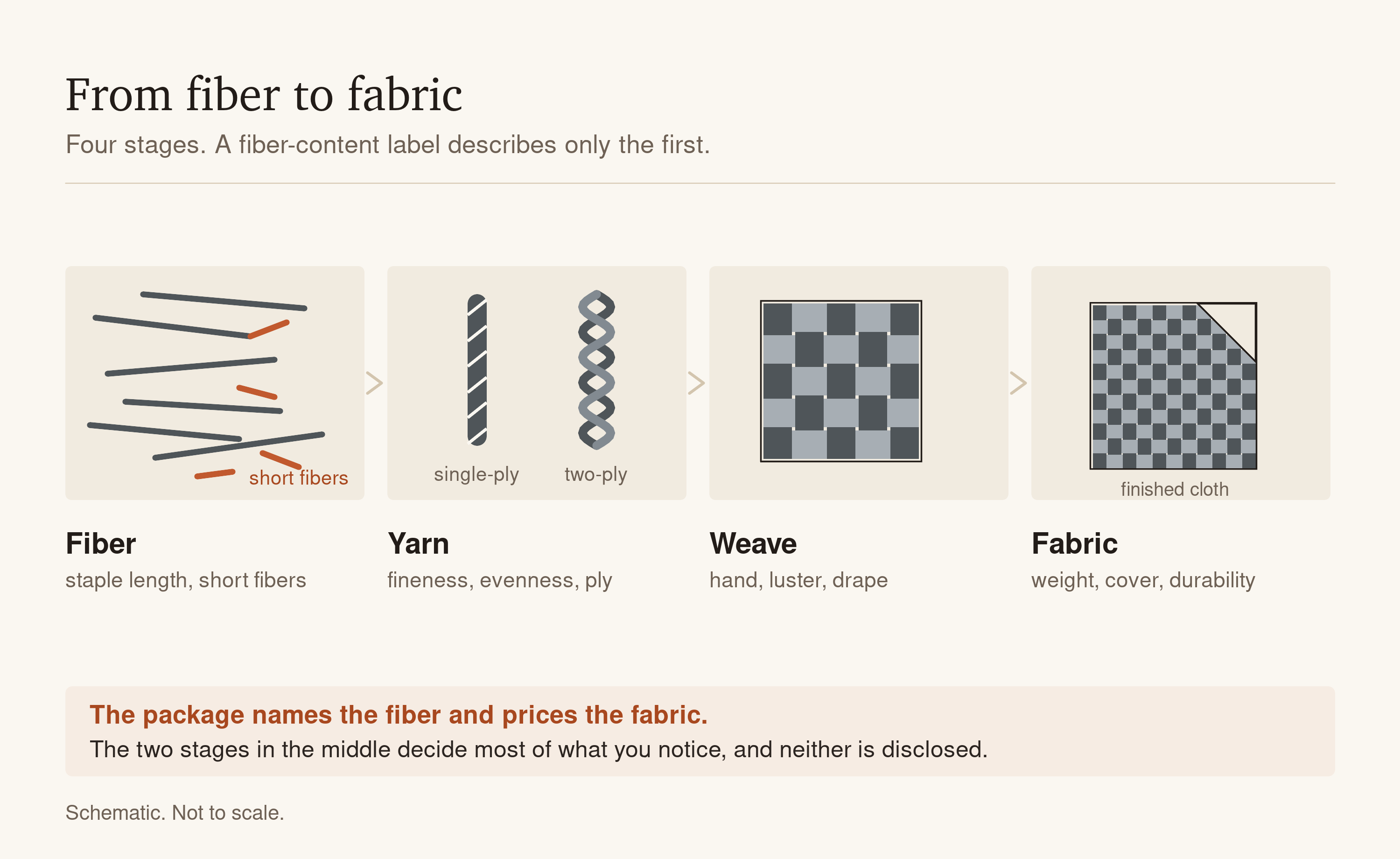
Nine things decide what a sheet is like to sleep on and how long it lasts. Most of the words printed on the package describe none of them, and some are not regulated at all.
A set of sheets carries more printed claims per square inch than almost anything else in a house. Thread count. Egyptian. Sateen. Bamboo. Certified. Deep pocket. Most of those words are doing less work than they appear to, and a few of them are not regulated at all.
This guide is not a shopping list. It is an attempt to sort the claims on a sheet package into three groups: the ones that describe a real, measurable property; the ones that describe something real but tell you nothing on their own; and the ones that are marketing language wearing a technical costume.
Nine things determine what a sheet is actually like to sleep on and how long it lasts. They are not equally important, and the order below is roughly the order in which they decide the outcome.
1. Fiber: what the sheet is actually made of
This is the only part of a sheet label that US law requires to be accurate in a specific way. The Federal Trade Commission’s Textile Rules require that a textile product disclose the generic names and percentages by weight of its constituent fibers, in order of predominance, along with a manufacturer identity and the country where it was processed or manufactured.
The word generic is the important one. A fiber has to be called what it is, not what it was made from. Cotton is cotton. A regenerated cellulose fiber is rayon or viscose — even if the cellulose came from bamboo. The FTC’s own guidance states that textiles “can only be called bamboo if they are made directly from actual bamboo fiber,” and it has spent fifteen years enforcing that against retailers. We cover that in detail in what “bamboo” sheets actually are.
The practical fibers for bed linen:
- Cotton. The default, and the one with the deepest measurement literature behind it. Absorbent, durable, gets softer with washing.
- Linen (flax). A bast fiber, coarser and stiffer when new, with a distinctive texture that softens substantially over years rather than weeks.
- Rayon/viscose, including rayon made from bamboo. Regenerated cellulose. Fluid drape, cool initial hand.
- Lyocell. Also regenerated cellulose, but made by dissolving cellulose directly in a recoverable solvent rather than by the chemical route viscose uses.
- Polyester and cotton/polyester blends. Cheaper, more wrinkle-resistant, less absorbent.
Two mechanics of the rule are worth knowing because they explain things people find confusing. Fibers are listed in descending order by weight, so “60% cotton, 40% polyester” is not a stylistic choice. And fibers present at under 5 percent are designated simply as “other fiber” rather than named — which is why a small quantity of something can be in a sheet without appearing on the label under its own name.
The rules also forbid words or symbols that imply a fiber which is not present, including phonetically similar or slightly misspelled variants. That provision is the reason the bamboo cases were winnable.
Note what the fiber name does not tell you: nothing about the yarn, the weave, the finish, or the construction. A bad cotton sheet and a good cotton sheet carry the same fiber statement.
2. Yarn: the part nobody prints on the package
Before a fiber becomes fabric it becomes yarn, and most of what separates a sheet that stays smooth from one that goes fuzzy happens here.
Staple length
Cotton fibers are short — roughly an inch. The USDA classes them in thirty-seconds of an inch. Upland cotton, which the USDA’s Economic Research Service puts at about 97 percent of US production, occupies staple codes running from under 0.79 inches to 1.36 inches and longer. American Pima, the extra-long-staple species, has its own scale, running from 1.20 inches up to 1.48 and above, and accounts for about 3 percent of the US crop.
Longer fibers mean fewer fiber ends per unit of yarn, and fewer ends means less of what makes a fabric feel rough and eventually pill. That is the mechanism, and it is real. What the evidence actually supports is narrower than the marketing:
A USDA-affiliated study published in the Journal of Cotton Science spun twenty-eight bales into 20s ring-spun yarn and found that short fiber content — the proportion of fibers under about 12.7 mm — was the single most important predictor for five of seven yarn properties measured. Yarn strength correlated with fiber length at r = 0.889 and with short fiber index at r = −0.807. The regression model explained about 95 percent of the variation in yarn strength.
So: long staple predicts strong, even yarn, and that is well documented. What we could not find is any peer-reviewed study testing staple length against the properties of a finished bed sheet — how it feels after a year, how it holds up to laundering. The chain from fiber to yarn is measured. The chain from yarn to bedsheet is inferred. That gap is worth knowing about when someone quotes staple length at you as if it settled the question.
Combing and spinning
Combing is a preparation step that removes shorter fibers before spinning. Given what the short-fiber-content research shows, it ought to matter, and it does — less dramatically than retail copy suggests. One study of matched single-jersey knits found combed yarn pilled at grade 3–4 against carded yarn’s grade 3 under one test method, with no difference in abrasion resistance and the pilling difference disappearing entirely under a second method at higher cycle counts. Half a grade, on one test. That is a real advantage and a small one.
Ring spinning and open-end (rotor) spinning produce measurably different yarns. In a controlled comparison, ring-spun yarns reached higher tenacity and better evenness than rotor yarns. But the same study found rotor yarns pilled less — which cuts directly against the retail assumption that ring-spun is better on every axis. Both studies used blended knits rather than cotton sheeting, so read them as direction, not as specification.
Ply
A single-ply yarn is one strand. A two-ply yarn is two strands twisted together. Ply is a legitimate construction choice with real consequences — and it is also the mechanism behind the most widespread number game in bedding, which is the subject of the next section.
3. Weave: how the yarns cross
Two structures cover almost all bed linen.
Plain weave is the simplest possible interlacing: every warp yarn passes over one weft yarn and under the next. Nothing floats. The result is a matte, crisp, dimensionally stable cloth. In sheeting this is usually sold as percale.
Sateen lets each warp yarn float over several weft yarns before passing under one. Those floats sit on the surface, reflect light along their length, and slide against skin differently from an interlaced surface. The result is the smoother, cooler-looking, more fluid cloth sold as sateen.
Everything people notice about the difference — the crispness of one, the slip of the other, why one wrinkles visibly and the other drapes — follows from float length. A published review of weave structure and fabric properties notes that fabrics with more floats show faster moisture transfer, that abrasion resistance rises as the weave becomes stiffer, and that findings on thermal behavior across weave types are genuinely contradictory between studies. That last point is worth holding onto: the confident claim that one weave sleeps cooler than the other is not as settled as it is stated.
Percale and sateen, compared properly goes through what is measured and what is not.
One thing to know now: percale has no binding standard definition. The commonly cited threshold of around 180 threads per inch traces to fabric glossaries, not to a standard. The ASTM performance specification for sheeting sets requirements for strength, shrinkage, pilling and colorfastness, and sets no fabric count requirement at all.
4. Fabric count: the thread-count problem
Thread count is the sum of the yarns running lengthwise (ends) and crosswise (picks) in a unit of fabric. ASTM D3775, the standard test method, covers exactly this measurement and is titled “End (Warp) and Pick (Filling) Count of Woven Fabrics.” The standard notes that the terms end count and pick count are replacing the older term fabric count “to provide clarity.”
The definition that matters is how a plied yarn gets counted. In the ASTM definition, individual warp and filling yarns “are counted as single units regardless of whether they are comprised of single or plied components.” One yarn is one thread, however many strands were twisted to make it.
Some suppliers have counted each ply separately, so a 300-count fabric woven from two-ply yarn is advertised as 600. In August 2005 the FTC’s Division of Enforcement wrote to the National Textile Association about the appropriate way to disclose thread count. As reported by the trade press at the time, the letter said consumers could be deceived by stating an inflated count achieved by multiplying the actual count by the number of plies, and that the honest description was “300 thread count, two-ply yarn.”
That letter appears to be the entire body of US federal pronouncement on the subject. No rule requires thread count on a label. No rule governs how it is measured for advertising. We found no enforcement action. What thread count actually tells you works through what the number is genuinely good for, because “thread count is meaningless” is also wrong.
5. Weight: where thread count stops working
Thread count describes how many yarns are packed into an inch. It says nothing about how thick those yarns are. Two fabrics with the same count can differ substantially in substance.
Fabric weight in grams per square meter captures what count misses, and it is the sensible descriptor for linen and flannel, where a high thread count is neither achievable nor desirable. Textile engineering uses cover factor for the same reason — a figure that combines thread density with yarn fineness, defined in the literature as the ratio of threads per inch to the square root of the cotton yarn count. It is a better single number than thread count. Almost nobody prints it.
Linen, and the limits of cotton vocabulary
Almost all the vocabulary above was built around cotton, and linen breaks most of it. Flax fibers are much longer than cotton fibers and are spun into coarser yarns, so a linen sheet has a far lower thread count than a cotton one by necessity, not by economy. Judging linen by thread count produces exactly the wrong answer. Weight in grams per square meter is the descriptor that works, and the texture that reads as roughness when new is the structure that produces linen’s characteristic hand after a few years of washing.
The same caution applies to flannel, which is a napped fabric where the raised surface, not the thread density, is doing the work.
6. Fit: the specification with no standard behind it
US mattress sizes are industry convention rather than a published national standard, so far as we could establish. The commonly used dimensions in inches are twin 38 × 75, full 54 × 75, queen 60 × 80, king 76 × 80, and California king 72 × 84, with twin XL longer than a standard twin.
Pocket depth is worse. The depth bands in circulation — standard, deep, extra-deep — overlap and contradict each other between sellers, because no standard defines them. A “deep pocket” sheet from one brand may be shallower than a “standard” sheet from another.
The only reliable move is to measure your own mattress from the seam at the top to the seam at the bottom, including any topper you sleep on, and buy to that number rather than to the adjective.
7. Finishing: what has been done to the cloth
Between the loom and the package a fabric is scoured, often bleached or dyed, sometimes mercerised, sometimes given a wrinkle-resistant or softening treatment. Some of this is permanent. Some of it is a surface coating that washes off, which is why a sheet that felt beautifully soft in the shop can feel different after three washes.
The tell is not on the label. What you can do is treat the first-wash feel as the real feel and the in-store feel as provisional.
8. Durability: the one document that sets actual numbers
There is a US performance specification for sheets. ASTM D5431, Standard Performance Specification for Woven and Knitted Sheeting Products for Institutional and Household Use, sets minimum requirements including:
- Breaking force — 178 N (40 lbf) minimum for 100 percent cotton, 222 N (50 lbf) for polyester/cotton
- Tear resistance — 7 N (1.5 lbf) minimum, each direction
- Pilling — rating of 4.0 minimum
- Dimensional change — 5 percent maximum for durable press, 2 to 3.5 percent for preshrunk, 8 percent length and 6 percent width for non-durable-press
- Colorfastness to laundering — alteration class 4 minimum, staining class 3 minimum
It is a voluntary specification, used mainly for institutional purchasing. We have not seen a consumer sheet package advertise compliance with it. That is the shape of this whole category: the one document that puts numbers on shrinkage, strength and pilling is the one number nobody markets.
9. Labels and certifications: what each actually certifies
Three marks turn up constantly on bedding.
OEKO-TEX STANDARD 100 certifies that every component of an article has been tested against a list of more than a thousand harmful substances, with limits scaled to how much skin contact the product has. Bed linen falls in Class 2, direct skin contact. It is a chemical-safety certification and nothing else. It says nothing about durability, softness, fiber quality, or how the fabric was made.
OEKO-TEX MADE IN GREEN adds two things on top: the manufacturing facilities must themselves be certified, and the product carries a unique ID that traces back to production sites. It covers manufacturing conditions, not product performance.
GOTS certifies organic fiber content plus environmental and social criteria through the whole processing chain. Its “Organic” grade requires at least 95 percent certified organic fibers; “Made with x% organic materials” covers 70 to 94 percent. Every company in the chain must be certified, with annual on-site audits.
None of the three sets a single performance requirement. Not a strength minimum, not a shrinkage limit, not a pilling grade. A fully certified sheet can be a bad sheet. The certifications answer real questions — what is in it, who made it, under what conditions — and they do not answer the question “is this good.”
A package, claim by claim
What each phrase on a typical sheet package is actually asserting:
- “100% cotton” — regulated fiber content statement. Reliable, and tells you nothing about grade, yarn or construction.
- “1000 thread count” — unregulated. Ask whether the yarn is plied. Under the ASTM definition a plied yarn is still one thread.
- “Egyptian cotton” — an origin claim. Unless it carries the Egyptian Cotton Association mark, nothing verifies it beyond general prohibitions on deceptive advertising.
- “Supima” — a licensed trademark, which means a contractual relationship exists and, since 2022, a traceability program sits behind it.
- “Sateen” or “percale” — weave descriptions. Real and useful. Neither has a binding standard definition in the US.
- “Bamboo” — if the sewn-in label says rayon or viscose, the fiber is regenerated cellulose and the FTC requires it be called that.
- “Deep pocket” — undefined. Measure the mattress.
- “OEKO-TEX certified” — chemical residue testing. Not a quality mark.
- “Hotel quality”, “luxury”, “premium” — no definition, no standard, no verification.
What the cotton names mean
Egyptian, Pima and Supima are three different kinds of claim wearing similar clothing: one is a geographic origin claim, one is a variety name, and one is a licensed trademark with a verification program behind it. They are not interchangeable, and only one of them has a defined enforcement mechanism. Egyptian, Pima and Supima separates them.
Putting it together
If you want a compressed version:
- Decide weave first. Percale or sateen is the difference you will actually notice every night. It is a preference, not a quality ranking.
- Treat thread count as a range, not a score. Somewhere around 200 to 400 in a single-ply cotton sheet is the region where the number stops telling you much. Past that, ask about ply.
- Read the fiber statement, not the fiber adjective. “Made with bamboo” on the front and “100% rayon” on the sewn-in label are two different claims, and only one of them is regulated.
- Measure your mattress. Pocket depth language is not standardized.
- Expect certifications to answer chemistry and conduct questions, not quality questions.
- Judge after the first wash, and then take care of them properly — which does more for how long a set lasts than most of the specifications above. How to wash and care for sheets covers what is actually evidenced, and how much popular laundry advice turns out not to be.
WiseEveryday does not test bedding and does not rank products. Everything above comes from federal rules, published standards, USDA classification documents and peer-reviewed textile research, and where the evidence runs out we have said so rather than filling the gap.
Sources
- 16 CFR Part 303, Rules and Regulations under the Textile Fiber Products Identification Act
- FTC, Threading Your Way Through the Labeling Requirements Under the Textile and Wool Acts
- FTC, Calling It Cotton: Labeling and Advertising Cotton Products
- ASTM D3775, End (Warp) and Pick (Filling) Count of Woven Fabrics, with the definition as reproduced by IDFL
- ASTM D5431, Performance Specification for Woven and Knitted Sheeting Products for Institutional and Household Use
- USDA Economic Research Service, Cotton Sector at a Glance and USDA AMS classification data documentation
- Thibodeaux et al. (2008), Journal of Cotton Science 12:368–377, on short fiber content and ring-spun yarn quality
- Ahmad et al. (2015), AUTEX Research Journal 15(1):30–34 and Begum & Milasius (2022), Fibers 10(9):74, on weave structure and fabric properties
- 16 CFR Part 423, the Care Labeling Rule
- OEKO-TEX STANDARD 100, OEKO-TEX MADE IN GREEN and the Global Organic Textile Standard