How to Wash and Care for Sheets Without Ruining Them
Temperature, detergent, bleach, drying, storage: what the published evidence supports, and how much of the standard laundry advice turns out to have nothing behind it.
Most laundry advice for sheets is folklore. Some of it is good folklore. But a surprising amount of what is repeated as established fact turns out to have no standard, no public-health body and no published study behind it — and a few things that are well documented never get mentioned.
This article separates the two. Where there is evidence, we give it and say what it measured. Where there is not, we say that plainly instead of repeating the advice with more confidence than it has earned.
One rule sits above everything below: follow the care label on the item you actually own. Fibers, finishes and dyes differ, and the manufacturer knows what it put on the cloth.
Start with a surprise about care labels
The FTC’s Care Labeling Rule covers textile wearing apparel and certain piece goods sold for home sewing. Bed linen is not in its scope. Sheets are not federally required to carry a care label at all. Most do, because manufacturers want them to, but it is a courtesy rather than an obligation.
Where the rule does apply, it defines something genuinely useful — what the temperature words mean:
Hot — initial water temperature 112 to 145 °F (45 to 63 °C)
Warm — 87 to 111 °F (31 to 44 °C)
Cold — up to 86 °F (30 °C)
Note how wide “hot” is. A hot wash at the bottom of that range is 45 °C, which matters a great deal for the next section.
The rule also has a quiet provision worth knowing: if either washing or drycleaning works, the label needs to give only one of them. A label is a method that works, not the only method that works.
Temperature: what it actually does
A 2021 review in Applied and Environmental Microbiology collects the domestic laundering evidence, and it is more specific than the usual advice.
Measured log reductions of organisms recovered from inoculated fabric after full wash cycles included S. aureus at 2.89 to 3.23 log₁₀ after 20 minutes at 46 °C (115 °F), and E. coli above 4.16 log₁₀ with Salmonella Typhimurium at 4.83 log₁₀ after 28 minutes at 55 °C (131 °F). Non-enveloped viruses were far more resistant in the same cycle — rotavirus 0.32 log₁₀, hepatitis A 0.29 log₁₀. The review states that reaching a 99.9 percent reduction for organisms such as Acinetobacter baumannii and S. aureus generally requires washing above 60 °C (140 °F).
Two things follow.
Domestic “hot” is often not hot in the microbiological sense. If your machine’s hot setting delivers 45 °C, it is not doing what a 60 °C wash does. This is not a reason for alarm — it is a reason to stop treating the temperature dial as the hygiene control.
Chemistry substitutes for heat. The review finds that enzymes and bleach become essential below 20 °C (68 °F), that activated oxygen bleach outperformed chlorine bleach against some organisms, and that enveloped viruses are inactivated by detergent surfactants even in cold water. It also notes the median US cold-water inlet temperature at 14.4 °C (58 °F) — American cold is genuinely cold. In a domestic machine, detergent is doing most of the work.
Drying contributes independently. Both the review and CDC guidance note that dryer heat, and ironing, add meaningful microbial reduction on top of the wash.
One important caveat about a number you will see quoted. CDC’s guidance that at least 160 °F (71 °C) for a minimum of 25 minutes is commonly recommended for hot-water washing comes from its guidelines for health-care facilities. It is not domestic advice, most household water heaters are not set that high, and the same guidance notes that low-temperature washing can be effective when the cycle and chemistry are controlled.
“Sanitize” is a regulated word
In US law, sanitizing is a pesticidal claim. EPA defines a sanitizer as a substance that reduces the bacterial population in the inanimate environment by significant numbers — for example a 3 log₁₀ reduction — without destroying all bacteria, and products making public-health antimicrobial claims must be registered under federal pesticide law with efficacy data behind them.
So a laundry product claiming to kill 99.9 percent of bacteria is making a registered pesticidal claim. One that says it helps freshen or removes odour-causing bacteria generally is not. The distinction is legally meaningful and almost never explained.
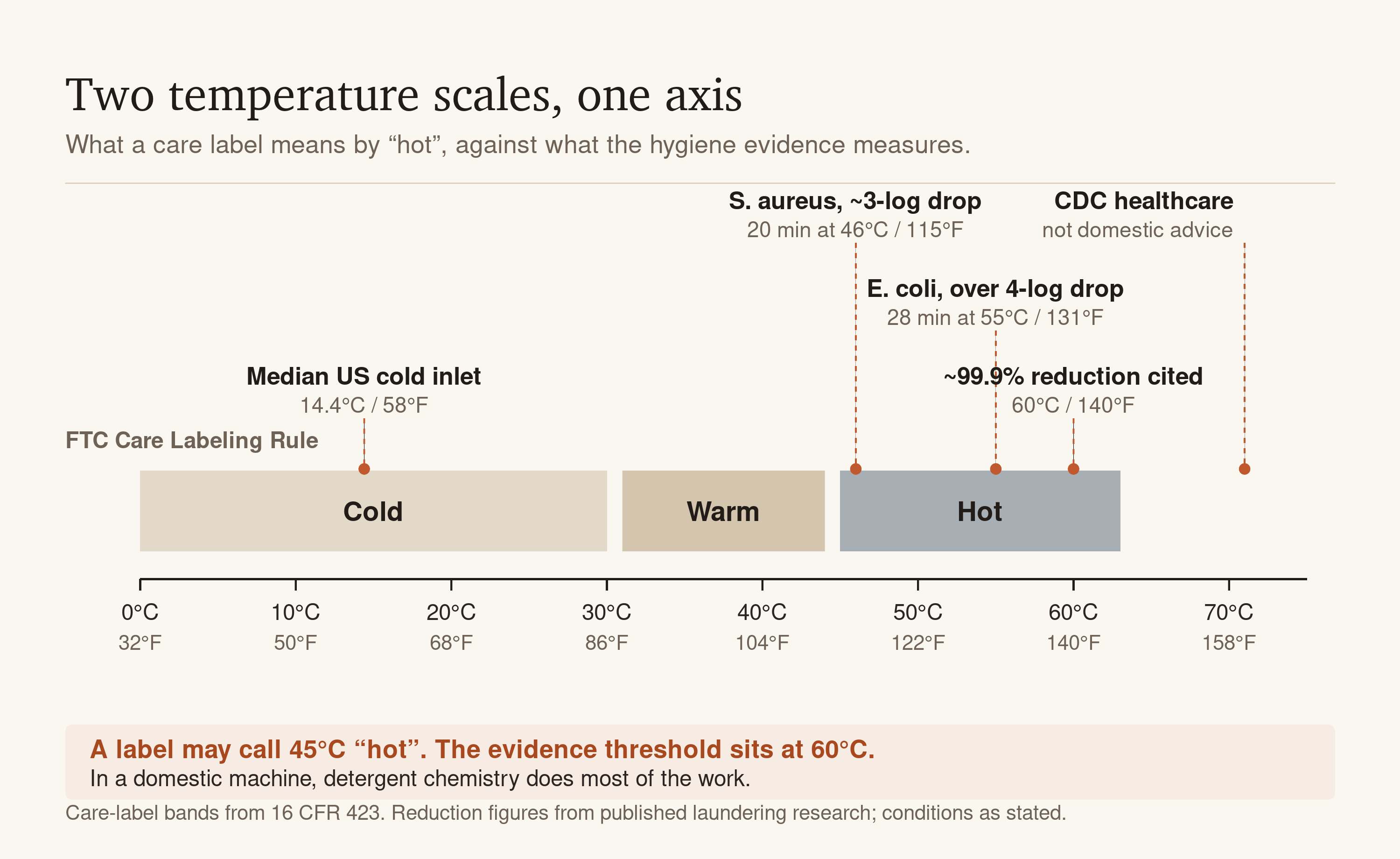 Not a recommendation — the marks show what the cited studies measured.
How often?
We went looking for authoritative guidance on how often a household should wash bed linen. There is none. Not from CDC, not from any national health body we could find. Every confident weekly-or-fortnightly rule in circulation traces to a retailer, a magazine or a blog.
The scientific literature backs up that absence. The same 2021 review states that there are no understandings of a definition for what it means to achieve a safe level of risk reduction in laundering practices. A field with no agreed endpoint cannot have a defensible frequency rule.
So: wash them when they need it, more often in hot weather or if someone is unwell, and know that anyone quoting you a number is quoting a convention rather than a finding.
Detergent, softener and additives
Fabric softener is the one with real measured downside. A Virginia Tech study measured household fabric softeners on cotton and polyester using standard methods for water vapor transmission (ASTM E96) and air permeability (ASTM D737). Softener reduced both, with the effect more pronounced on cotton than polyester; rinse-cycle softener reduced air permeability most, dryer sheets second. In plain terms, softener makes the cloth breathe less — a poor trade on something you sleep under all night.
The same study found something rarely reported: rinse-cycle softener increased flammability in both fiber types with repeated laundering, to the point that treated polyester specimens failed a children’s sleepwear standard after 25 cycles. That is a finding about softener generally, not about sheets specifically, and it is a reason to be deliberate rather than habitual about it.
The common claim that softener ruins absorbency we could not verify. Breathability, yes, measured. Absorbency specifically, no published measurement located. We are separating those because they usually get merged.
Optical brighteners. Widely discussed, poorly evidenced in anything we could reach. Every accessible source was either a chemical supplier or content marketing. We have no position to offer.
Stains
The best-evidenced result here is about bleach, and it is more nuanced than the bottle suggests. A study in the Journal of the American Oil Chemists’ Society tested sodium hypochlorite bleaching of stained cotton across temperature, concentration, time and pH. Temperature, concentration and time were all significant; pH was not. Lower bleach concentration produced better outcomes than higher. Cold and warm temperatures were more acceptable than very cold or hot. And at room temperature — 25 °C (77 °F) — soaking for up to 16 hours remained acceptable.
Acceptability there was defined two-sidedly: at least 75 percent whiteness and retention of at least 90 percent of original breaking strength. That is the right way to think about bleach. A stain-removal result that costs you a tenth of the fabric’s strength is not a success.
Now the part that will be unwelcome. “Never use hot water on blood, it sets the stain” is advice we could not verify. No standard, no public-health body, no peer-reviewed paper. The underlying chemistry is orthodox — heat denatures proteins, and industrial proteases have temperature optima — and the advice may well be right. But it is repeated as established fact by everyone and sourced by no one. Cold water first on a protein stain costs you nothing, so there is no reason to stop doing it; there is a reason to stop calling it settled.
Drying
Here the published evidence is unusually clear and unusually ignored.
A study in the Textile Research Journal examined cotton fabric under three tumble-drying regimes — wet fabric with heat, wet fabric tumbled at room temperature, and already-dry fabric tumbled at high heat — assessed by electron microscopy, weight loss and tensile testing. Wet fabric dried with heat showed severe fiber damage. Room-temperature tumbling caused less damage than heated drying. And already-dry fabric tumbled at high heat showed severe damage of a different character. The authors concluded that damage can be minimized by reducing unnecessary tumble-drying time.
So the habit of taking sheets out slightly damp is not fastidiousness. Over-drying is a distinct, measured mechanism of damage, separate from the heat of drying itself. Lower heat, shorter time, and stop before bone dry.
Shrinkage and what a sheet is supposed to survive
Dimensional change is measured by standard methods — AATCC TM135 for fabrics and TM150 for finished garments — which express the result as a percentage change in length and width after specified laundering.
More useful for a buyer is that there is a US performance specification for sheets, ASTM D5431, which sets maximum allowable dimensional change: 5 percent for durable press, 2 to 3.5 percent for preshrunk, and 8 percent in length and 6 percent in width for non-durable-press. It also sets a minimum pilling rating of 4.0, a minimum breaking force of 178 N (40 lbf) for 100 percent cotton, minimum tear resistance of 7 N (1.5 lbf), and colorfastness minimums.
Two caveats. Those are maximum allowable tolerances, not typical observed values — we found no published figure for typical residual shrinkage in retail cotton sheeting. And the specification is voluntary, aimed largely at institutional purchasing. No US rule requires shrinkage disclosure on bed linen.
Practically: expect a first-wash shrink, wash before measuring anything, and buy fitted sheets with the mattress depth you actually have rather than the one that will just fit before laundering.
Pilling
Pilling is measured by standard methods — ASTM D3512 using a random tumble tester, ASTM D4970 using a Martindale — both graded on a 5-to-1 scale against visual standards, where 5 is no pilling and 1 is severe.
Both standards say something worth repeating. Neither is recommended for acceptance testing — D3512 because of poor between-laboratory precision, D4970 because interlaboratory data are unavailable. A brand quoting a pilling grade is quoting a number that its own governing standard says should not be used to accept or reject a shipment.
On what causes pilling, the standards say only that results depend heavily on fiber type, yarn construction, finishing and actual wear conditions. The widely repeated explanations beyond that — low-twist yarns, short-staple cotton, polyester blends holding pills on rather than shedding them — are mechanistically plausible and we could not source them to a standard or a study. Treat them as reasonable expectations, not facts.
Storage
Good evidence exists here, and it comes from textile conservation rather than from lifestyle writing. The Canadian Conservation Institute’s guidance on textiles and the environment gives figures:
Humidity. Mould develops in three months or more at 70 percent relative humidity, but within a few days at 90 percent. Below 40 percent RH textiles become increasingly brittle. Roughly 40 to 70 percent is the working range.
Temperature. The rate of chemical decay roughly doubles for each 5 °C (9 °F) increase.
Light. Damage is cumulative — lux multiplied by hours. Ultraviolet in daylight and some electric sources is a major cause of yellowing and fiber weakening.
Dust. Sharp silica particles can cut fibers during handling, and at higher temperature and humidity fine dust cements itself to fibers. The same guidance names wood and acidic tissue paper as harmful pollutant sources inside storage furniture.
Which supports the ordinary version: cool, dry but not arid, dark, clean, and not directly against untreated wood. The more specific consumer rules — cotton bags rather than plastic, refolding along different lines, acid-free tissue between layers — are conservation practice we could not trace to a stated evidence base, so treat them as sensible craft rather than as findings.
The short version
Follow the care label, and know that on sheets it is voluntary and that it lists one method that works, not the only one.
Wash warm rather than hot for routine loads. Domestic hot is often below the temperature that matters microbiologically anyway, and detergent chemistry is doing most of the work.
Go hotter deliberately, not habitually — illness, allergy management, heavy soiling — and expect more wear as the price.
Use less bleach rather than more, and cooler rather than hotter, on the evidence.
Skip fabric softener. It measurably reduces breathability, more on cotton than on synthetics.
Under-dry rather than over-dry. This is the single best-evidenced piece of advice in the article.
Don’t overload the machine — especially with sateen, whose surface floats snag.
Be more conservative with regenerated cellulose. If the label says rayon, viscose or lyocell — including anything sold as bamboo — follow the care label rather than improvising.
Store cool, dark and clean.
Wash them when they need washing. Nobody authoritative has ever published a number.
For what to buy in the first place, what actually makes a good set of sheets covers fiber, yarn, weave, weight and fit. Percale and sateen behave differently in the wash, and it is worth knowing which you have.
Sources
Abney et al. (2021), Applied and Environmental Microbiology, on laundry hygiene and odor control
CDC, Guidelines for Environmental Infection Control in Health-Care Facilities (2003), Laundry and Bedding — healthcare guidance, not domestic advice
Simpson & Riggs (1983), JAOCS 60, on hypochlorite bleaching, stain removal and fabric strength
Canadian Conservation Institute, CCI Notes 13/1, Textiles and the Environment
ASTM D5431, Performance Specification for Woven and Knitted Sheeting Products