Percale vs Sateen: How the Two Weaves Differ
One interlaces every yarn; the other floats yarns across the surface. Everything people notice about the two follows from that, including the claim the evidence does not settle.
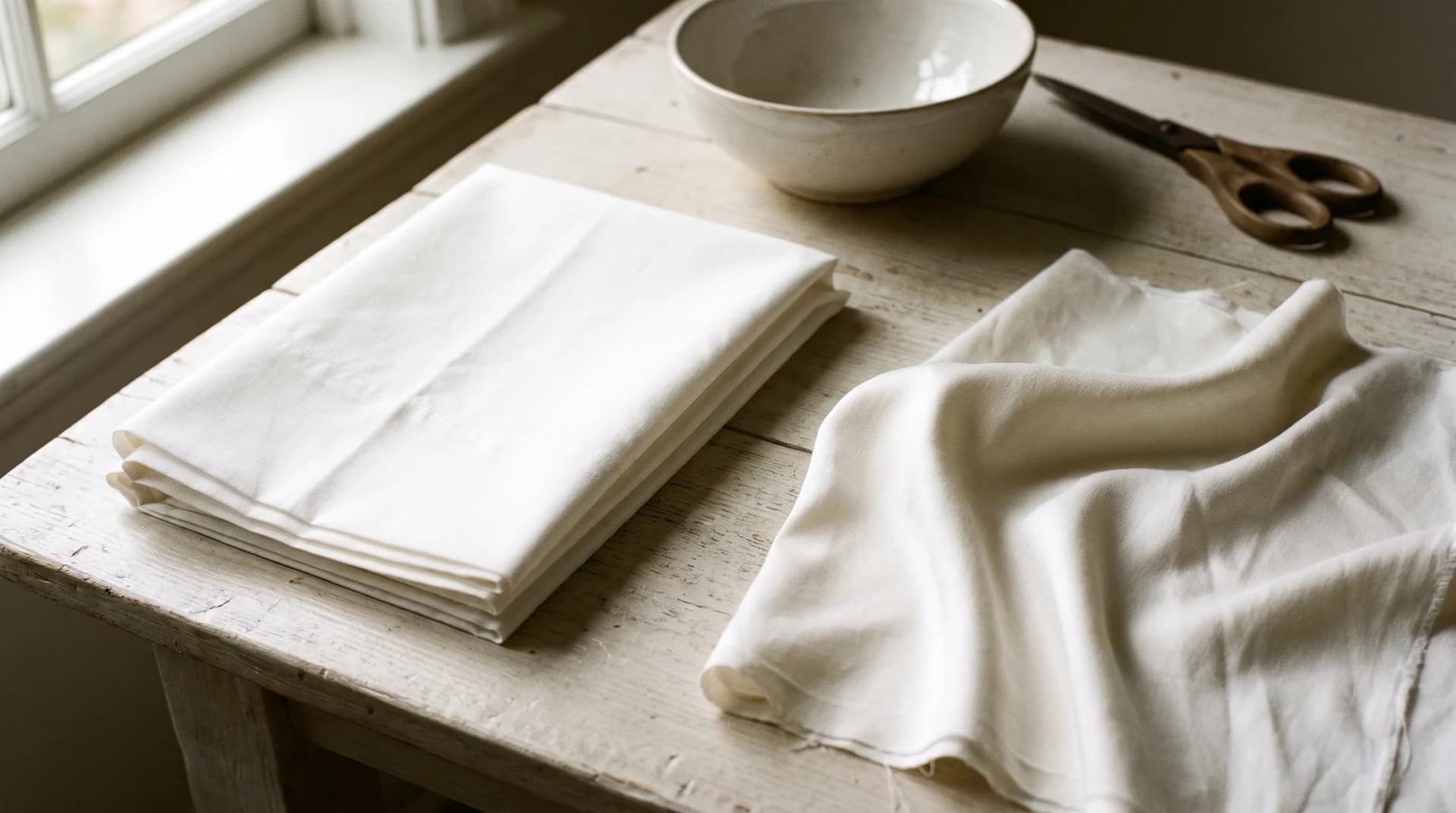
Percale and sateen are not grades. They are two ways of crossing the same yarns, and the difference between them is the single choice that most changes what a sheet is like to sleep on. It is a preference. Neither is the better fabric.
What follows is the structural difference, what it produces, and — because this is a category thick with confident claims — where the measured evidence actually stops.
The structural difference
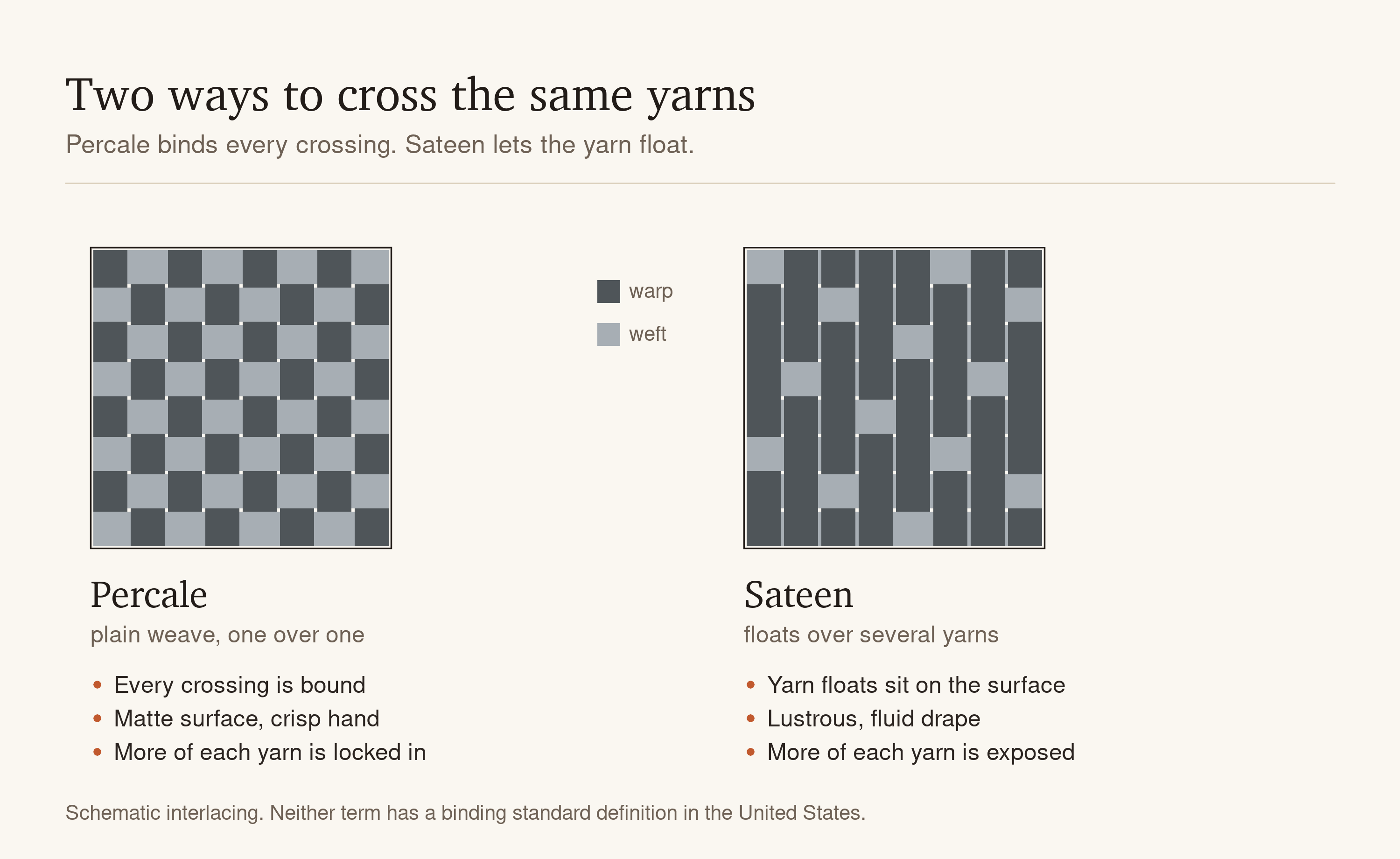
Percale is a plain weave. Plain weave is the simplest interlacing there is: each warp yarn passes over one weft yarn, then under the next, alternating all the way across, and the next warp yarn does the opposite. Every crossing is an interlacement. Nothing passes over more than one yarn at a time.
Sateen is a float weave. Each warp yarn passes over several weft yarns before going under one. The stretch of yarn lying unbound on the surface is called a float. The binding points are staggered so they do not line up into a visible diagonal, which is what distinguishes sateen from twill.
That is the entire difference. Everything below follows from float length.
What follows from it
Surface and light
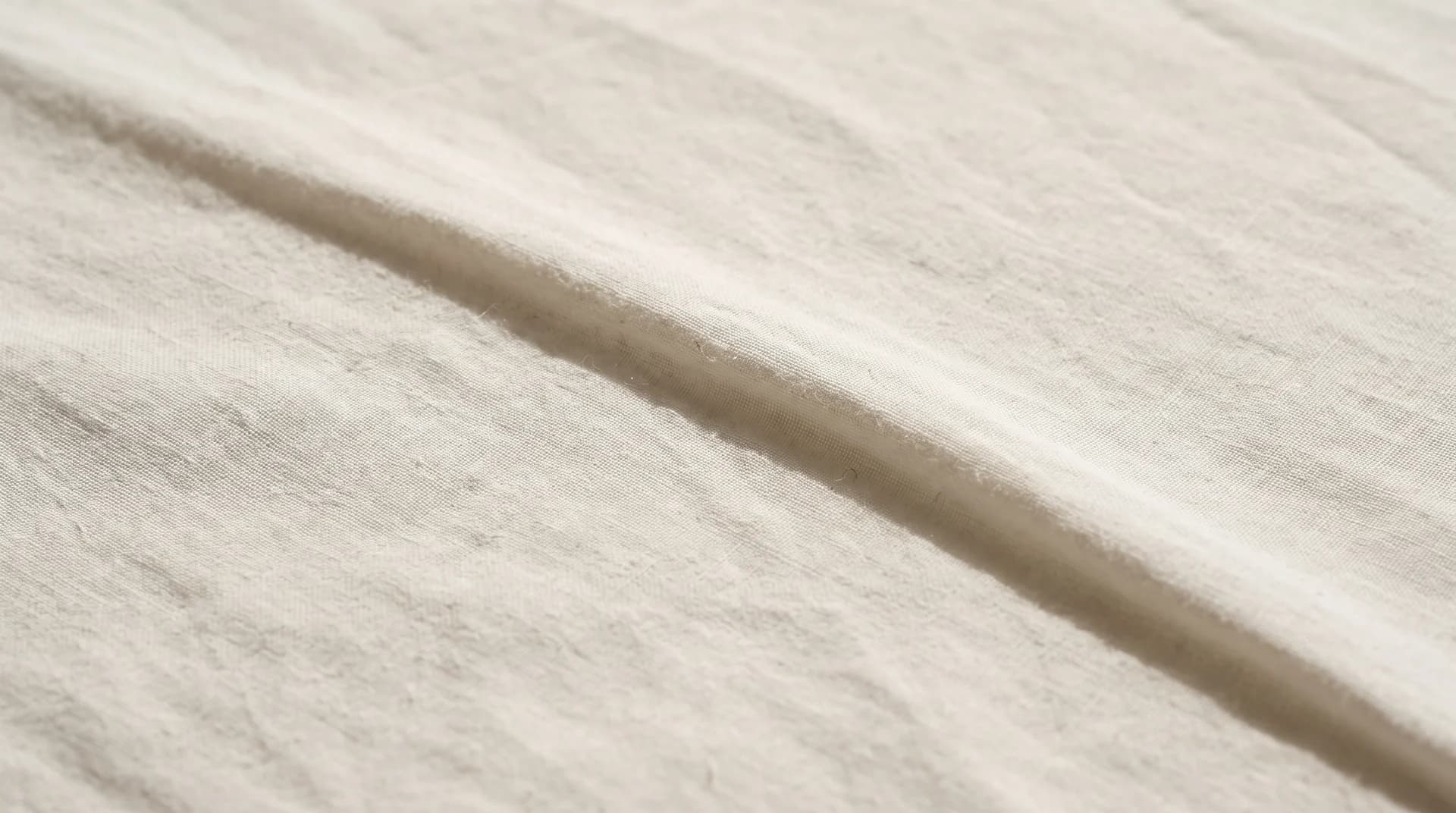
A plain weave presents a surface of constant, tight interlacings: matte, uniform, no sheen. A sateen presents long stretches of parallel yarn, and yarn reflects light along its length. That is why sateen looks lustrous and percale looks flat. The luster is a geometric consequence of the floats, not a coating and not a fiber property.
Hand
Percale is crisp. The word people reach for is “hotel sheet” or “a good shirt.” It has body, it makes a faint sound when it moves, and it holds a crease.
Sateen is smooth and fluid. Fewer interlacements per unit area means less resistance to bending, so the cloth drapes rather than standing. Skin passes over floats rather than over a grid of crossings.
Wrinkling
Percale wrinkles visibly. A tightly interlaced structure records a fold. Sateen wrinkles less obviously, partly because its drape lets creases fall out and partly because a lustrous surface hides them.
Wear
Floats are exposed. A length of yarn lying on the surface has more of itself available to catch, abrade and eventually fuzz than a yarn locked into an interlacing every crossing. This is the honest mechanical argument that sateen is more vulnerable to surface wear.
The published evidence here is directional rather than specific: a review of weave structure and fabric properties reports that abrasion resistance increases as a woven structure becomes stiffer, which points the same way. We did not find a controlled study measuring abrasion or pilling of percale against sateen in matched cotton sheeting. The mechanism is sound and the specific measurement is missing, and both of those are worth saying.
Where the evidence actually stops
The most repeated claim in this comparison is that percale sleeps cooler and sateen sleeps warmer. It is stated everywhere with total confidence. It deserves more care than that.
What is measured: weave structure demonstrably affects air permeability. A study in the AUTEX Research Journal wove eight structures from the same cotton ring-spun yarn — 29 tex warp, 35.5 tex weft — holding areal density and cover factor uniform, and measured air permeability to EN ISO 9237 and thermal resistance to ISO 11092 on a sweating guarded hotplate. Plain weave came out at 28.7 mm/s air permeability with a thermal resistance of 0.031, against much higher air permeability for the looser structures tested, several exceeding 100 mm/s.
What that study did not include is a sateen. Its comparison set was plain, half panama, ottoman, matt and four twills. So it establishes convincingly that weave structure changes air permeability and thermal resistance, and it does not establish the percale-versus-sateen case specifically.
Meanwhile a broader published review of weave structure and fabric properties reports that findings on thermal behavior across weave types are contradictory between studies — one investigation finding plain weave lowest in thermal resistance, another finding the opposite. The review also reports that fabrics with more floats show faster moisture transfer, which if anything runs against the simple “sateen sleeps hot” story.
So here is the honest position. Weave changes thermal and moisture behavior: that is established. The direction people confidently assign to percale and sateen is plausible, consistent with the structures, and not something we can point to a controlled measurement of in matched sheeting. Anyone stating it as settled fact is going further than the literature does.
There is also a confound that rarely gets mentioned: sateen and percale are not usually offered at the same thread count, in the same fiber, at the same weight. When someone compares their sateen set to their percale set, they are comparing two products that differ in several ways at once.
The other weave words
Percale and sateen dominate cotton sheeting, but a few other terms turn up and are worth placing.
- Twill. Also a float structure, but the binding points line up into a visible diagonal rather than being staggered. Structurally between plain and sateen; less common in sheets than in shirting.
- Jersey. Not a weave at all — a knit. It stretches, it does not hold a crease, and it behaves like a T-shirt because it is constructed like one.
- Flannel. A finish rather than a structure: the surface of a woven cloth is brushed to raise a nap. The nap traps air, which is what makes it warm. Judge flannel by weight, not by thread count.
- Linen. A fiber, not a weave, though it is almost always plain woven. Flax yarns are coarser than cotton, so linen sheeting has a much lower thread count by necessity.
Living with each
The two weaves ask for slightly different handling.
Percale takes a few washes to lose its factory stiffness, which means the first night is often the worst night. It responds well to being taken out of the dryer slightly damp and smoothed flat, and it is the one that looks materially better ironed — the crispness people like is the flat surface.
Sateen is the one that punishes rough handling. Floats snag on rings, zips, pet claws and overloaded machines, and a pulled float shows on a lustrous surface far more than a pulled interlacing shows on a matte one. Washing on a full load with anything that has a hook or a hard edge is the usual cause of a sateen sheet developing a run.
Neither needs fabric softener. There is measured evidence that softener reduces a cotton fabric’s water vapor transmission and air permeability, which is to say it makes the cloth breathe less — a poor trade for a temporary hand improvement on something you sleep under.
Neither is a standard
Percale has no binding definition in the United States. The threshold repeated in glossaries — around 180 threads per inch and upward — comes from fabric reference material rather than from a standard. ASTM D5431, the performance specification for sheeting products, sets requirements for breaking force, tear resistance, pilling, dimensional change and colorfastness, and sets no fabric count requirement and no weave requirement.
In practice both words are used honestly by most sellers, because there is no commercial advantage in calling a sateen a percale. But nothing compels it.
Choosing
Percale suits you if you like a bed that feels crisp and taut, you associate freshly ironed cotton with good sleep, you do not mind visible wrinkles, and you want the structurally more durable surface.
Sateen suits you if you like a fluid, smooth, slightly weighty drape, you want a bed that looks composed without ironing, and you prefer luster to matte.
Two practical notes. Sateen’s exposed floats mean it is the fabric that punishes rough handling — snags, overloaded machines, high-heat drying. And percale usually needs a few washes before it stops feeling stiff, so first-night disappointment is common and temporary.
If you are still deciding between everything else on the package, what actually makes a good set of sheets covers fiber, yarn, weight, fit and finishing. If you are trying to interpret the number printed next to the weave name, thread count explains what it counts. And whichever weave you choose, how you launder it will do more for its lifespan than the weave will.