Thread Count: What It Actually Tells You
Thread count is not a quality score, and it is not meaningless either. What the number counts, how plied yarns inflate it, and the single letter the FTC has written about it.
Thread count is the most printed number in bedding and the least defended. It is worth understanding properly, because both of the popular positions are wrong. It is not a quality score. It is also not meaningless.
What follows is what the number measures, how it gets inflated, what US regulators have actually said about it, and the narrow band of situations in which it tells you something real.
What is being counted
A woven fabric has yarns running lengthwise and yarns running crosswise. The lengthwise ones are ends (the warp). The crosswise ones are picks (the weft, or filling). Thread count is the sum of the two, per unit distance.
There is a standard for measuring it. ASTM D3775 is titled Standard Test Method for End (Warp) and Pick (Filling) Count of Woven Fabrics, covers all types of woven fabric, and reports the count per inch in the English system or per centimeter in the metric system. The standard notes that the older umbrella term fabric count is being replaced by the separate terms end count and pick count “to provide clarity.” It also states that the method is considered satisfactory for acceptance testing of commercial shipments.
So the measurement is standardized. Counting yarns in a piece of cloth is not a difficult or contested procedure. Everything that goes wrong happens before and after the measurement, not during it.
The ply problem
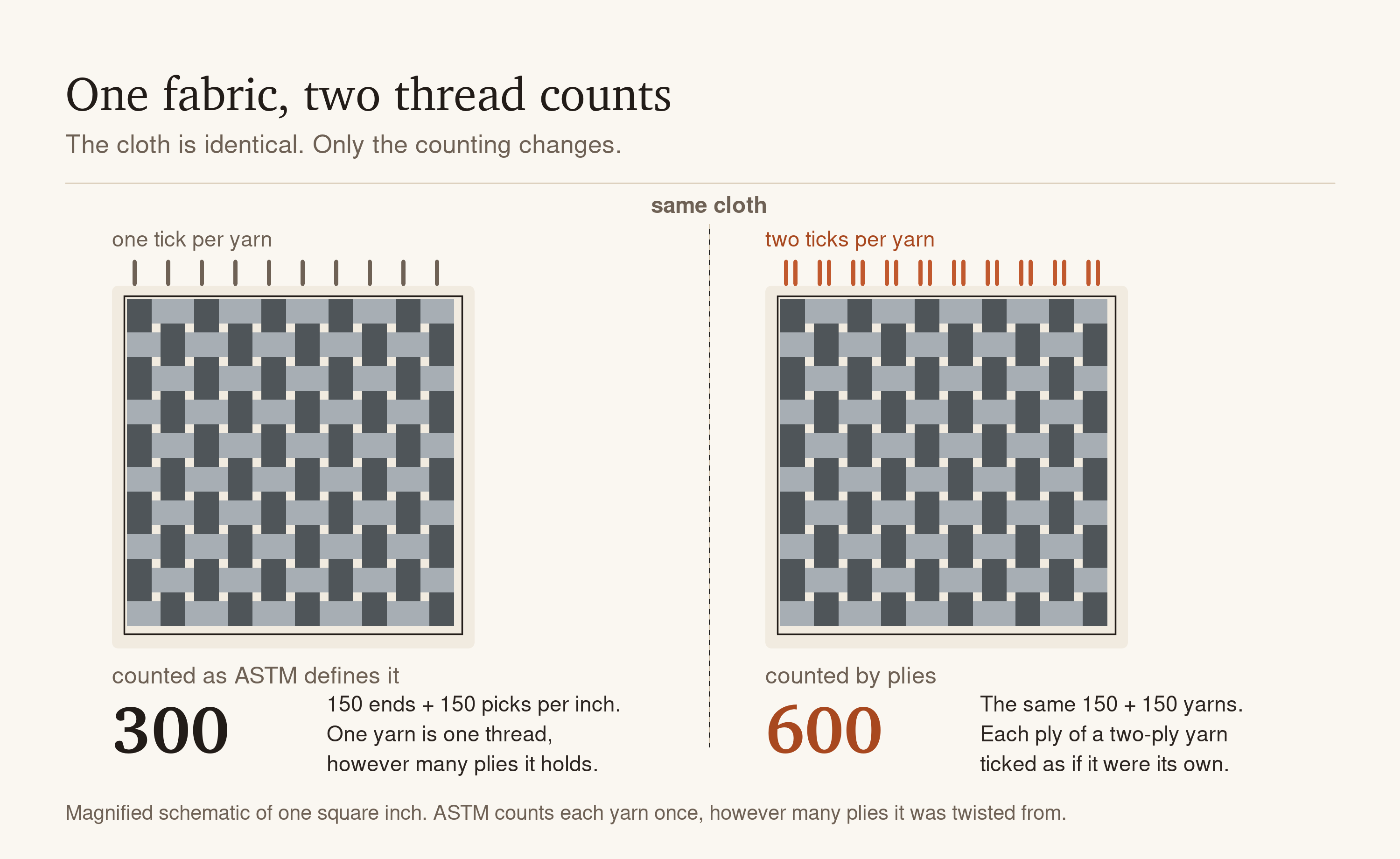
Here is the whole controversy in one definition. ASTM defines thread count as the sum of warp and filling yarns per unit distance, counted with the fabric under zero tension and free of folds, and specifies that individual warp and filling yarns “are counted as single units regardless of whether they are comprised of single or plied components.”
A plied yarn is made by twisting two or more single strands together before weaving. Under the definition above, a two-ply yarn in the cloth is one thread. It went through the loom once. It occupies one position in the fabric.
The inflation method is to count the plies instead. A fabric woven with 150 ends and 150 picks of two-ply yarn measures 300 by the standard definition. Multiply by two plies and it becomes 600. Use four-ply yarn and the same cloth becomes 1200. Nothing about the fabric changed. Only the arithmetic did.
This matters physically, not just semantically. To fit more yarns into an inch you need finer yarns, and there is a limit to how fine a cotton yarn can be spun and still be woven and still be strong. A genuinely very high single-ply count requires exceptionally fine yarn, which is difficult and expensive. A very high plied count requires only a different way of counting. The second is much easier to produce than the first, and on the package they look identical.
We looked for an authoritative figure on the practical ceiling for single-ply cotton sheeting and could not find one in a standard or in peer-reviewed work. We are not going to invent a number. What can be said with confidence is the structural point: past a certain density, additional count in a cotton sheet is being achieved by some means other than putting more distinct yarns in the cloth.
Why finer yarn is the constraint
Yarn fineness is measured in cotton count, written Ne. The system is inverse: a higher Ne means a finer yarn, because it is defined by how many 840-yard hanks make up a pound. Coarse sheeting yarn might be in the 20s; fine shirting and sheeting yarn runs much higher.
To weave more yarns into an inch, each yarn has to be thinner, which means a higher Ne, which means spinning a strand of the same strength out of less material. That is where staple length starts to matter: longer fibers with fewer short fibers spin into finer yarn that still holds together. This is the honest connection between a high single-ply count and cotton quality — and it is why the cotton names on the package and the number on the package are related, though not in the way the package implies. It is also why a genuinely high single-ply count is expensive to make.
None of that applies when the count was reached by multiplying plies. The yarn did not have to get finer. Nothing had to get better.
The same cloth, four ways
Take one fabric: 150 ends and 150 picks per inch, woven from two-ply yarn.
- Counted by the ASTM definition, it is 300.
- Counted by plies, it is 600.
- Woven from four-ply yarn at the same density and counted by plies, it becomes 1200.
- Described honestly, it is “300 thread count, two-ply” — which is what the FTC was reported to have recommended in 2005.
All four describe the same piece of cloth. Only one of them lets you compare it to anything.
What US regulators have said
Very little, and only once.
On 2 August 2005, James A. Kohm, then Associate Director of the FTC’s Division of Enforcement in the Bureau of Consumer Protection, wrote an advisory opinion letter to the National Textile Association in response to a question about the appropriate way to disclose fabric thread count. The letter is listed in the FTC’s advisory opinion library under that description.
The FTC’s own copy of that letter is a scanned image with no machine-readable text, and we were unable to read it directly. What we can report is how it was described at the time. The trade publication Home Textiles Today reported the FTC as saying that consumers could be deceived or misled by the practice of stating an inflated thread count achieved by multiplying the actual count by the number of plies within the yarn, and that the accurate description of such a fabric would be along the lines of “300 thread count, two-ply yarn.” A textile consultancy summarising the same letter reported the position identically: individual threads should be counted as one thread regardless of ply.
Two independent sources agreeing on the substance of a document neither of us can read is reasonable evidence, and we are telling you exactly how strong it is rather than putting the FTC’s words in quotation marks as though we had verified them.
What we can state from primary sources is what does not exist:
- No federal rule requires a thread count on a sheet label. The FTC’s Textile Rules require generic fiber names and percentages, manufacturer identity, and country of origin. Thread count is not among them, and no section of the rules addresses it.
- No federal rule governs how an advertised thread count is arrived at.
- We found no FTC enforcement action over thread count. The 2005 advisory letter appears to be the entire federal record.
The contrast with bamboo is instructive. Mislabeling rayon as bamboo produced fifteen years of FTC enforcement and millions of dollars in civil penalties, because fiber content is a regulated disclosure. Inflating thread count produced one letter, because thread count is not.
Nor does the sheeting standard care
ASTM D5431, the performance specification for woven and knitted sheeting products, sets minimum requirements for breaking force, tear resistance, pilling, dimensional change after laundering, colorfastness and flammability.
It sets no fabric count requirement whatsoever.
The one document that defines what a sheet has to achieve to be considered acceptable does not mention the number that dominates sheet marketing. That is not an accident of drafting. It is a statement about which properties predict performance.
So what does the number tell you?
Something, within limits.
Within a single fabric type, from a single maker, at a single ply, count tracks density. A 200-count percale and a 400-count percale from the same line, both single-ply, are genuinely different cloths: the higher count is finer-yarned and denser. Denser generally means smoother and less air-permeable; a published review of weave structure and fabric properties notes that air permeability decreases as a woven structure becomes denser. If you are choosing between two products that differ only in count, the number is informative.
Across makers, fabric types, or ply constructions, it is close to useless. A 300-count percale and a 300-count sateen are different fabrics. A 600-count plied sheet and a 600-count single-ply sheet are very different fabrics. The number is not comparable across those boundaries, and the package gives you no way to know which boundary you are crossing.
Very high counts are a flag to ask a question, not a disqualification. The question is: single-ply or plied? A brand that is proud of a genuinely fine single-ply construction will tell you. A brand that will not say has told you something.
Denser is not automatically better
There is a quiet assumption inside thread-count marketing: that packing more yarn into the cloth improves it without limit. Density is a trade-off, not a gradient.
A denser fabric is smoother and more opaque. It is also less air-permeable — the published review of weave structure notes that air permeability falls as a woven structure becomes denser — and less permeable fabric moves less air across the skin. People who describe very high count sheets as sleeping warm are describing something structurally real, not imagining it.
Density also has weight and stiffness consequences. Past a point, more yarn in the same inch produces a heavier, stiffer cloth that drapes less well. Whether that is a good outcome depends entirely on what you want, which is exactly the sort of judgment a single ascending number is bad at expressing.
What the number leaves out
Thread count says nothing about how thick the yarns are. Textile engineering uses cover factor for that reason — a figure combining thread density with yarn fineness, defined in the literature as the ratio of threads per inch to the square root of the cotton yarn count. Cover factor describes how much of the fabric plane is actually covered by yarn. It is a better single descriptor of a woven cloth than count alone, and it is essentially never printed on consumer packaging.
Fabric weight in grams per square meter captures some of the same information and is the sensible measure for linen and flannel, where high thread counts are neither achievable nor desirable. A linen sheet with a low thread count is not a worse sheet. It is a different fiber with longer, coarser yarns, and thread count is the wrong instrument.
Nor does count say anything about fiber quality, yarn evenness, finishing, or how a fabric will behave after fifty washes. The strongest predictors of yarn quality in the published research are fiber length distribution and short fiber content — properties measured at the bale, invisible in the finished cloth, and never disclosed.
The practical version
- Choose weave first. It changes the nightly experience more than count does.
- Treat roughly 200 to 400 as the ordinary useful range for single-ply cotton sheeting. Below it, cloth tends to feel thin; above it, the number stops carrying reliable information.
- When a count looks remarkable, ask about ply. The absence of an answer is an answer.
- Ignore count entirely for linen and flannel.
- Give more weight to fiber statement, weave, weight and construction, all of which the seller can describe honestly if they want to.
Thread count became the dominant number in bedding because it is a number, in a category with very few of them, on a product that is otherwise hard to describe. That is a marketing problem solved, not a consumer problem solved. Understanding what it counts is enough to stop it working on you.
The rest of the picture is in what actually makes a good set of sheets.
Sources
- ASTM D3775, End (Warp) and Pick (Filling) Count of Woven Fabrics
- IDFL, reproducing the ASTM thread count definitions
- FTC advisory opinion to the National Textile Association (2005), reported at the time by Home Textiles Today
- ASTM D5431, Performance Specification for Woven and Knitted Sheeting Products for Institutional and Household Use
- 16 CFR Part 303, Rules and Regulations under the Textile Fiber Products Identification Act