Egyptian, Pima and Supima Cotton: What the Labels Mean
Three words that look like points on one scale are actually three different kinds of claim: a variety, an origin, and a licensed trademark. Only one has a verification program.
Egyptian. Pima. Supima. The three words appear on sheet packaging as though they were points on one scale, ascending in quality. They are not. They are three different kinds of claim, with three different mechanisms behind them, and only one of them has a verification program you can check.
Sorting them out is mostly a matter of asking what sort of statement each one is: a claim about species, a claim about geography, or a claim about a license.
First, the underlying botany
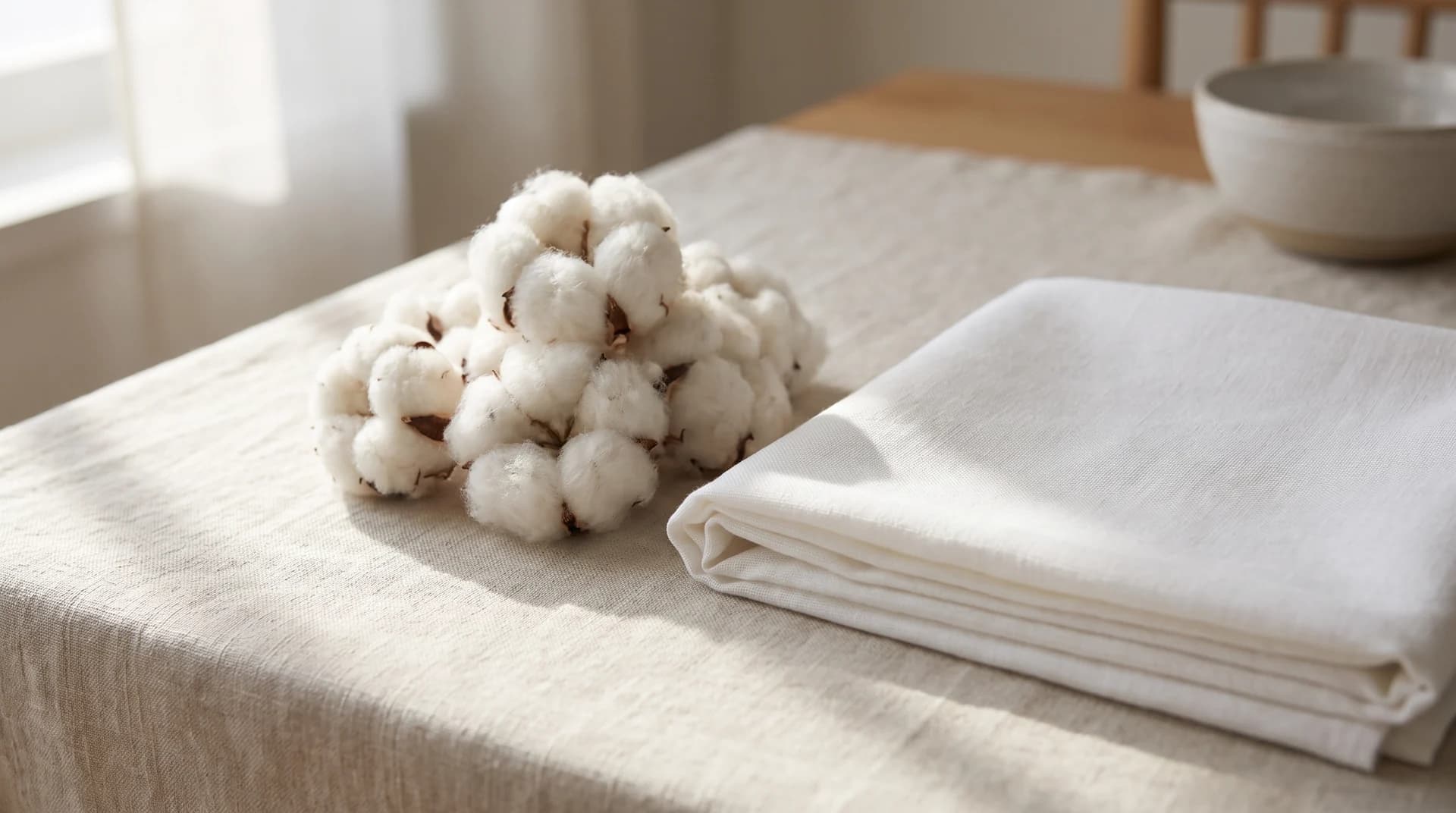
Commercial cotton is dominated by two species. Gossypium hirsutum, called Upland, is the workhorse: the USDA’s Economic Research Service puts it at about 97 percent of US production. Gossypium barbadense is the extra-long-staple species, known in the US as American Pima, and accounts for about 3 percent of the US crop.
The physical difference is fiber length. USDA’s Classification of Cotton describes G. barbadense as varying from 1¼ to 1 9/16 inches in length. The USDA classes staple length in thirty-seconds of an inch and maintains separate scales for the two: Upland runs from under 0.79 inches up through 1.36 inches and longer, while American Pima runs from 1.20 inches up to 1.48 and above.
Length is one of several properties USDA measures instrumentally when classing a bale. The others are micronaire, which reflects fineness and maturity; length uniformity index; strength in grams per tex; color, reported as reflectance and yellowness; leaf grade; and trash content. Notably, none of that appears on any consumer package, and the marketing vocabulary has no term for most of it.
Why length matters, precisely
Longer fibers mean fewer fiber ends per length of yarn. Fewer ends means a smoother, stronger, more even yarn.
The evidence for that is good, and it is specific about which property does the work. A study published in the Journal of Cotton Science spun twenty-eight bales into 20s ring-spun yarn and found that short fiber content was the single most important predictor for five of seven yarn properties measured. Yarn strength correlated with fiber length at r = 0.889 and with the short fiber index at r = −0.807; the model explained about 95 percent of variation in yarn strength.
What that research measures is yarn. We were unable to find any peer-reviewed study that tested staple length against the properties of a finished bed sheet — its hand after a year, its durability in domestic laundering. The step from long fiber to good yarn is documented. The step from good yarn to better sheet is a reasonable inference that nobody appears to have measured. That gap is the reason to treat “extra-long staple” as a genuine input rather than as a guarantee of outcome.
“Pima”: a variety name
Pima is the US name for the extra-long-staple G. barbadense crop. The USDA uses “American Pima” as the standard designation in cotton classing and maintains a distinct staple-length scale for it, so within USDA classification the term is defined.
On a consumer textile label it is a different matter. The FTC’s Textile Rules require the generic fiber name — cotton — along with percentages, manufacturer identity and country of origin. There is no provision addressing cotton variety claims, and no rule setting out what a seller must hold in order to print “Pima” on a package. A false claim would still be deceptive advertising under general FTC Act principles, but there is no bespoke rule and no verification program attached to the word itself.
The commonly repeated story about where the name comes from — that it honours the Pima people, on whose land early US barbadense breeding was done — we could not confirm from a primary USDA or peer-reviewed source, only from consumer articles. We are leaving it as an unverified tradition rather than repeating it as fact.
“Supima”: a licensed trademark
Supima is a US trade association that owns and licenses the SUPIMA trademark for American-grown extra-long-staple cotton. This is the one of the three that is structurally different: it is not a description, it is a contract. A product carrying the mark carries it because someone signed a license.
Since 2022 the organization has run a traceability program it calls AQRe, which according to its own announcements combines blockchain tokenisation of fiber volumes through a platform called TextileGenesis with forensic origin testing by Oritain, which builds an origin fingerprint from naturally occurring trace elements reflecting soil, climate and altitude. The stated aim is to validate Supima content at stages from farm through retail.
That description comes from Supima and its commercial partners, and we report it as their account rather than as independently verified. We tried to read Supima’s own licensing terms — what percentage of Supima fiber a licensed product must contain, what audits apply, what the license warrants — and could not obtain them; the licensing pages did not render as readable text. So we cannot tell you the minimum content threshold, and we are not going to guess one.
What can be said fairly: the mark ties a name to a license and, since 2022, to a fiber-identity program. That is more than an unverified adjective. What it is not is a fabric-quality standard. Nothing in a Supima license speaks to yarn count, weave, finishing, shrinkage or how long the sheet will last.
“Egyptian cotton”: an origin claim
This one is a geographic claim, and geography is not a property. Egypt grows cotton of more than one staple class, so “grown in Egypt” does not by itself establish that a fiber is extra-long staple, or which species it is.
There is a licensing body. The Egyptian Cotton Association, based in Cairo, administers an Egyptian Cotton trademark and an accreditation program for manufacturers. It publishes registers of accredited manufacturers, suspended parties and a black list, and states that it uses DNA testing to confirm the identity of cotton in accredited products. It also markets Egyptian cotton as “softer, finer and more durable than any other cotton in the world” — which is the association’s own promotional claim, offered without a measurement, and we quote it as such rather than reporting it as a finding.
As with Supima, we could not obtain the association’s license terms: minimum content, species requirement, audit frequency. Unknown.
The important asymmetry is this. The phrase “Egyptian cotton” printed on a package without that mark is verified by nothing. We searched the FTC’s enforcement and guidance record and found no action, consent order or dedicated guidance about Egyptian cotton mislabeling. The FTC’s cotton labeling guidance mentions “Egyptian Cotton” only as a formatting example in a fiber content statement, and sets no substantiation standard for it.
That absence is striking against the comparison case. Mislabeling rayon as bamboo is a fiber content violation, and it produced fifteen years of FTC enforcement and millions in civil penalties. Origin claims about cotton produced, so far as we can find, nothing.
There has been at least one significant commercial incident: in 2016 a major US retailer ended its relationship with a large sheet supplier over Egyptian cotton misrepresentation, and consumer class actions followed. We could not obtain primary court or agency documents on that matter and are describing it only as contemporaneous business reporting characterized it, without figures or findings.
Why these claims are hard to police
There is a structural reason origin and variety claims are weakly enforced while fiber content claims are not.
Fiber content is testable in a laboratory from the finished product. Cotton is not rayon, and a test will say so. Origin and variety are not visible in the finished fiber in the same way: a cotton fiber from Egypt and a cotton fiber from Arizona are both cotton, and telling them apart requires either an unbroken chain of custody or forensic techniques — DNA analysis, or trace-element fingerprinting of the kind Oritain describes. Both of the licensing bodies in this article have moved toward exactly those techniques, which tells you the problem is real.
The other structural weakness is dilution. A batch can be blended anywhere along a supply chain that runs from gin to spinner to weaver to converter to brand, often across several countries. Nothing in the finished cloth records which stage introduced what. This is why a license backed by bale-level record-keeping is worth more than a word, and why an unverified word is worth very little.
Reading a package
Three questions, in order:
- What does the sewn-in fiber content label say? That is the regulated statement. “100% cotton” is a fact. Everything on the front of the box is a marketing claim about that fact.
- Is there a mark, or just a word? A licensing mark implies a contractual relationship and a register you can check. An adjective implies nothing.
- Will the seller describe the construction? Weave, ply, yarn count and finished weight are the facts that describe the cloth. A seller who leads with the cotton name and will not discuss construction is telling you where the interesting part of the story is not.
Four different things wearing similar clothes
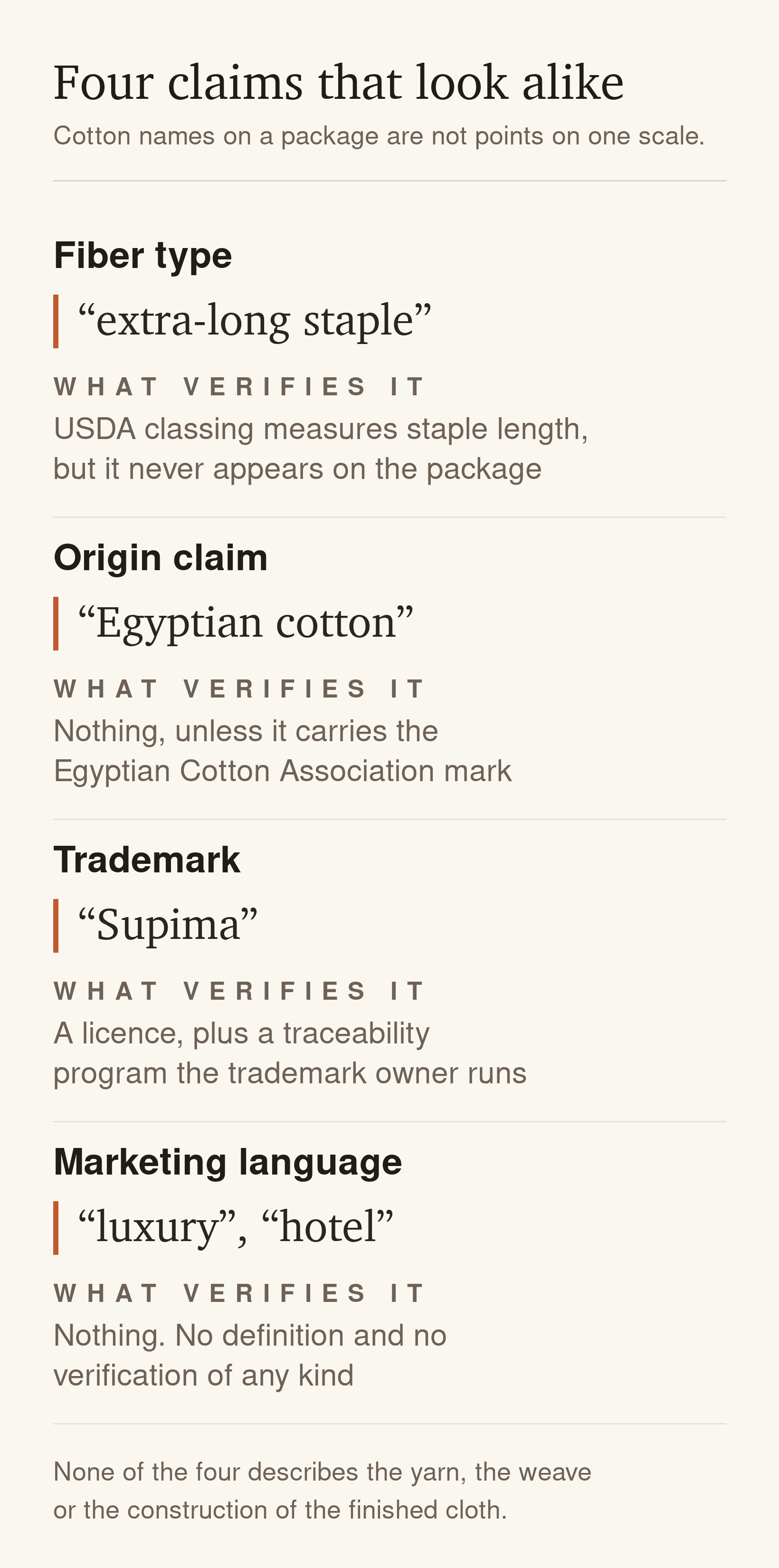
- Fiber type — extra-long staple, G. barbadense. A measurable physical property, classed by USDA, invisible on packaging.
- Origin claim — “Egyptian”. Says where, not what. Unverified unless it carries the association’s mark.
- Trademark — “Supima”. Says a license exists and, since 2022, that a traceability program sits behind it. Says nothing about the fabric.
- Marketing language — “luxury”, “hotel”, “premium”, “the finest in the world”. No definition, no verification.
What to do with this
Take a cotton name as evidence that a seller has chosen a better raw material, and as evidence of nothing else. The fiber is the first of many decisions in a sheet: yarn preparation, spinning, ply, weave, density, finishing and quality control all sit between the bale and the bed, and any of them can undo a good fiber.
A licensed mark is worth slightly more than an unlicensed adjective, because someone is contractually accountable for it. Neither is worth as much as the seller who will tell you the weave, the ply, and the finished weight — because those are the facts that describe the cloth you will actually sleep on.
What actually makes a good set of sheets puts fiber in its place among the other eight. Thread count covers the other number people over-trust. And if the label says something other than cotton, what “bamboo” sheets actually are covers the fiber claim with the longest enforcement history behind it.
Sources
- USDA Economic Research Service, Cotton Sector at a Glance
- USDA Agricultural Marketing Service, cotton classification data documentation
- Thibodeaux et al. (2008), Journal of Cotton Science 12:368–377
- FTC, Calling It Cotton: Labeling and Advertising Cotton Products
- 16 CFR Part 303, Rules and Regulations under the Textile Fiber Products Identification Act
- Oritain, on its traceability partnership with Supima
- the Egyptian Cotton Association