What “Bamboo” Sheets Actually Are
Almost every bamboo sheet is rayon, and the FTC has spent fifteen years enforcing that point. What the process does, and what the antibacterial and eco claims are worth.
“Bamboo” sheets are, in almost every case, rayon. Not bamboo processed into cloth the way flax is processed into linen — bamboo cellulose dissolved in industrial chemistry and re-formed as a manufactured fiber. That is not a fringe criticism. It is the position of the Federal Trade Commission, which has enforced it against major US retailers for fifteen years.
This article covers what the fiber actually is, what US law requires it to be called, what the evidence says about the two claims that sell it — that it is naturally antibacterial and that it is environmentally superior — and where the honest uncertainty lies.
Bamboo is a grass, and grasses do not spin
Bamboo is a woody grass. It grows famously fast: a peer-reviewed study of Moso bamboo in The Plant Cell recorded whole-culm elongation of up to 114.5 cm per day, with culms exceeding 20 m in 45 to 60 days. That much of the marketing is straightforwardly true.
What a culm is not is a source of soft, spinnable fiber. Its cellulose is locked into a rigid, heavily lignified structure. To make a fabric that feels like the ones sold as bamboo sheets, that structure has to be chemically taken apart.
The viscose process, step by step
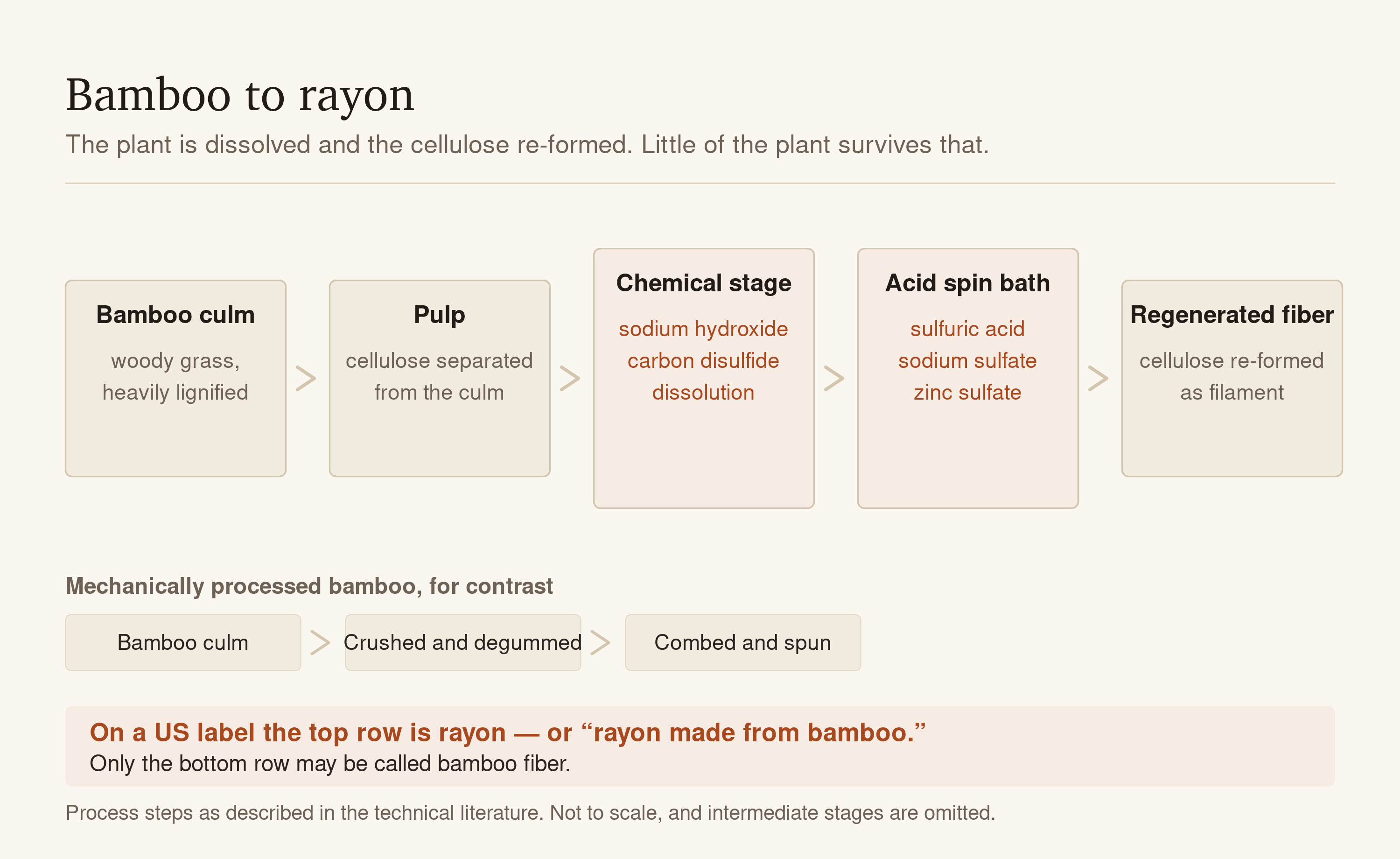
The route used for essentially all bamboo bedding is the viscose process — the same one used for wood-pulp rayon since the early twentieth century. As described in the technical and peer-reviewed literature:
- Steeping. Cellulose pulp is soaked in sodium hydroxide, forming alkali cellulose. Published process conditions include roughly 18 percent NaOH for about 30 minutes at 50 °C.
- Aging. The alkali cellulose is held while oxidative depolymerisation reduces the chain length.
- Xanthation. The alkali cellulose is treated with carbon disulfide, forming cellulose xanthate. A standard charge reported in the literature is around 36 percent carbon disulfide on cellulose, at about 32 °C for 150 minutes.
- Dissolution. The xanthate is dissolved in dilute sodium hydroxide, producing the viscous orange solution the process is named for.
- Ripening. The solution is held — around 16 hours at room temperature in one published protocol — until it is spinnable.
- Spinning and regeneration. The solution is extruded through spinnerets into an acid bath containing sulfuric acid with sodium sulfate and zinc sulfate. The xanthate decomposes and cellulose is regenerated as filaments, with carbon disulfide released in the process.
The output is regenerated cellulose. The European man-made fiber industry body defines viscose simply as “a cellulose fibre obtained by the viscose process” — a definition by process, not by feedstock. That is the technical heart of the matter: viscose is a thing you do, not a plant you use.
What survives
Not much of the plant, structurally. A study in the Journal of Thermal Analysis and Calorimetry found bamboo viscose, Tencel and conventional viscose all to be cellulose II — the polymorph produced by regeneration, not the cellulose I of the living plant. Microscopy in a South African comparative study found bamboo viscose and ordinary viscose rayon indistinguishable, both showing the lengthwise striations and serrated cross-sections characteristic of the process; the authors put it plainly, writing that regenerated bamboo “is actually technically viscose rayon.”
The differences that do exist are small and within one fiber class. The thermal study found bamboo viscose slightly lower in crystallinity than Tencel and marginally better at water retention and release than conventional viscose. Real, measurable, and a long way from “the properties of bamboo.”
What US law requires it to be called
The FTC’s Textile Rules require textile products to disclose generic fiber names. A manufactured fiber must be identified by its generic name, not by the plant it was derived from. The FTC’s guidance for businesses states that such a product “should be labeled and advertised using the proper generic name for the fiber, such as rayon, or ‘rayon made from bamboo.’” Its consumer-facing page is blunter: textiles “can only be called bamboo if they are made directly from actual bamboo fiber.”
The enforcement record is unusually long for a labeling question:
- August 2009 — the FTC charged four companies with falsely labeling rayon as bamboo and with unsubstantiated antimicrobial, eco-friendly and biodegradable claims.
- February 2010 — warning letters to 78 retailers, including most of the large US chains.
- January 2013 — civil penalties totalling $1.26 million across four national retailers: Sears $475,000, Amazon $455,000, Macy’s $250,000, Leon Max $80,000.
- December 2015 — a further $1.3 million: Bed Bath & Beyond $500,000, Nordstrom $360,000, J.C. Penney $290,000, Backcountry.com $150,000, charged in part because they had continued after receiving the 2010 warnings.
- April 2022 — $5.5 million in civil penalties, Kohl’s $2.5 million and Walmart $3 million, covering both the bamboo labeling and unsubstantiated environmental claims.
The FTC’s framing in 2015 was direct: it is misleading, the agency said, to call bamboo that has been chemically processed into rayon simply “bamboo.”
This is why the front of a package and the sewn-in label often disagree. The label is the regulated statement. If it says rayon or viscose, that is what the fiber is.
The antibacterial claim
The claim is that bamboo contains a natural antimicrobial agent, usually called “bamboo kun,” which survives into the finished fabric.
We looked for the compound. There is no peer-reviewed paper that isolates, characterizes, names or assigns a structure to any substance called bamboo kun. The sources that treat it as a real material are review articles repeating industry copy, and the frequently cited Japanese testing result behind most of the marketing could not be traced to any primary test report.
The laboratory evidence on the fabric is more interesting, because it genuinely disagrees with itself — and because none of it supports the marketing story.
- A study in BioResources tested natural bamboo fiber by a shake-flask method against E. coli, S. aureus and Candida albicans and measured a 0 percent bacteriostatic rate against all three. Regenerated bamboo viscose in the same study measured 75.8 percent against S. aureus. The authors attributed effects they did see to removal of nutrient sources and pH change rather than to any antimicrobial compound.
- A study in the AATCC Journal of Research measured 72 to 98 percent inhibition of S. aureus for mechanically and chemically extracted natural bamboo fibers, and 37.45 percent for commercial bamboo viscose — the weakest of everything tested. The authors attributed the natural fibers’ activity to retained lignin, and the viscose’s to residual processing chemicals.
- A South African study found bamboo viscose fabric significantly more antimicrobial than cotton — but equally so with ordinary viscose rayon, concluding that no evidence was found that regenerated bamboo fabrics are superior to other regenerated cellulose fibers, nor that natural bamboo’s antimicrobial properties remain unchanged in regenerated bamboo fibers.
Two of those three studies got results in opposite directions for the same fiber types, which is a reason for humility about the numbers. But on the point that matters they agree completely: no study attributes bamboo viscose’s behavior to a surviving bamboo compound, and no study finds bamboo viscose better than ordinary viscose. Whatever is happening tracks the process, not the plant.
The FTC reached the same conclusion by a different route, stating in 2009 that rayon does not retain natural antimicrobial properties from the bamboo plant, and treating such claims as requiring competent and reliable scientific substantiation.
There is also a regulatory line worth knowing. Under EPA rules, an article treated with a pesticide to protect the article itself can be exempt from registration — but EPA’s stated policy is that the exemption does not extend to articles bearing implied or explicit public health claims against human pathogens. A sheet claiming to protect you from germs is making a different and much more heavily regulated claim than a sheet claiming to resist odour in the fabric.
The environmental claim
This needs splitting in two, because the crop and the process are different subjects and the marketing consistently merges them.
The crop
The growth rate is real and impressive. Beyond that, we could not verify the standard claims. We found no peer-reviewed source quantifying irrigation, pesticide or fertiliser inputs for bamboo grown as textile pulp feedstock — and research on nitrogen and phosphorus addition to managed Moso stands suggests fertiliser is in fact applied in production plantations, which runs against the usual framing. We are not asserting the opposite claim either. We are saying the evidence we could find does not support “bamboo needs no pesticides or irrigation,” and that it is repeated far more often than it is sourced.
The process
Here the literature is specific. A 2025 review in Fibers reports that the viscose process loses 25 to 35 percent of its carbon disulfide unrecovered and generates 200 to 300 metric tons of wastewater per metric ton of fiber. By contrast, the lyocell process — which dissolves cellulose directly in a recoverable amine oxide solvent rather than deriving a xanthate — achieves reported solvent recovery of 98.9 to 99.5 percent.
Carbon disulfide is not a nuisance chemical. The US Agency for Toxic Substances and Disease Registry’s 2025 toxicological profile documents historical exposures in rayon plants ranging from 0.43 to 60 ppm, with 10 to 60 ppm typical in the 1950s and below 10 ppm after 1972. Peripheral neuropathy is described as the most sensitive and consistent adverse effect reported in viscose rayon workers; retinal microaneurysms were seen at 5 to 30 ppm; a meta-analysis found a pooled relative risk of 1.56 for coronary heart disease. Importantly, the cardiovascular excess is tied to historical exposures above roughly 10 to 16 ppm, and a Finnish cohort found the excess risk disappeared after exposure controls were introduced. This is a documented occupational hazard of the process; it is not a statement about conditions in any particular mill today, which would require facility-level data we do not have.
The regulatory response is worth knowing about. The EU Ecolabel criteria for textiles set a hard cap on sulfur emissions to air from man-made cellulose fiber production: 30 g per kg for viscose staple fiber, and 40 or 170 g per kg for filament depending on the washing method. A numeric emissions ceiling exists precisely because there are emissions to ceiling.
And lyocell is not simply the better answer
The obvious conclusion — choose lyocell — is more complicated than it looks. A life-cycle comparison published in the International Journal of Life Cycle Assessment found lyocell roughly twice the global warming potential and three times the primary energy demand of viscose, while viscose was about twice as acidifying and an order of magnitude worse on ecotoxicity, with zinc sulfate alone responsible for over 90 percent of viscose’s ecotoxicity impact.
That study was conducted on the Chinese electricity grid, and its energy-side results are conditional on that. But the shape of the finding is the point: this is a trade-off between toxicity and energy, not a ranking. Anyone presenting either fiber as simply the green one is compressing a real trade-off into a slogan.
What the FTC expects of green claims generally
The FTC’s Green Guides are direct about unqualified environmental claims. Because it is highly unlikely that marketers can substantiate all reasonable interpretations of such claims, the Guides say, marketers should not make unqualified general environmental benefit claims — and it is deceptive to misrepresent that a product offers a general environmental benefit. “Eco-friendly” on a package is exactly the sort of claim that provision addresses.
Two smaller points. An unqualified “biodegradable” claim is deceptive unless the item completely decomposes within one year after customary disposal — a much harder test than most people assume. And the Green Guides contain no section on the word “sustainable” at all, which is worth remembering when it appears on a package.
Where the genuine uncertainty is
Two things we could not resolve, and would rather say so than paper over:
Whether bamboo lyocell exists at commercial scale. A Chinese patent describes the process and a conference paper compares the fiber, so it is technically real. Every claim that a specific product on sale is bamboo lyocell rather than bamboo viscose traced back to a retailer. We could not verify production at scale either way. If a brand tells you its bamboo sheets are lyocell, that is a claim you would want documented.
Whether bamboo viscose sheeting performs differently from cotton sheeting. The best controlled comparison we found used single-jersey knits matched at 169 g/m², measuring water vapor resistance, thermal resistance, thermal absorptivity and moisture permeability across cotton, bamboo viscose and viscose rayon. Its conclusion: in none of the cases could any of the differences be proved significant at a 95 percent confidence level. We found no equivalent measurement on woven bed sheeting. So the “cooler, more breathable” claim is not supported by the controlled evidence we could locate — and the study that fails to support it was measuring knits, not sheets.
The practical position
Bamboo viscose sheets can be genuinely pleasant. Viscose has a fluid drape and a cool initial hand that many people prefer, and none of the above says otherwise.
What the evidence does say is that you are buying rayon, that its qualities come from the viscose process rather than from bamboo, and that the two claims doing most of the selling — naturally antibacterial, inherently eco-friendly — are one unsupported and one much more complicated than the package suggests.
The practical test is simple. Read the sewn-in fiber content label. If it says rayon or viscose, you know what you have, whatever the box says. And if a seller is still describing it as bamboo fiber in 2026, after fifteen years of federal enforcement on exactly that point, that tells you something about the seller.
What actually makes a good set of sheets covers the rest of the label, and Egyptian, Pima and Supima does the same job for the cotton names. How to wash and care for sheets covers laundering, and viscose is the fiber where following the care label rather than improvising matters most.
Sources
- 16 CFR Part 303, Rules and Regulations under the Textile Fiber Products Identification Act
- FTC, Bamboo Textiles and How to Avoid Bamboozling Your Customers
- FTC enforcement: 2009 charges, the 2010 warning to 78 retailers, 2013 penalties of $1.26 million, 2015 penalties of $1.3 million and the 2022 action against Kohl’s and Walmart
- CIRFS definition of viscose
- Forsberg et al. (2024), Sustainability 16(10):4127, on the viscose process
- ATSDR, Toxicological Profile for Carbon Disulfide (2025)
- Guo et al. (2021), International Journal of Life Cycle Assessment 26(8):1545–1555, comparing lyocell and viscose
- Chen et al. (2022), The Plant Cell 34(10):3577–3610, on Moso bamboo growth
- US EPA, PRN 2000-1, on the treated articles exemption
- 16 CFR Part 260, the FTC Green Guides