The Cookware Materials Guide: Cast Iron, Carbon Steel, Stainless, Nonstick and Enameled Cast Iron
Cast iron, carbon steel, stainless, nonstick and enamel behave differently because of two measurable properties: how fast a metal moves heat, and how much heat it holds. Understand those two things and choosing cookware stops being a matter of opinion.
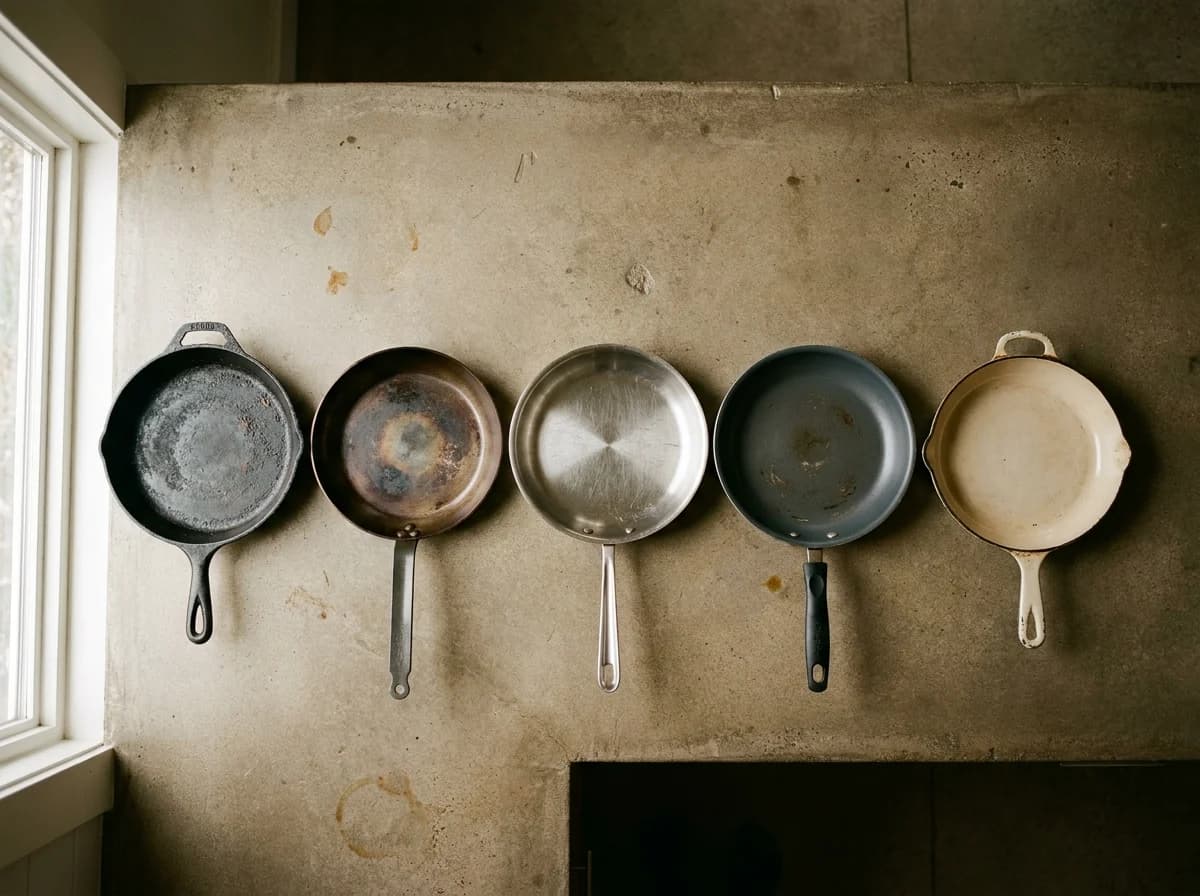
Almost every cookware guide starts with a product. This one starts a step earlier, with the metal the pan is made of — because the material decides how a pan behaves on your stove, and it is the one thing about a pan you can never change afterward.
Five materials cover nearly everything sold for home kitchens: cast iron, carbon steel, stainless steel, nonstick coatings, and enameled cast iron. None of them is the best one. Each is a specific trade-off, and the pan that is wrong for your eggs is often exactly right for your steak.
The goal here is not to tell you what to buy. It is to get you to the point where you can pick up a pan, know what it is made of, and predict what it will do — how fast it heats, whether it will hold its temperature when cold food hits it, whether tomato sauce is a problem, and what it will ask of you at the sink.
Two properties explain most of what cookware does
Nearly every argument about cookware comes from confusing two different things: how quickly heat moves through a metal, and how much heat the pan can hold. They are separate, they often point in opposite directions, and once you separate them the rest of this is straightforward.
Conduction: how fast heat moves
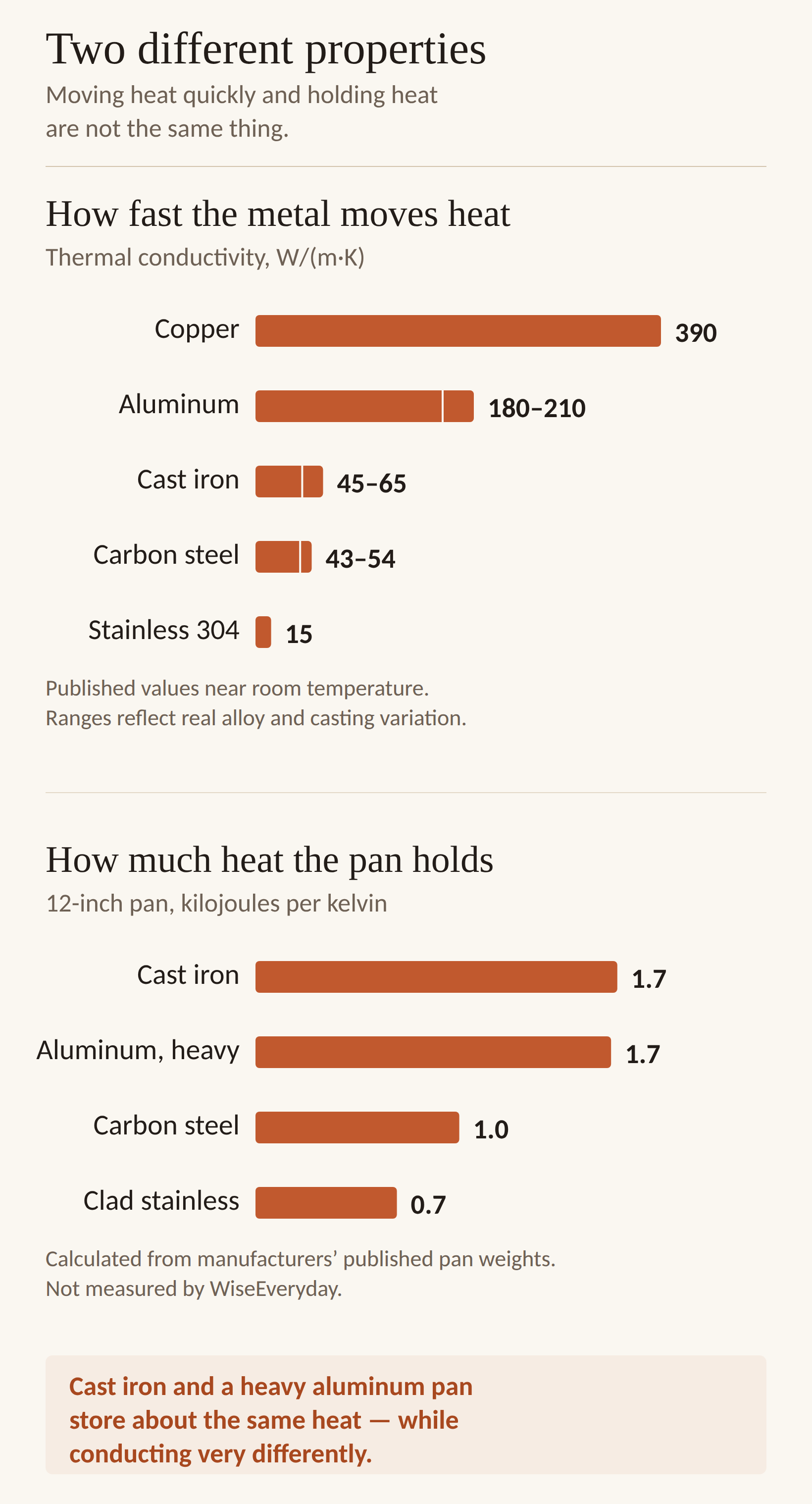
Thermal conductivity measures how readily a material passes heat along. Published values near room temperature, in watts per meter-kelvin:
- Copper — about 400 pure; about 390 for the copper actually used in pans
- Aluminum — about 237 pure, but the alloys pans are made from run roughly 180 to 210
- Cast iron — roughly 45 to 65 for the gray, flake-graphite iron used in cookware
- Carbon steel — roughly 43 to 54
- Stainless steel, Type 304 — about 15 at room temperature, about 16 once hot
The spread is enormous. Stainless moves heat roughly a twenty-fifth as well as copper, and somewhere between a twelfth and a sixteenth as well as aluminum. That single fact is why almost no good stainless pan is actually made of stainless alone.
And most published figures describe pure metals, which no pan is made of. Cookware aluminum is an alloy and conducts 10 to 25 percent worse than the textbook number. Cast iron resists a single figure even harder: measurements on production castings of one nominal grade span roughly 44 to 66, because conductivity depends on the size and shape of the graphite flakes in the casting. Anyone quoting cast iron at a precise 52 is quoting the middle of a wide range as if it were a property.
Retention: how much heat the pan holds
Specific heat capacity measures how much energy a material stores per kilogram for each degree of temperature. Aluminum is about 0.9 kJ/(kg·K), copper about 0.39, and every ferrous cookware material — gray cast iron, carbon steel, stainless — sits around 0.5.
Those three ferrous numbers are not meaningfully different from one another, whatever you may have read. Reference data puts gray iron, ductile iron and Type 304 all near 0.49 at room temperature, and carbon steel's own value climbs from about 0.44 to 0.53 between room temperature and 200 °C. The temperature effect is bigger than the differences between the metals.
So aluminum stores about twice as much heat per kilogram as iron does — which seems to contradict everything you have ever been told about a cast iron skillet.
Why cast iron holds heat, and where that stops being true
The resolution is that specific heat is measured per kilogram, and what matters in a kitchen is total stored heat: mass times specific heat. Cast iron wins on mass.
Using manufacturers' published weights for 12-inch pans, a Lodge cast iron skillet is listed at 7.69 lb against 3.00 lb for an All-Clad tri-ply stainless pan. Two and a half times the mass comfortably beats aluminum's two-to-one advantage per kilogram, so the iron pan holds roughly twice the heat. That is why a cold steak barely dents its temperature, while the same steak stalls a thin pan into steaming the meat instead of searing it.
But the comparison is usually left half-told. A heavy commercial aluminum fry pan of the same size weighs around 4 lb, and with double the specific heat per kilogram it stores about as much total heat as the cast iron skillet does. Cast iron's thermal mass is a real advantage — over thin pans. It is not an advantage over aluminum as a material.
“Cast iron heats evenly” is the wrong description
This is among the most repeated claims in cookware writing, and the numbers do not support it. Gray cast iron conducts roughly a quarter to a third as well as aluminum, so heat entering the base spreads sideways slowly. A skillet on a burner narrower than the pan should be expected to run hot in the middle and cool at the rim until the whole thing equalizes.
That is a prediction from material properties rather than a measurement, and it is worth saying so: we could find no published, controlled study of surface-temperature uniformity in cast iron pans. The conductivity figures are solid; the inference from them is reasonable; the two are not the same kind of claim.
What cast iron does well is better established — it holds a temperature. The honest description is not “even” but slow and stable: slow to heat, slow to react when you change the burner, hard to knock off temperature once it is there. Preheating longer than feels necessary, over a burner that roughly matches the pan, is how you work around the conduction problem.
Even “cast iron stays hot” has a wrinkle. Dark, rough iron radiates heat far more readily than bright polished steel, so an uncovered iron pan sheds heat in a way a shiny pan does not. One chemist's published measurement of two pots left to cool found the cast iron dropping faster than the stainless despite holding more than twice the heat. That is an informal measurement rather than a study, but the physics behind it is not in dispute, and it is a useful check on the idea that mass alone decides everything.
Five questions to ask about any pan
Everything below answers the same five questions, asked of each material in turn:
- How fast does it respond? Conductivity plus thickness — whether the pan follows your burner or ignores it.
- How much heat does it hold? Mass times specific heat — whether you get browning or steaming when food goes in.
- Does food stick, and what stops it? A coating, a seasoning layer, or technique. Three genuinely different mechanisms.
- What is the temperature ceiling? Some materials simply get hotter. Others have something on them that degrades first.
- Is it reactive, and what upkeep does it need? Whether acidic food is a problem, and what you owe the pan afterward.
A sixth question — will it work on your stove? — depends on your cooktop rather than the pan, and has its own section further down.
Cast iron
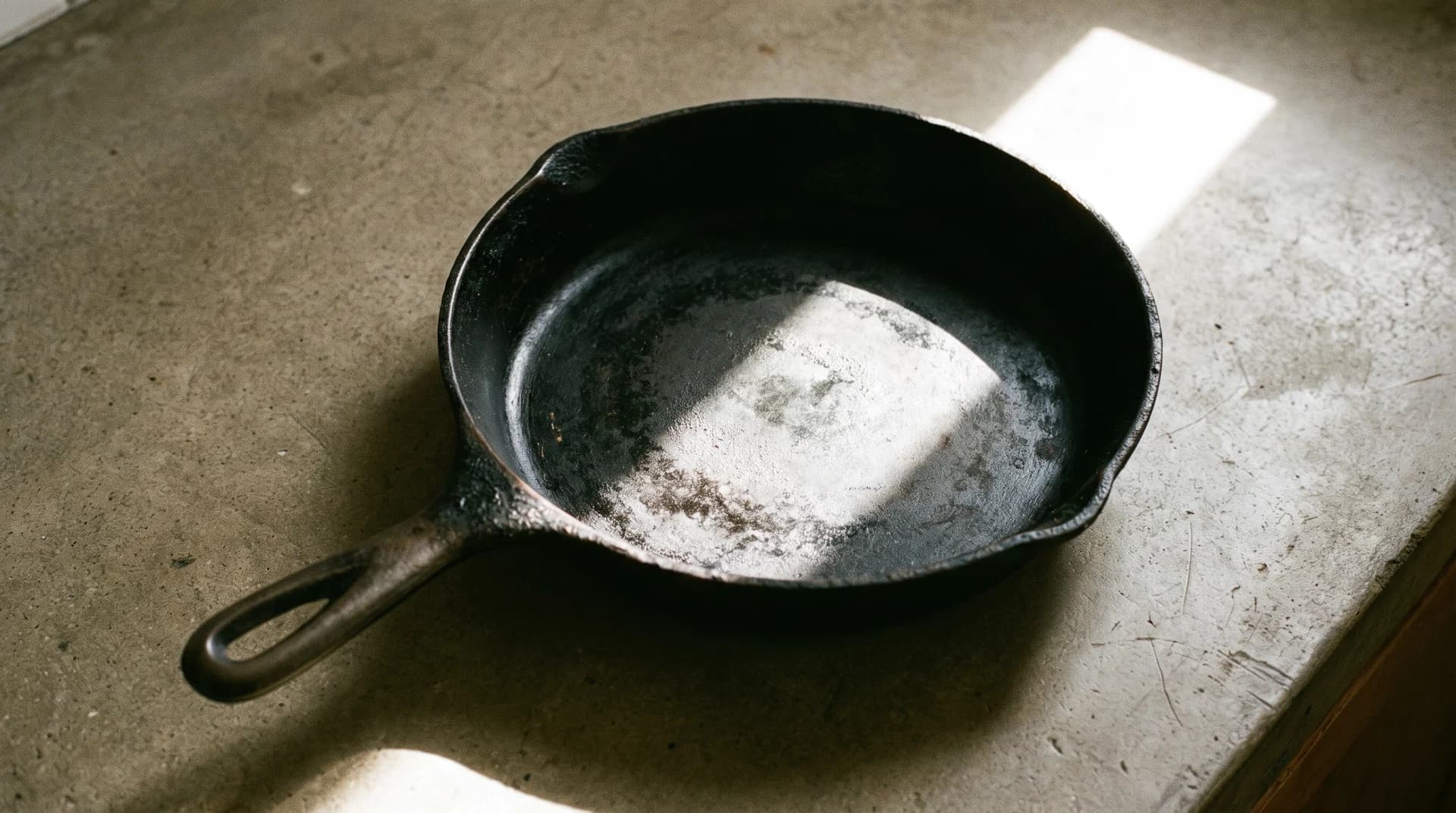
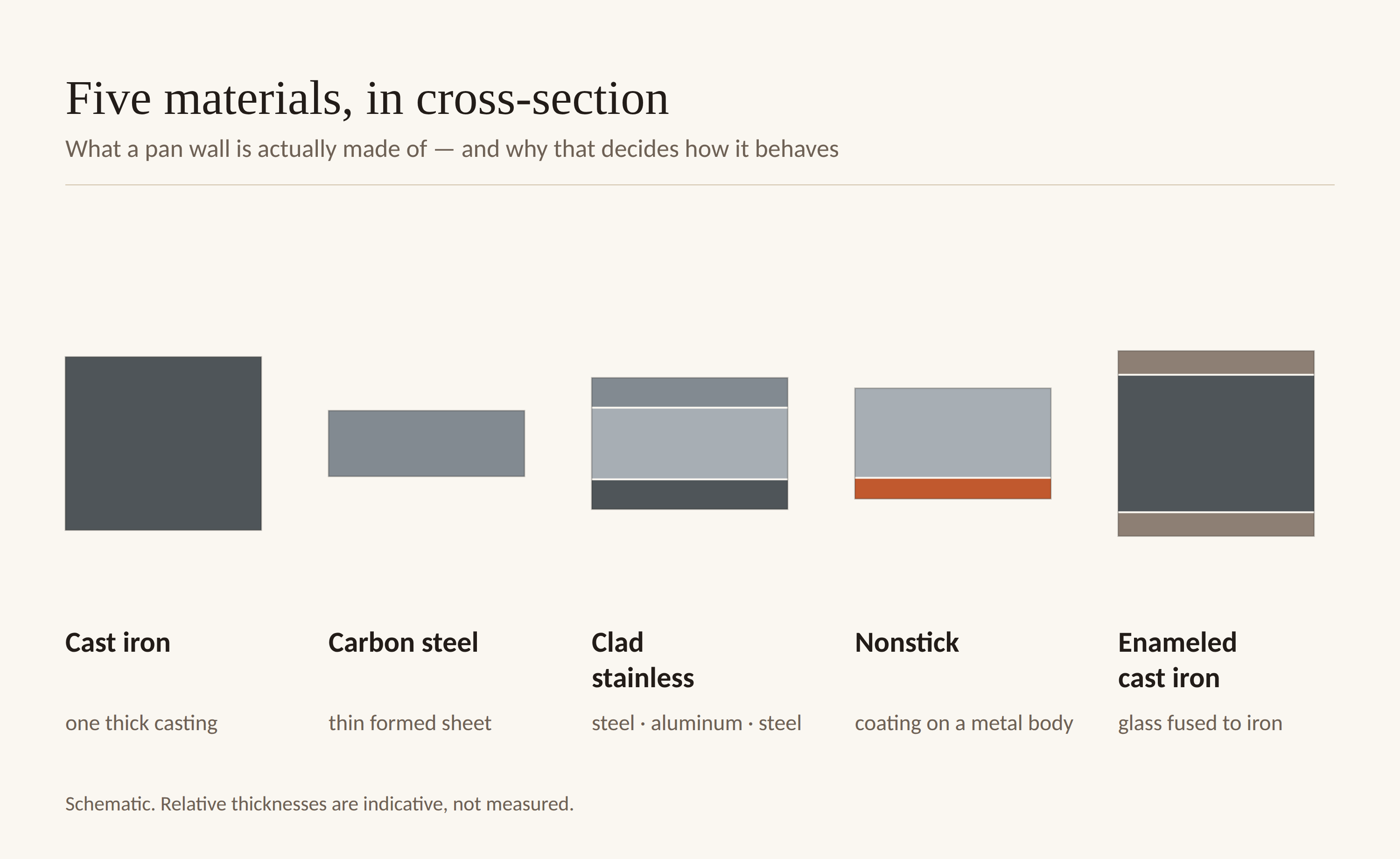
What it is. An iron-carbon alloy carrying more than about 2 percent carbon plus more silicon than steel, poured into a mold and usually cast as one piece including the handle. Nothing in it can delaminate or wear out.
How it behaves. Modest conduction, high mass — slow and stable, as above. It takes real time to heat through, runs hotter over the burner than at the rim, and resists temperature drops better than almost anything else in a home kitchen. Superb for searing; awkward when you need the heat down now.
The surface: what seasoning actually is
Bare cast iron is not naturally nonstick. Its release comes from seasoning — a real film formed by heating thin layers of oil, not a residue of grease.
The underlying chemistry is textbook. Unsaturated fats react with oxygen and cross-link into a hard, dry, water-repelling network — the same reaction that makes linseed oil harden into a solid film in oil paint, which is where most of the research on it lives.
What is less settled is how much of a real pan's release comes from that film. The one published surface analysis of a seasoned iron pan we could find — a 2023 study of seasoned Chinese woks using electron microscopy and X-ray spectroscopy — credited the nonstick behavior to a nanotextured iron-oxide layer built up by repeated oiling and heating, not to a polymerized oil film. Chemical & Engineering News appended a correction to its own cast-iron explainer in 2024 noting that researchers have not definitively proved the polymer layer is what makes the pan nonstick.
So the popular account is probably part of the story rather than all of it — and a real seasoning layer likely contains polymerized oil, some pyrolyzed material, and iron oxide from the metal underneath. Lodge itself describes seasoning as “oil baked onto the pan through a process called polymerization,” which is accurate as far as it goes and notably more careful than the folk version in which the oil simply turns to carbon. We go through the chemistry, and where it runs out, in a separate piece on what seasoning actually is.
Two practical rules follow, and both are better supported than the mechanism debate:
- Use thin coats. In a thick film the surface cures first and then blocks the oxygen the rest of the layer needs. Measurements from the technical staff at a major artists'-oil maker found thin films curing within days while very thick ones barely moved for three weeks — and thick applications can stay wet underneath for years. On a pan, that is what leaves a heavy coat sticky instead of hard. Lodge's own instruction: “just a thin layer, not enough to drip or run when you tilt it.”
- Expect it to build over many cookings. Every time you cook with fat you add another layer. One seasoning session does not produce a finished pan.
Acid, and the iron that ends up in your food
Acidic ingredients attack the seasoning layer, and the manufacturer guidance is more specific than the folklore. Lodge advises against leaving acidic ingredients in cast iron for more than about 45 minutes, and says deglazing with wine or adding a little lemon juice should not cause problems. A quick deglaze is unremarkable; a long tomato braise in bare iron is how you strip a patch of seasoning.
The related effect is that iron migrates into the food, and it has been measured. Foods cooked in iron cookware averaged more than double the iron content of the same foods cooked in non-iron pans, with applesauce rising roughly ninefold. The strongest predictor was acidity, then cooking time, then moisture — which is exactly why a long acidic braise is the worst case and a splash of wine is not. That research is decades old and used bare or lightly seasoned iron, so a well-seasoned modern pan sits at the low end. For most people this is a neutral-to-useful side effect rather than a problem, and it explains the metallic taste people notice in tomato sauce cooked in bare iron.
Heat limits. Very high — there is no coating to break down. Lodge notes the seasoning itself starts to degrade at sustained temperatures around 650 °F (about 340 °C). Oven limits vary by product where a handle, knob or silicone sleeve is involved, so the manufacturer's figure is the one that applies to your pan.
Upkeep. Dry it properly and keep the film alive. Rust is recoverable: a neglected pan can be stripped and re-seasoned, which is not true of any coated pan.
Strong at: searing, shallow frying, cornbread and skillet baking, stovetop-to-oven cooking, lasting indefinitely.
Awkward at: delicate fish, quick heat changes, long acidic cooking, and being lifted one-handed by anyone who would rather not.
Carbon steel
What it is. Iron with well under 1 percent carbon, pressed or spun from sheet rather than poured into a mold. Chemically close to cast iron; structurally nothing like it.
How it behaves. Its conductivity sits in cast iron's range, so it moves heat about as well. The difference is thickness: a 12-inch carbon steel pan runs around 4 lb against nearly 8 for cast iron, which means less stored heat and much faster response. It heats quickly, cools quickly, and follows the burner. The short version — carbon steel keeps cast iron's surface chemistry and trades its mass for agility.
The surface. The same seasoning process as cast iron, with the same uncertainties, the same thin-coat rule and the same acid limitation. A well-established pan handles eggs; a new one does not.
Watch for warping. Thin steel is vulnerable to both uneven heating and thermal shock, and de Buyer — one of the main manufacturers — addresses both: match the pan to the burner, raise heat gradually, never put a hot pan in contact with cold water, and deglaze with hot liquid rather than cold. A warped base is a real problem on a flat electric or induction cooktop.
Strong at: high-heat searing where you also want control, stir-frying, crepes and omelets once seasoned, anything you need to move around.
Awkward at: long acidic cooking, holding temperature under a big cold load, and the first few months while the seasoning builds.
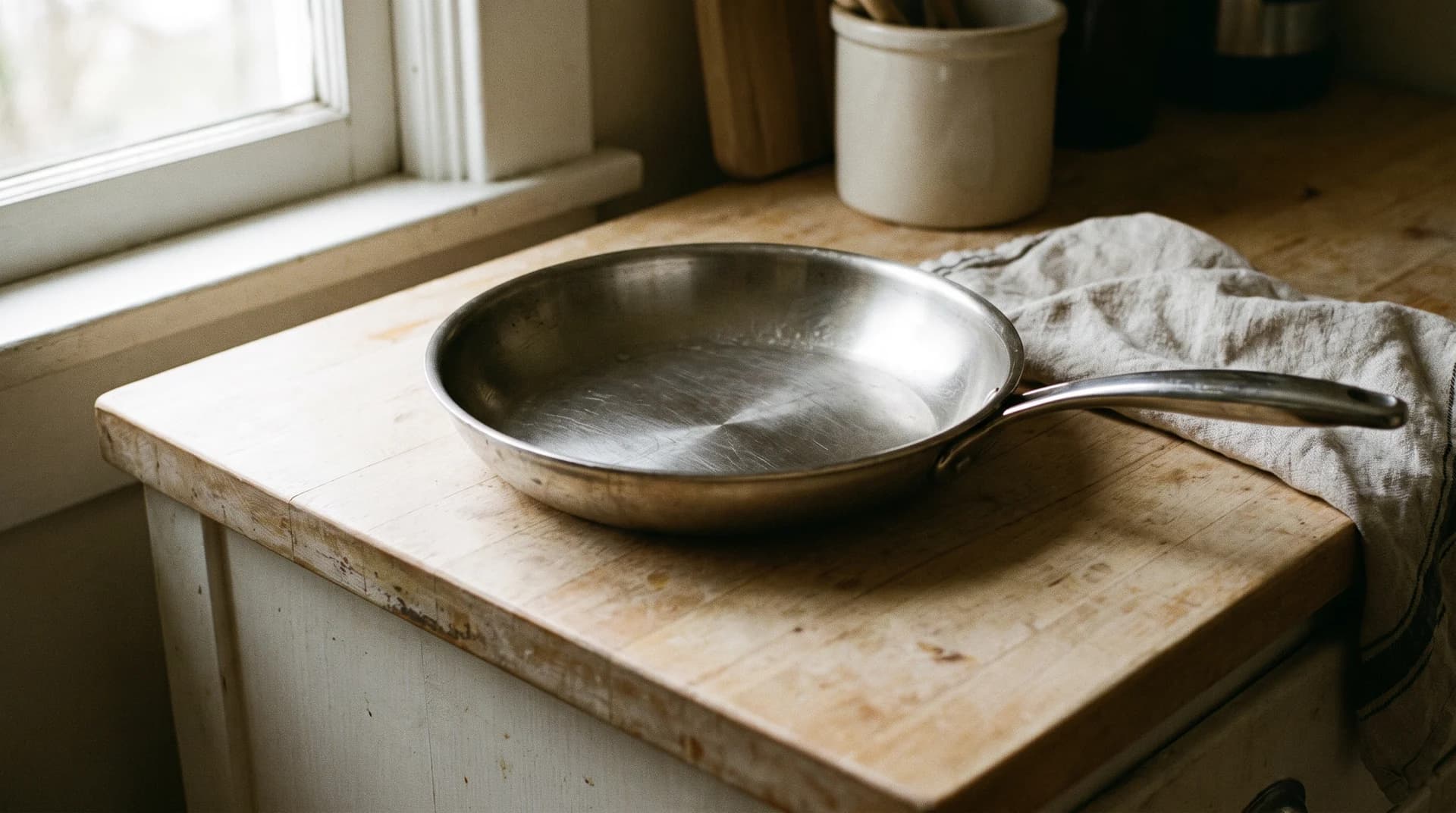
Stainless steel
What it is. Usually Type 304, whose ASTM specification allows 18 to 20 percent chromium and 8 to 10.5 percent nickel. You will see it sold as 18/10 — a cutlery-trade convention rather than a specification. The British Stainless Steel Association is blunt: 18/8 and 18/10 denote the same grade, and the “10” does not indicate genuinely higher nickel. One nearby label does mean something different: 18/0 is a separate alloy family, nickel-free ferritic 430.
Chromium forms a self-repairing oxide film a few nanometers thick, and that passive layer is what resists corrosion. It is not the same as being inert — stainless can still be pitted by salt and marked by acids left standing — so largely non-reactive is the accurate description. Nickel stabilizes the non-magnetic crystal structure, which matters later for induction.
How it behaves — and the problem it has to solve. At about 15 W/(m·K), stainless is a poor conductor: roughly a twelfth to a sixteenth of aluminum's. A pan made of stainless alone spreads heat sideways slowly, so it runs hot directly over the burner and cooler toward the rim.
How cladding fixes it
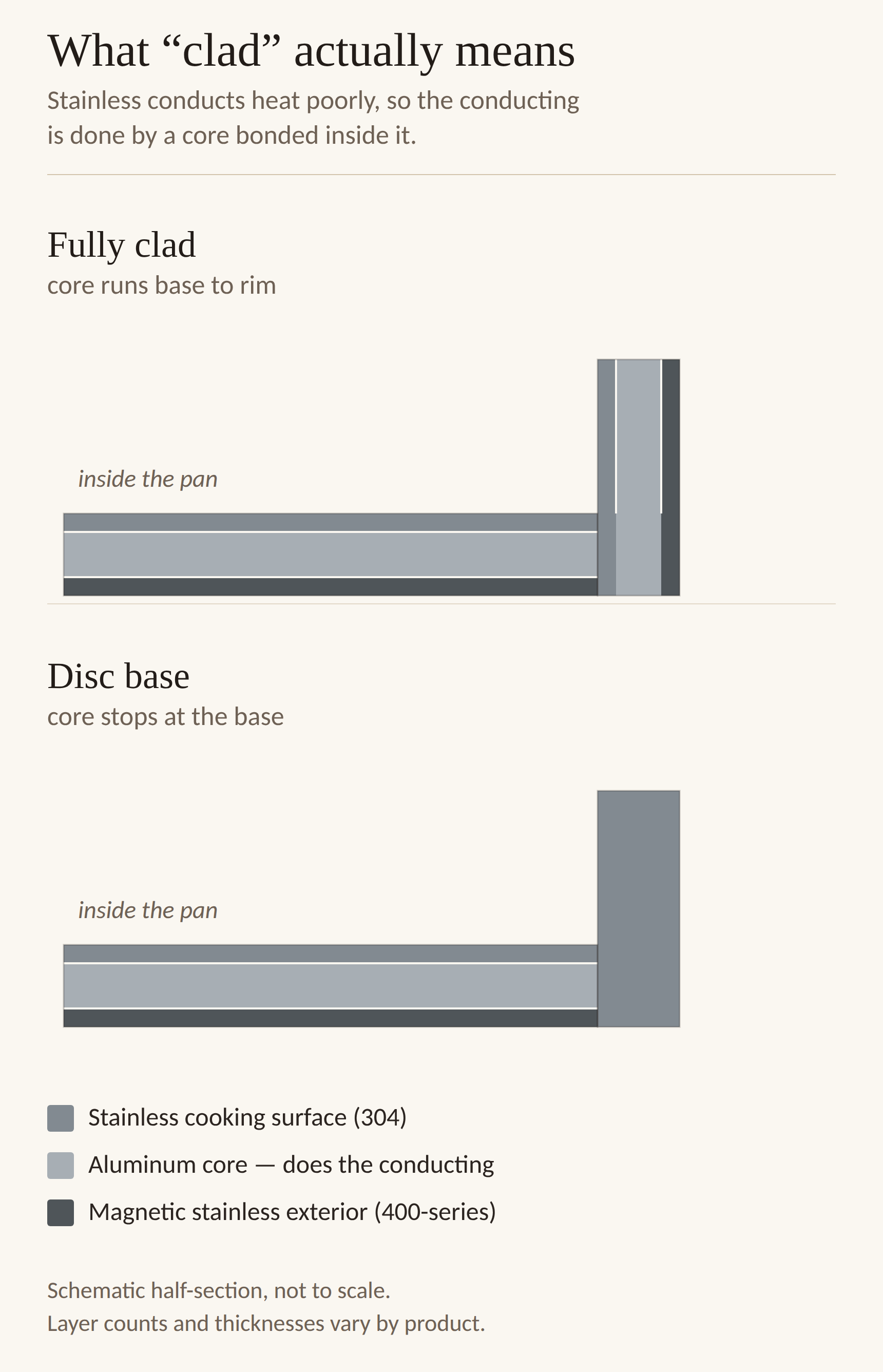
The answer is to build the pan in layers. A core of aluminum, or sometimes copper, is roll-bonded between layers of stainless — pressed together under heat and pressure until the metals form a true metallurgical bond, not a glued sandwich. The stainless provides the cooking surface and the durability; the core does the conducting.
“Tri-ply” is the basic steel-aluminum-steel sandwich. Five-ply adds layers, usually but not always alternating — copper-core designs use thin aluminum plies as barriers between copper and steel rather than as heat spreaders, so a ply count tells you less than it appears to.
Two details are worth more than most marketing language:
- The two stainless faces are usually different grades. All-Clad's own patent describes using a magnetic 400-series stainless on the exterior specifically to make the pan work on induction, while the cooking surface stays non-magnetic 304. The inside and outside of your pan are doing different jobs.
- The core may stop at the base. A disc-bottom pan conducts well on the base and poorly up the sides, because only the base carries the core; a fully clad pan behaves consistently from base to rim. That matters most when heat has to reach food above the base line — a sauce reducing, or anything that climbs the walls. Being straight about the evidence: the construction difference is visible in a cutaway, but we found no published measurement comparing how the two actually cook. Neither is wrong, and a heavy disc base is not automatically worse than thin full cladding.
Why food sticks to it
Stainless is neither seasoned nor coated, and food genuinely does stick. The mechanism is protein bonding directly to the metal — and the direction of the effect is the opposite of what most people assume. Adhesion gets stronger as the surface gets hotter: research on protein fouling found roughly seven times as much protein bound at 85 °C as at 25 °C, because heat denatures the protein and exposes more binding sites.
Food nonetheless releases once a crust forms and the contact area dries and shrinks, which is why patience rather than force is what gets a steak off the pan. Exactly how that release happens has not, as far as we can find, been studied in a searing pan. The practical advice is well established even though the mechanism is not: preheat properly, then leave the food alone until it lifts.
One popular explanation deserves to be retired. The claim that preheating makes the metal expand and “close its pores” is not supported by anything: rolled stainless is a dense metal with surface roughness rather than pores, and thermal expansion is uniform, so heating widens a groove rather than closing it. The real reasons to preheat are simpler — a fully heated pan does not stall when cold food hits it, and it reaches crust-forming temperature before the food has time to sit and bond at low heat. The full picture, including what the water-droplet test does and does not tell you, is here.
Reactivity and upkeep. Low enough not to matter. Tomatoes, wine, vinegar and long acidic braises are all fine — a genuine advantage over bare iron and carbon steel — and there is no seasoning to maintain. Rainbow tinting, white mineral spots and brown staining are cosmetic.
Heat limits. None that matter in a kitchen. High heat is fine, the oven is fine, and there is no coating to consume.
Strong at: pan sauces and deglazing, acidic ingredients, browning where you want to keep the fond, being ignored for a decade.
Awkward at: eggs and delicate fish without attention, and price — good multi-layer construction is expensive, and thin single-layer stainless is among the least pleasant pans to cook on.
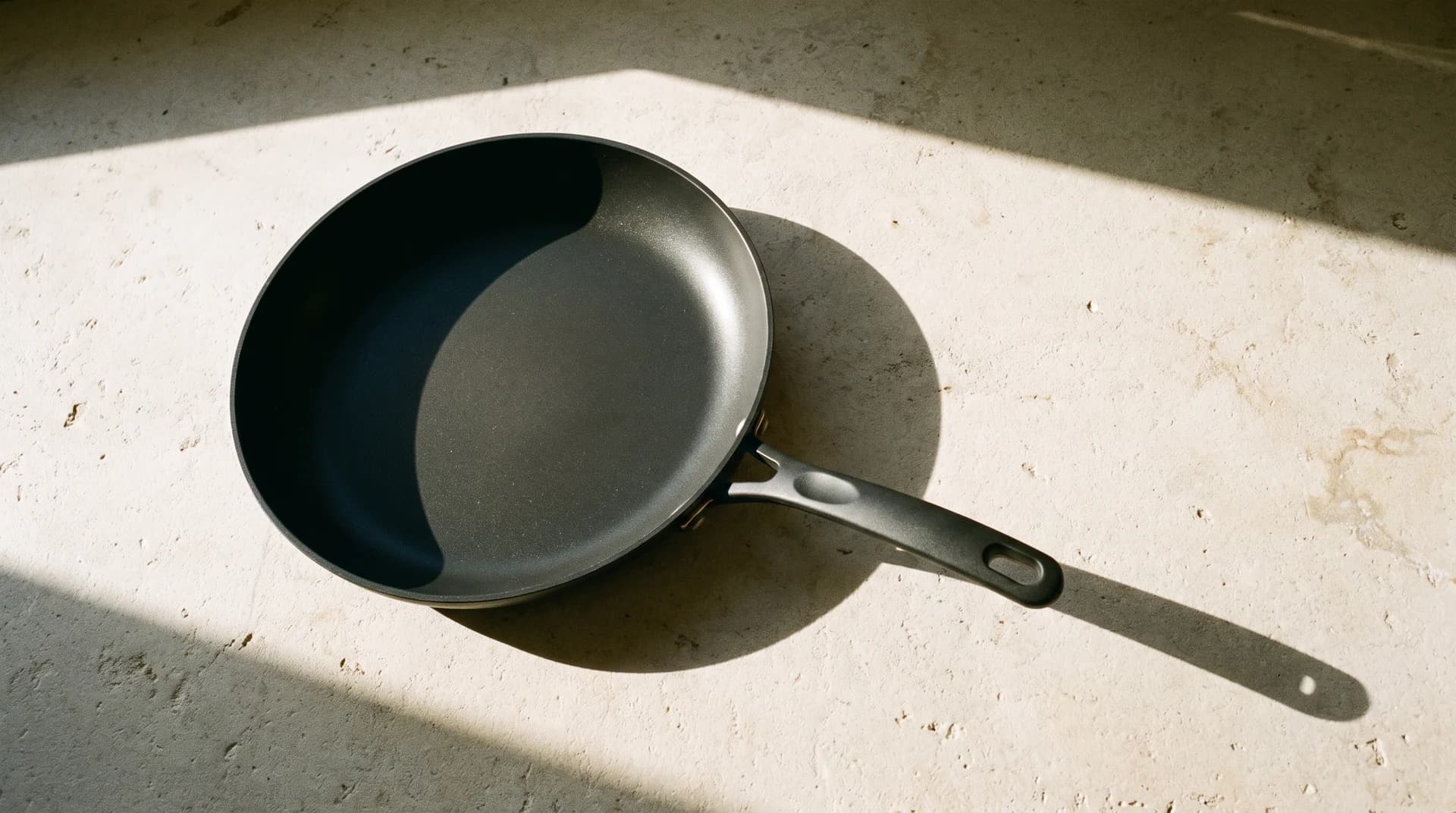
Nonstick: the fluoropolymer kind
What it is. Usually PTFE — polytetrafluoroethylene — though the category is broader than the name. The FDA regulation authorizing these coatings for repeated food contact covers PTFE alongside two related fluoropolymers, FEP and PFA, and singles out PFA as a coating resin. In practice these are multi-layer systems baked onto an aluminum or steel body, with a primer beneath the release topcoat rather than a single film of pure PTFE. US regulators permit them for repeated food contact and cap how much may migrate into food.
What it is genuinely good for. Eggs, pancakes, crepes, delicate fish, cooking with very little fat, and washing up in ten seconds. Nothing else here does those things as easily, and no technique makes stainless as forgiving with an omelet.
The practical takeaway, first
The safety question around nonstick has a specific and manageable answer. The risk is not cooking on the coating; it is overheating an empty pan. Four rules cover it:
- Never preheat a nonstick pan empty. Add the fat or the food first. This is the one that matters.
- Don't sear in it, and don't put it under a broiler. It is not the tool for that job anyway.
- Keep it off the highest burner setting.
- If you keep birds, treat overheating as a serious risk rather than an inconvenience. See below — this is the one case where the evidence is genuinely stark.
Everything after this is the reasoning behind those rules.
The temperatures, precisely
This subject is usually written about badly, by presenting a manufacturer's service limit as the point where something dangerous begins. They are different things.
The service limit. Manufacturers give a maximum recommended use temperature of about 500 °F (260 °C). That is a do-not-exceed figure for the coating's sake, not the temperature at which a hazard starts.
Decomposition. Meaningful breakdown starts higher. NIOSH's criteria document puts softening and the first gaseous breakdown products near 625 °F (330 °C), and the compounds associated with illness become dominant around 840 °F (450 °C). A useful reality check: the same FDA regulation above specifies that these coatings are cured at 750 to 800 °F during manufacture. Decomposition is a rate process that accelerates with temperature, not a switch that flips at a threshold.
Where sources disagree. The temperature at which human symptoms appear is not firmly established — published figures range from roughly 660 to 790 °F (350 to 420 °C), and the lower figure is not clearly attributed in the sources that repeat it. We are flagging the disagreement rather than picking a number.
Why the empty pan is the case that matters. Water-based cooking pins the surface near the boiling point, far below any threshold. Frying is a narrower margin than people assume, since oil at 375 to 450 °F sits within reach of the recommended ceiling. An empty pan has nothing holding it back at all. You will see a specific figure quoted for how fast an empty pan heats; it traces to an advocacy organization's 2003 report rather than to peer-reviewed work, so we are not repeating it.
Birds, and people
Birds are the genuinely serious case, and this is the best-evidenced part of the section. Cornell's College of Veterinary Medicine describes PTFE degrading above about 280 °C (540 °F) and releasing pyrolysis products that birds are especially vulnerable to because of their respiratory anatomy. In the underlying budgerigar studies, exposure of nine minutes or more produced clinical signs and death in 97 percent of the birds, with no reliable warning beforehand.
In people, the documented condition is polymer fume fever, and the honest description is neither alarming nor dismissive. It begins 12 to 24 hours after inhaling decomposition products, presents as a flu-like illness — fever, aches, chest tightness, dry cough — peaks within about a day, and settles over the next day or two, with full recovery typical within five to ten days. Death is exceedingly rare even in severe cases. Historically the classic exposure was occupational; the modern domestic route is the dry, overheated pan. How often that actually happens in home kitchens is not something the literature quantifies, and we are not going to guess.
On scratched pans, the honest answer is that we could not find a position from the FDA or its European counterpart, and the confident reassurances in circulation are not traceable to a regulator.
How long a coating lasts
Coatings wear out, and this is the structural fact that should shape the purchase: a coated pan is a consumable and an uncoated pan is not. Buy accordingly — cheap enough that replacing it is unremarkable.
Standardized abrasion tests do exist, contrary to what is often claimed: BS 7069, the non-stick requirements added to EN 12983-1 in 2023, and the Cookware Manufacturers Association's voluntary methods, which typically oscillate an abrasive pad across the surface under a fixed load until the coating fails. What they do not do is measure lifespan. They measure cycles to failure, no standard converts cycles into years, and manufacturers rarely disclose which method or load sits behind a durability claim. So a number of years quoted on a box is a product claim, not a property of the material.
What the labels mean
“PFOA-free” is true and no longer tells you anything. PFOA was a polymerization aid used in manufacturing rather than a deliberate ingredient — though residues could remain in finished goods, which is why the EPA program targeted product content as well as factory emissions. Under the EPA's voluntary PFOA Stewardship Program, eight major manufacturers committed in 2006 to a 95 percent reduction against a year-2000 baseline by 2010 and to work toward elimination by 2015, and the EPA states manufacture and import have since been phased out in the US. Two honest qualifications: the EPA notes existing stocks may still be used and some imported articles may contain PFOA — in 2020 it began requiring importers to notify the agency before bringing in articles with long-chain perfluoroalkyl coatings — and “PFOA-free” is a marketing term with no regulated testing standard behind it.
The wider vocabulary on a nonstick box — “ceramic,” “titanium,” “diamond,” “toxin-free” — is a separate problem, and we decode it term by term here.
On PFAS, stated carefully. PTFE is a fluoropolymer, and under the OECD's 2021 structural definition it is a PFAS. Whether large, stable fluoropolymers should be regulated like the smaller, mobile PFAS compounds that drive most environmental concern is an open question. Industry-affiliated reviews argue fluoropolymers meet “polymer of low concern” criteria; a 2020 critique in Environmental Science & Technology disputed that, largely because assessing the polymer alone ignores emissions across its full life cycle. Anyone telling you this is settled, in either direction, is ahead of the evidence.
Nonstick: the sol-gel “ceramic” kind
What it is. Not ceramic in the pottery sense. It is a silica-based coating applied as a liquid and cured into a hard, glass-like network — the sol-gel process it is named after. Patents describe a silica backbone built with silicone (siloxane) components bonded into it, and it is the silicone, not the silica, that provides the release.
How it behaves. Release is genuinely good when new, often excellent, and it tolerates more heat than PTFE without the fume issue. How much more is entirely product-dependent, and the spread is remarkable: GreenPan states its coating can be heated to 850 °F (450 °C), while Le Creuset rates its own ceramic nonstick at 550 °F (280 °C), dropping to 425 °F with a glass lid. When people say manufacturers set their own limits, this is what that looks like — a factor-of-two disagreement inside one category. Read the limit for the pan you own.
On “PFAS-free.” These contain no PTFE, and that much is definitional. PFAS-free is a different claim, and it belongs to the formulation rather than the category. Independent testing by the Ecology Center found pans labeled PTFE-free to be genuinely free of fluorinated compounds — while also finding “PFOA-free” routinely applied to pans that were PTFE-coated and did not say so. And at least one granted patent in this space specifies a fluorinated silane in the top layer to improve release, which would fall inside the PFAS definition. The reasonable position: most are PFAS-free, the brands that say so are generally borne out by the testing that exists, and it is worth checking per product rather than assuming from the word “ceramic.”
Durability. The same abrasion standards can be run on these coatings, but they were designed around PTFE, and abrasion is not how sol-gel coatings usually fail — PPG, a major coatings supplier, identifies thermal and chemical stress as the bigger cause and says the field lacks widely adopted testing methods. There is now one genuine head-to-head: a 2025 peer-reviewed study compared five commercial ceramic coatings against PTFE and found PTFE held better release, with peel force up to three times lower than the best ceramic — but two ceramic formulations beat PTFE on one wear mode. The useful conclusion is not “ceramic is worse.” It is that the spread between ceramic formulations was larger than the gap between ceramic and PTFE, which makes the word on the box a poor predictor of anything.
Strong at: the same jobs as PTFE, for households that would rather avoid fluoropolymers.
Awkward at: being compared — the claims are unusually hard to evaluate.
Enameled cast iron
What it is. A cast iron body coated in vitreous enamel — powdered glass fused to the metal. For cast iron specifically, firing runs around 730 to 770 °C over a long soak, cooler and slower than the hotter, faster firing used on sheet steel, because a thick casting has to come up to temperature throughout. The bond is chemical rather than merely mechanical: the classic study of enamel adherence found adhesion stronger than the tensile strength of the glass itself.
How it behaves. Thermally this is cast iron and behaves exactly like it — same mass, same slow stable heat, same conduction limits, same need to preheat. Everything that changes is at the surface.
The surface. Glass is effectively non-reactive to food acids, so the acid problem disappears for as long as the enamel is intact — long tomato braises and wine reductions are all fine, and there is no seasoning to build or protect. Two caveats keep that from being absolute: prolonged storage of acidic food can dull the finish cosmetically, and a breach exposes bare iron again. There is also no seasoning to help with release, so food sticks to enamel much as it does to stainless.
What goes wrong. Enamel is hard and brittle at the same time, which is not a contradiction — it resists scratching well and impact badly. It is typically cited at around 5 to 6 on the Mohs scale, though the value varies with the glass formulation. The two failure modes have different causes, and both major manufacturers document them:
- Chips come from knocks, dropped lids and metal tools. Le Creuset warns against sharp metal utensils; Staub recommends wooden or silicone.
- Cracking and crazing come from thermal shock. Le Creuset is explicit: heat and cool gradually, never fill a hot pan with cold water or plunge it into cold water, and never heat an empty pan or let one boil dry. Staub says the same.
Once the enamel is breached it is not repairable at home — and Le Creuset's position is that a pot with an interior chip should be retired rather than nursed along. Our care guide covers cleaning, staining, the dishwasher question and what the makers actually say about damage.
Heat limits are stricter than most people expect, and they depend on the fittings rather than the pot. Le Creuset's general guidance is low to medium heat, and its UK instructions restrict high heat to boiling water and reducing sauces — a direct restriction on dry searing. For the oven, Le Creuset gives 390 °F (200 °C) for phenolic knobs, 500 °F (260 °C) for stainless knobs and 660 °F (350 °C) for cast iron handles. Staub also sets its limits by fitting, but its published figures differ between its US and European documentation, so use the sheet that came with your pot rather than a number from the internet. Either way, the knob is usually the limiting part — the phenolic one is what catches people out.
A cosmetic choice with a practical side. Le Creuset's own comparison of its finishes is more useful than most marketing copy, partly because it admits a downside: light sand enamel makes the fond easy to see as it builds, and it stains. Dark satin enamel is designed for searing, hides staining, and develops a patina that improves release over time — closer to bare iron than to glass in that respect — though the company still advises medium heat.
Strong at: braises, stews, soups, bread baking, oven-to-table serving, anything long and acidic.
Awkward at: very high-heat searing, being dropped, and cost.
Will it work on your stove?
Gas and conventional electric cooktops heat the pan from outside and do not much care what it is made of. Induction is different, and the difference explains every compatibility rule you have ever read.
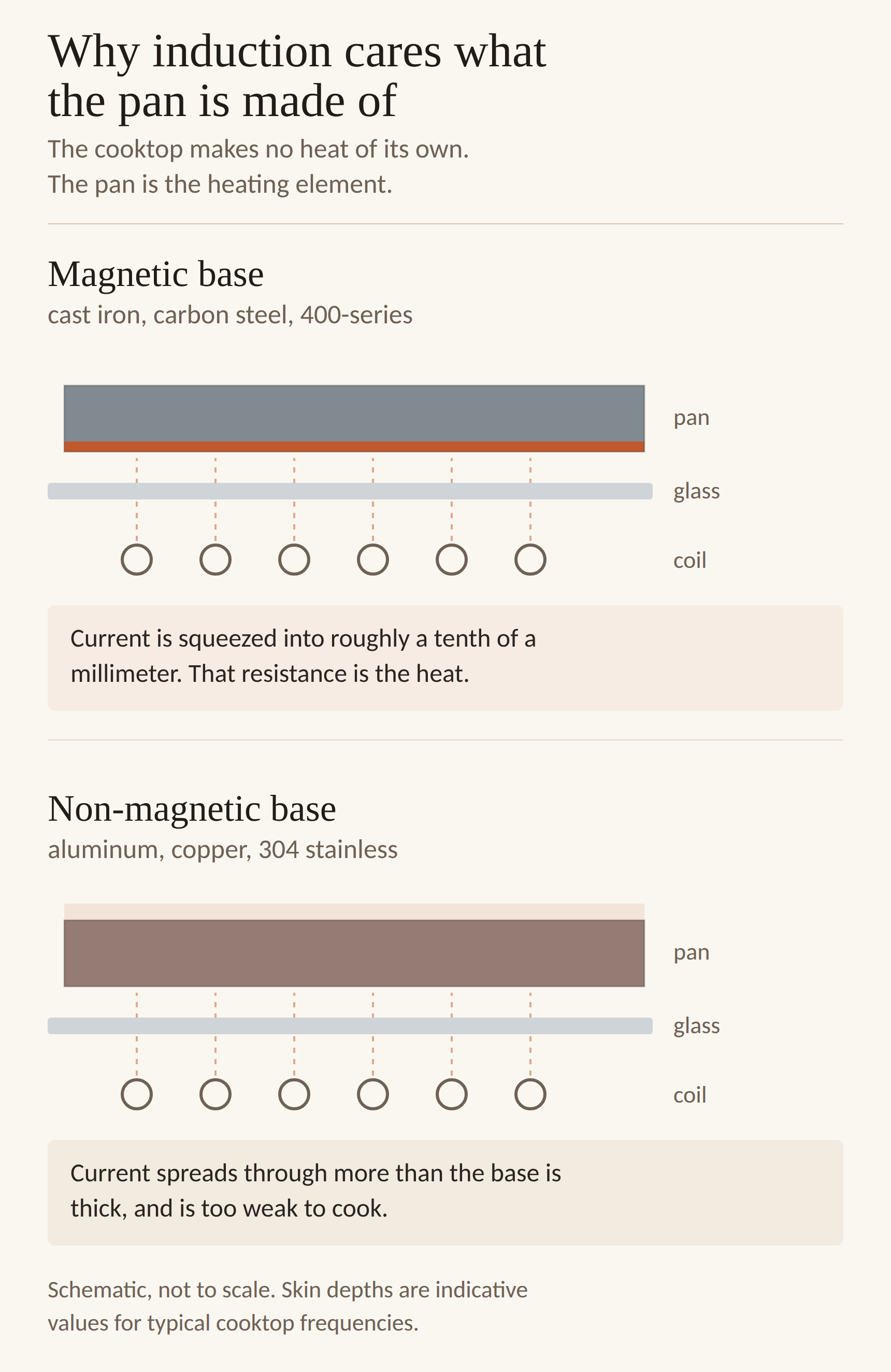
An induction cooktop does not generate heat in its own surface. A coil beneath the glass produces a rapidly alternating magnetic field, which drives electrical currents in the base of the pan; those currents meet resistance in the metal, and that resistance is the heat. The pan is the heating element. The glass still gets hot, but by conduction from the pan — which is why it cools quickly once you lift the pan off, and why induction cooktops carry a residual-heat warning light.
Why magnetism matters. Magnetic metals take this far better, for one main reason: they squeeze the induced current into an extremely thin layer at the surface of the pan — on the order of a tenth of a millimeter, against a few millimeters in non-magnetic stainless, which is thicker than the pan base itself. Crowding the current into that thin skin is what makes the heating efficient. Magnetizing and demagnetizing the metal adds a little heat of its own, but at the frequencies a cooktop runs at, engineering references put it below ten percent of the total. If you have read that induction works by magnetic hysteresis, that is the small part of the story standing in for the large one.
What that means at the store:
- Cast iron, enameled cast iron and carbon steel all work, without qualification.
- Aluminum and copper do not, on an ordinary cooktop. They conduct too well and lack the magnetism that would concentrate the current, so the pan gives the cooktop's electronics a load they cannot couple to efficiently — the limitation is as much in the circuit as in the metal. “All-metal” cooktops running at higher frequencies do heat aluminum, but they are rare. On the cooktop in almost any kitchen, a non-magnetic pan will not cook.
- Stainless depends on the grade. The 304 family used for cooking surfaces is largely non-magnetic; ferritic grades are magnetic. That is why induction-ready clad pans carry a magnetic 400-series layer on the outside — the cooking surface and the induction surface are different steels doing different jobs.
The magnet test, and its limits. Put a magnet on the base: if it grips firmly, the pan will heat. Two cautions. Test the flat center rather than the rim — forming can leave even non-magnetic stainless slightly magnetic at the edges, and some pans carry a magnetic disc smaller than the base looks, which is why GE tells owners to measure the flat magnetic area rather than the pan. And a firm grip means the pan will work, not that it will work well: that also depends on the base being flat enough for full contact, and on its diameter relative to the element — Whirlpool warns that a pan much smaller than the marked ring may not switch it on at all. For a specific pan, the manufacturer's statement is authoritative.
How to choose
There is no best material, and any guide that names one has quietly swapped a question about physics for a question about taste. What there is instead is a reliable chain: the cooking you do → the property that governs it → the materials that have that property.
Start with the task.
- Eggs, pancakes, delicate fish, low-fat cooking. Property: surface release, which no bare metal has. Material: a coated pan, fluoropolymer or sol-gel. Trade-off: you are buying a consumable.
- Searing, hard browning, crust. Property: stored heat plus a high temperature ceiling. Material: cast iron, or carbon steel if you want to be able to lift and move the pan.
- Pan sauces, deglazing, acidic ingredients, anything where the fond is the point. Property: non-reactivity, plus a surface you can read. Material: clad stainless — bare stainless has the conduction problem with no fix.
- Braises, stews, long slow cooking, oven-to-table. Property: stored heat and non-reactivity together, which only one material combines. Material: enameled cast iron.
- Stir-frying and fast, hot, active cooking. Property: responsiveness — low mass with a high ceiling. Material: carbon steel.
Then be honest about maintenance. Seasoned iron and carbon steel need a habit: dry them promptly, keep the film in reasonable shape, don't leave them soaking. It is not a difficult habit, but it is a habit — and if you already know from experience that pans sit in your sink overnight, iron will frustrate you and rust will follow. Choosing stainless and enamel instead is a sensible response to knowing yourself, not a compromise that needs justifying.
Then check the stove. If you cook on induction, the magnet test is a gate on everything above. There is no point choosing a material on its merits if the pan won't switch the element on.
Then accept that one pan will not do everything. This is not an argument for buying a big set. It is why most working kitchens end up with two or three materials rather than one: something coated for eggs, something heavy for searing, something non-reactive for sauces. Which you need first depends entirely on what you cook — which is why this guide will not hand you a list.
What this guide does not do
It does not rank brands or name a best pan. Material is only part of what determines how a pan performs. Two skillets of the same material can behave very differently depending on thickness, cladding, base construction and finish, and none of that is visible in a product photograph.
Where a fact depends on the specific product, it says so rather than inventing a number. Oven-safe temperatures, coating lifespan, maximum burner settings, whether an individual pan works on induction — all vary by manufacturer and model, sometimes by a factor of two within one category. The documentation for the pan in front of you is the correct source.
Nothing here is based on testing we performed. WiseEveryday does not operate a product testing program, and this article does not pretend otherwise. Material properties come from published reference data and peer-reviewed measurement; temperature and health information from the medical literature and federal agencies; care and heat limits from manufacturers' own documentation. Where a practical conclusion is drawn from a material property rather than from a study, the text says so — and where the evidence is thinner than the popular account suggests, as with what a seasoning layer is actually made of or how evenly cast iron really heats, it says that too.
The useful thing about material properties is that they don't depend on anyone's opinion. Gray cast iron will still conduct a fraction as well as aluminum next year, a dry coated pan on a high burner will still be the specific thing to avoid, and a magnet will still tell you most of what you need to know about induction. That is enough to make most cookware decisions well, and it is the part of this subject worth learning once.
Sources
- Lodge, de Buyer, Field Company and Smithey care and seasoning documentation
- Nickel Institute / AISI, Cleaning and Descaling Stainless Steels (Designers’ Handbook Series No. 9001)
- British Stainless Steel Association, Care and Maintenance of Stainless Steel
- FDA food-contact authorization for perfluorocarbon resins, 21 CFR 177.1550
- OECD, Reconciling Terminology of the Universe of Per- and Polyfluoroalkyl Substances (ENV/CBC/MONO(2021)25)
- US EPA, 2010/2015 PFOA Stewardship Program
- Chemours Teflon™ cookware coating documentation and PPG QuanTanium® coating documentation
- Guerrero Vacas et al. (2025), sol-gel ceramic versus PTFE non-stick coatings
- Le Creuset, Staub and Lodge enameled cast iron care documentation
- ISO 6769, Mohs scratch hardness of vitreous and porcelain enamels
- Thermal property values for the five materials are drawn from published engineering reference data, principally ASM Ready Reference: Thermal Properties of Metals (ASM International, 2002). WiseEveryday did not measure them.