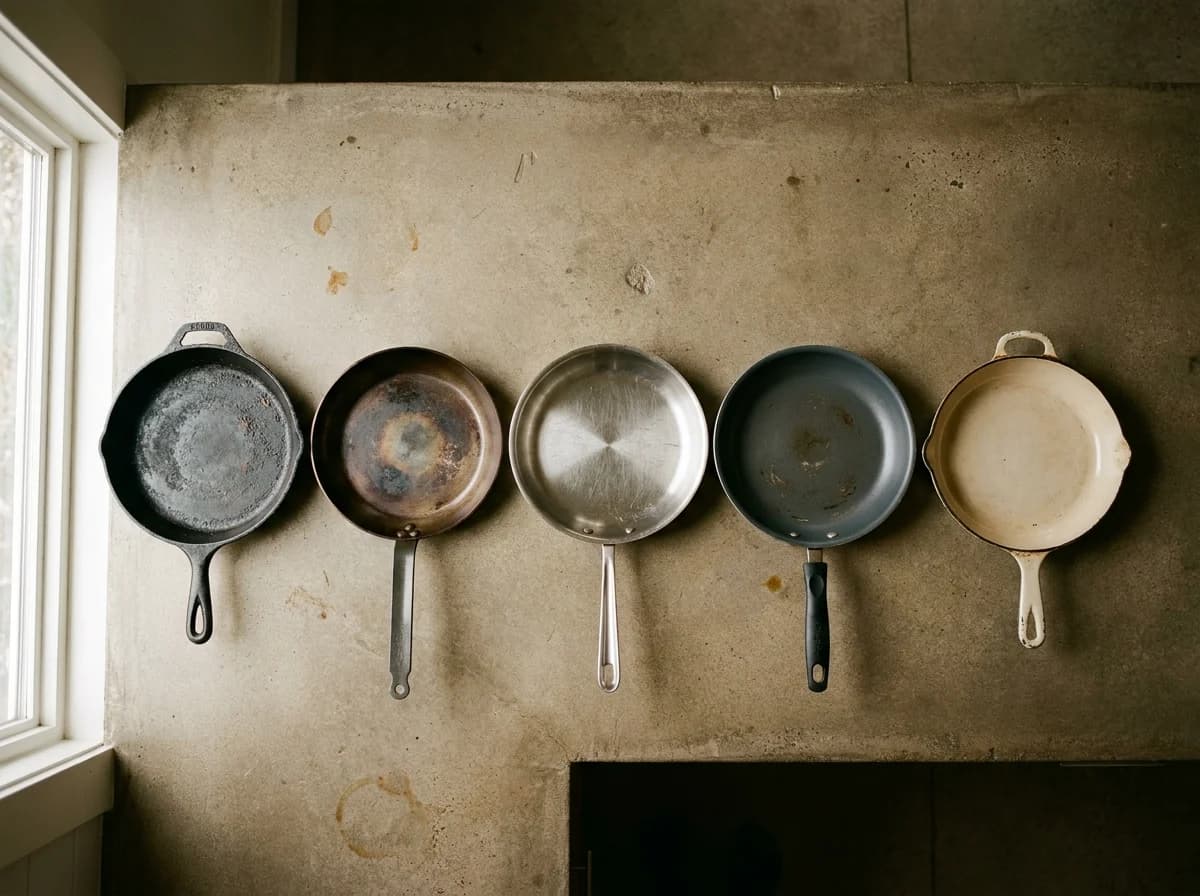
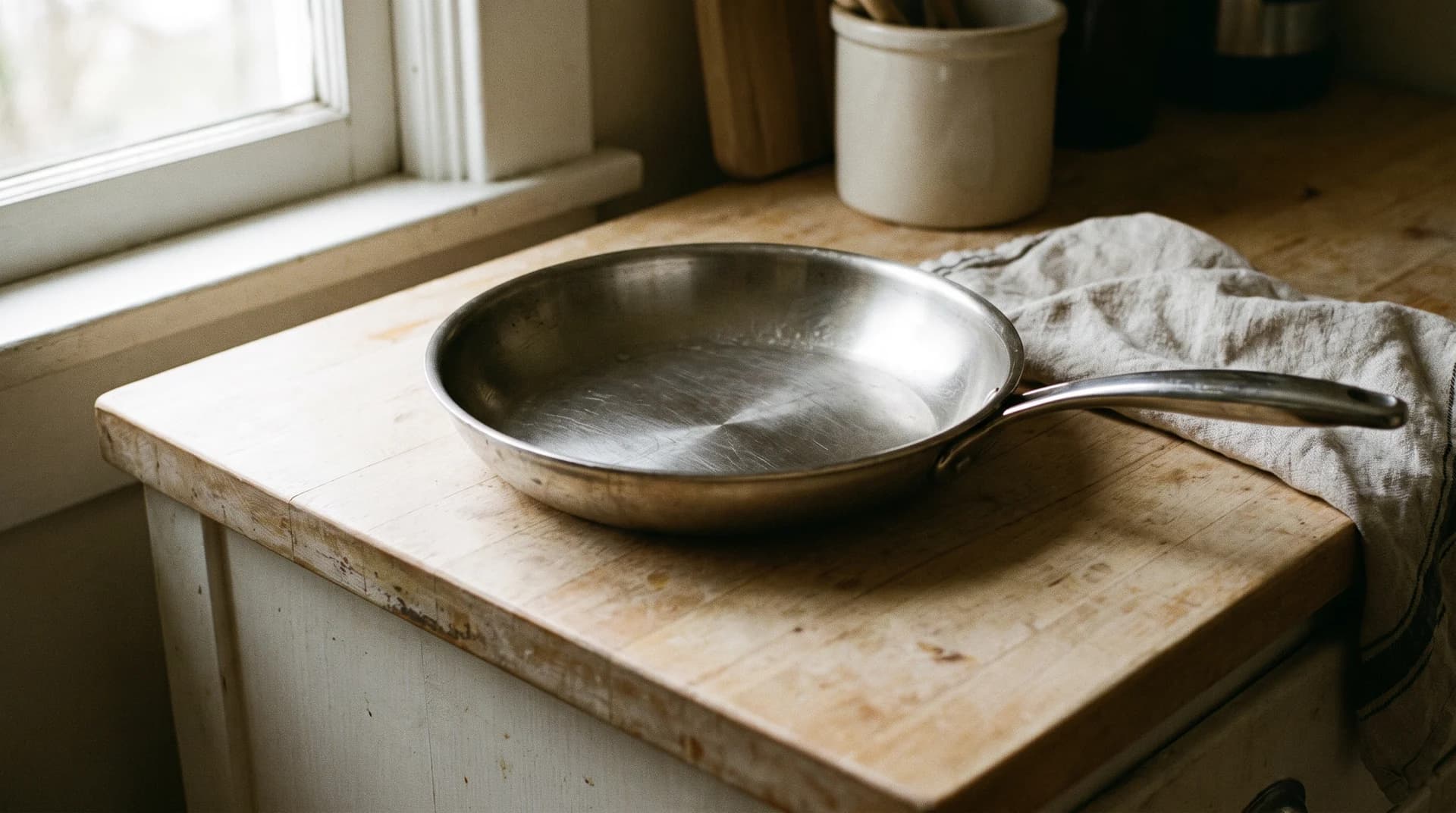
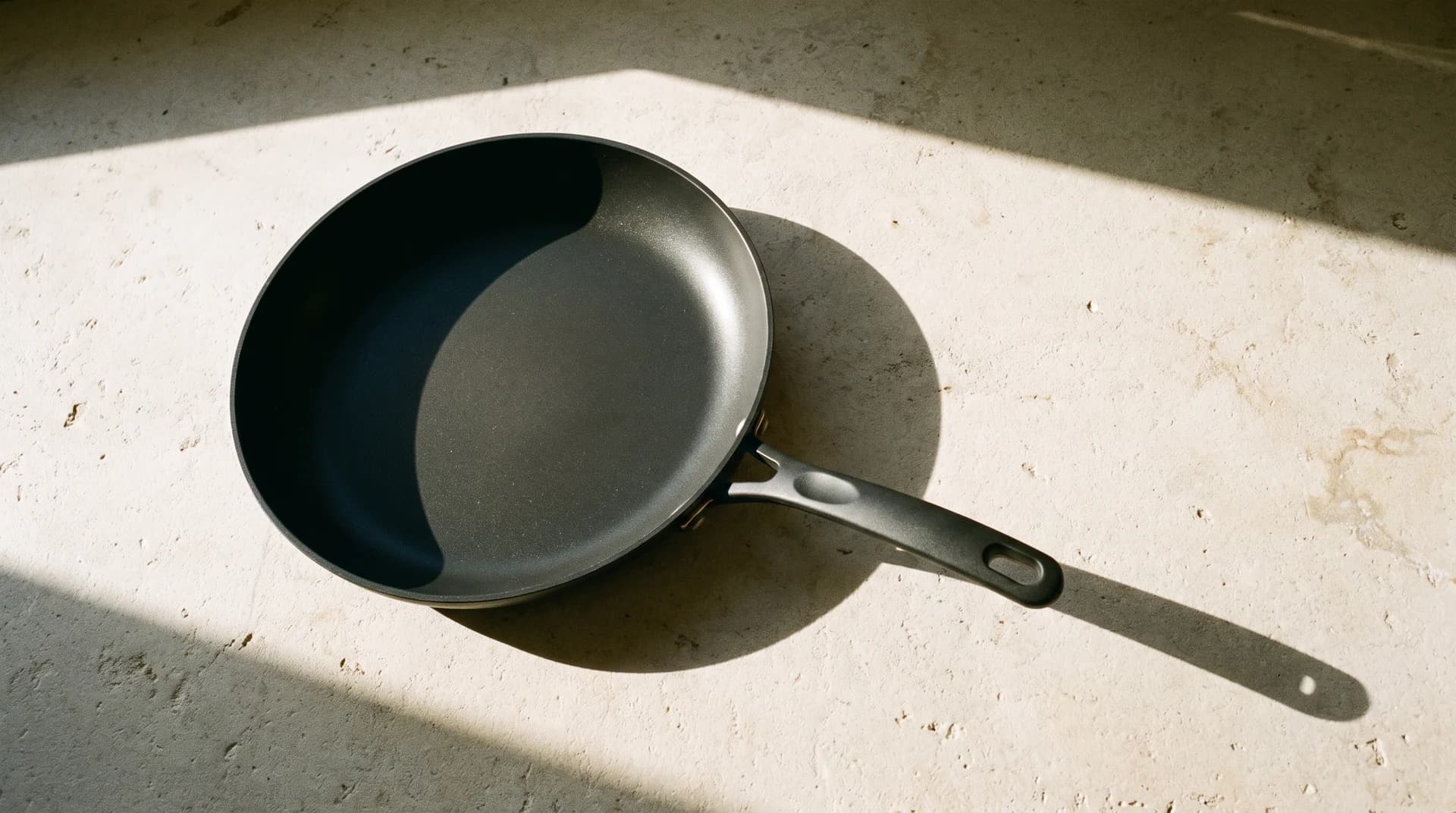
What Seasoning Actually Is, and What It Does to a Pan
Seasoning is a real chemical film, not leftover grease. But the polymer story everyone repeats is the leading hypothesis rather than settled fact, and the most-cited advice traces back to one blog post from 2010.
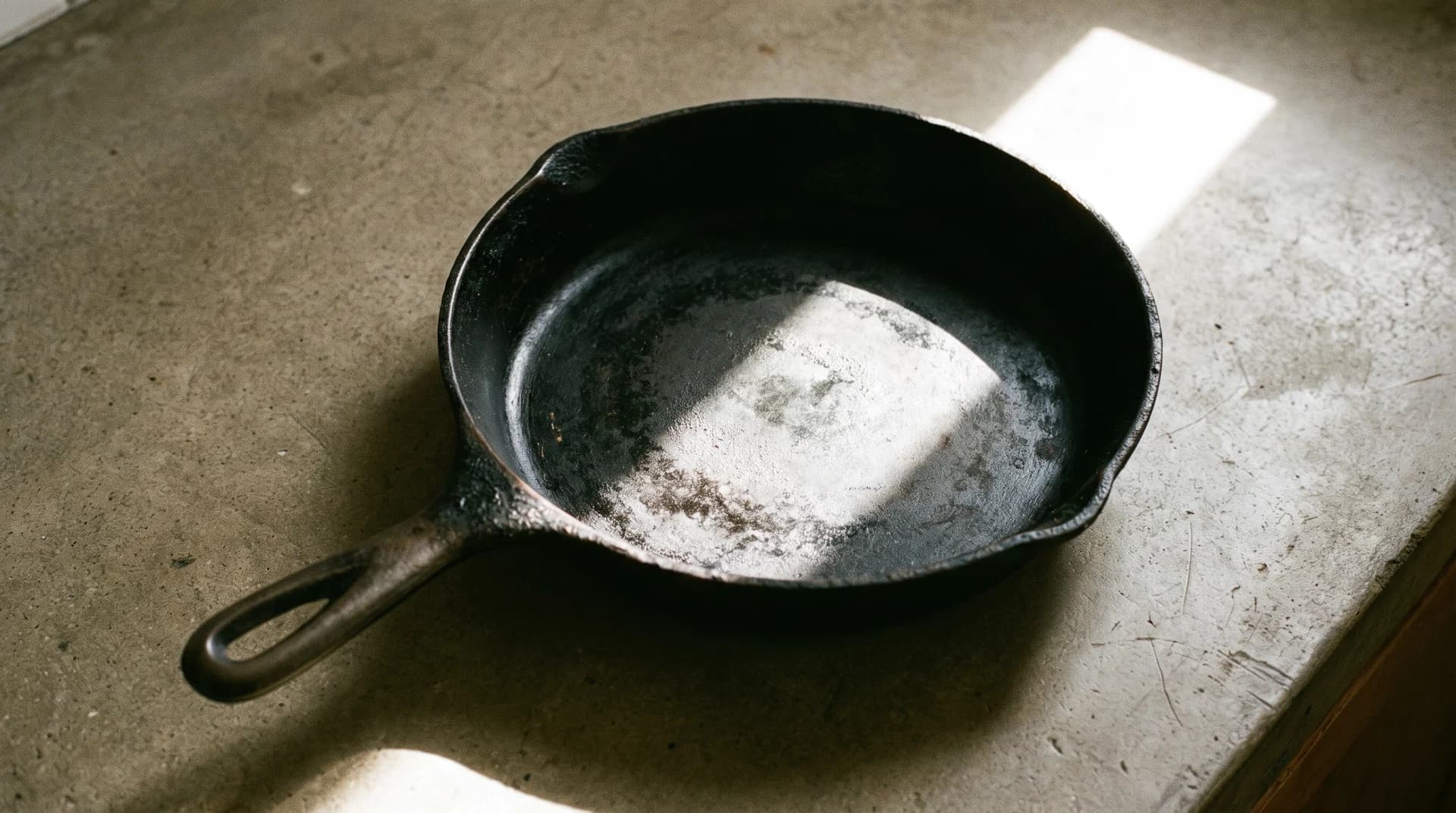
Seasoning is the strangest thing in a home kitchen: a surface you create yourself, by accident as much as on purpose, that nobody can fully explain. There is a great deal of confident advice about it online, and a surprising amount of that advice traces back to a single blog post from 2010.
Here is what is actually known, what is manufacturer preference dressed up as chemistry, and what nobody has tested.
The chemistry that is settled
Seasoning is a real film, not a residue of grease you failed to wash off. When you heat a thin layer of oil in an iron pan, unsaturated fats react with oxygen through a radical chain reaction and cross-link into a hard, dry, water-repelling network.
This is not an obscure process. It is the same reaction that makes linseed oil harden into a solid film in oil paint, and the oil-painting literature is where most of the research on it lives. Painters have been managing this chemistry for six hundred years; they just call it drying rather than seasoning.
That much is textbook. The interesting part is what happens when you go looking for evidence that this is what is actually on your skillet.
The part that is not settled
The polymer-film story is repeated everywhere as established fact. It is better described as the leading hypothesis.
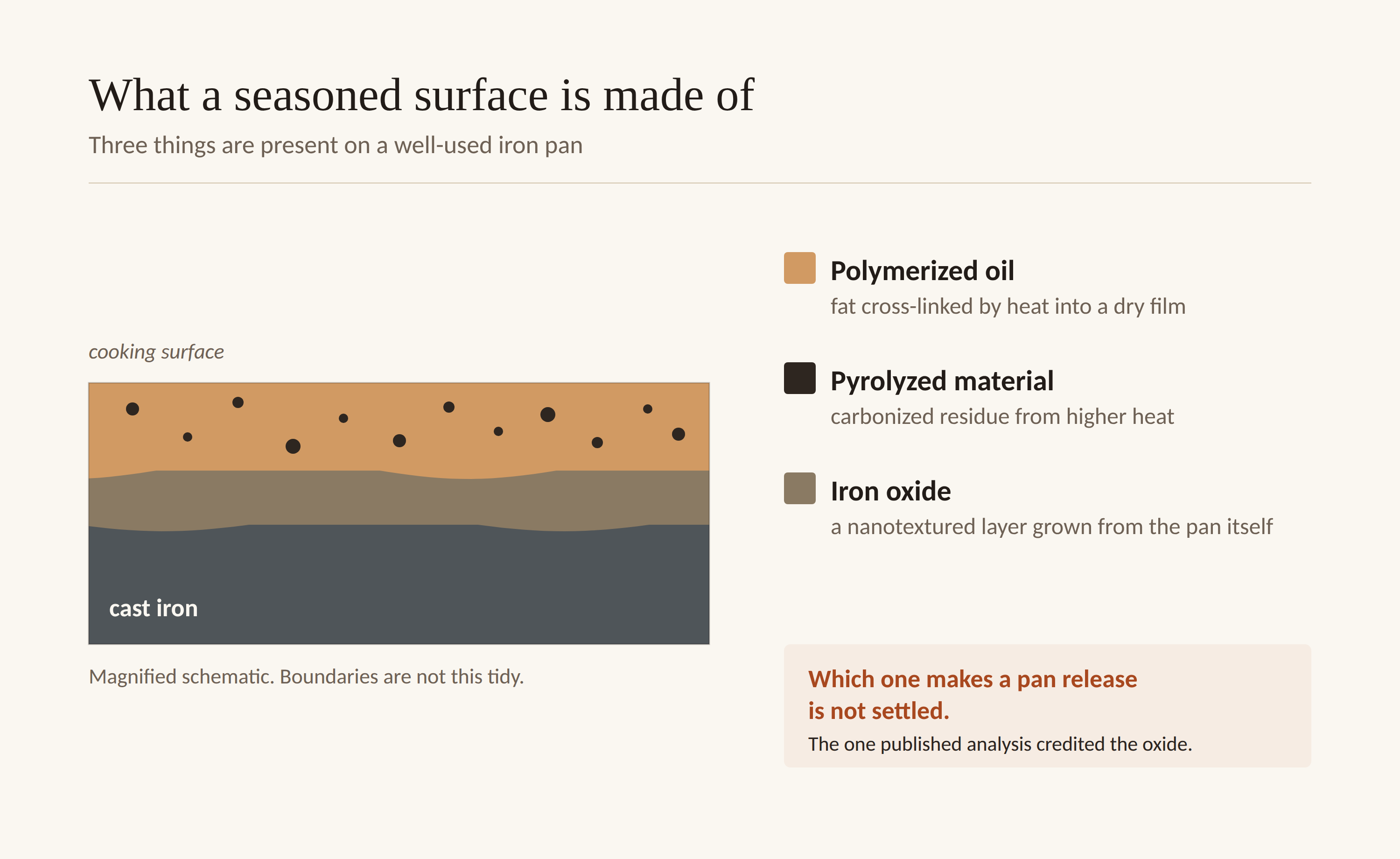
The only published surface analysis of a seasoned iron pan we could find is a 2023 study of seasoned Chinese woks, which examined the surface with electron microscopy, X-ray diffraction and photoelectron spectroscopy. It concluded that repeated oiling and heating gradually builds a nanotextured iron-oxide layer — magnetite, grown from the pan itself — and attributed the nonstick behavior to that structure rather than to a polymerized oil film.
The authors describe the result as “conditional hydrophobicity”: the surface repels water when the food is relatively dry, and wets when the food is wet. That is a genuinely useful idea, because it matches what people actually experience. A seasoned pan that releases a steak beautifully will still weld itself to an egg.
And in 2024, Chemical & Engineering News — the American Chemical Society's news magazine — appended a correction to its own cast-iron explainer noting that while some authors credit the polymerized layer, researchers have not definitively proved it is what makes the pan nonstick.
The honest summary: a mature seasoning layer probably contains polymerized oil, some pyrolyzed material, and iron oxide from the metal underneath. Which of those is doing the work is not settled. Lodge's own current wording is careful — seasoning is “oil baked onto the pan through a process called polymerization” — and notably avoids the folk version in which the oil simply turns to carbon.
Two rules that hold regardless
Usefully, the practical advice does not depend on winning the mechanism argument.
Thin coats, and it matters more than it sounds
This is the single most common mistake, and the reason is physical. In a thick oil film, the surface cures first and then acts as a barrier to the oxygen the rest of the layer needs.
The clearest measurement of this comes from the technical staff at a major artists'-oil manufacturer, who tracked oxygen uptake by weighing oil films as they cured. Thin films gained weight within two days. Very thick films barely moved for three weeks — and they warn that thick applications can leave a still-wet core for years.
On a pan, that uncured layer underneath is exactly what produces a sticky, tacky finish, or a seasoning that flakes off in sheets later. Both Lodge and Field diagnose flaking the same way: too much oil, applied too thickly, without the time to bond. Lodge's instruction is to use “just a thin layer, not enough to drip or run when you tilt it.” Wipe the pan as though you were trying to remove the oil, not apply it.
It builds over many cookings, not one session
Every time you cook with fat, you add to the film. Lodge says so directly, and so does de Buyer, which tells buyers that year one is still building those layers. A single seasoning session gives you a starting surface, not a finished one.
Which oil? The manufacturers disagree, and the famous answer has a problem
Four major manufacturers give four different answers, and none of them cites data.
- Lodge: a neutral oil with a high smoke point; they reach for vegetable or canola.
- de Buyer: grapeseed, avocado, canola, peanut or sunflower.
- Field: their own blend of grapeseed, sunflower and beeswax.
- Smithey: no strong feelings; they use grapeseed, and say a variety of oils or even lard will do.
They also contradict each other outright. Field says it does not recommend flaxseed oil, because it “is prone to creating a more brittle seasoning that flakes easily.” Smithey lists flaxseed as acceptable. Lodge warns against tallow, lard and ghee for seasoning because they can go rancid — while Smithey endorses beef tallow.
When four manufacturers disagree this comprehensively, that is the finding. There is no settled chemistry being applied here; there is house practice.
Where the flaxseed advice came from
The flaxseed recommendation is worth tracing, because it is repeated as though it were science.
It comes from a single personal blog post published in 2010. That post cites no primary literature — its author says plainly that she wanted to understand the chemistry and found nothing addressing the question directly. Her argument was that seasoning is fat polymerization, polymerization is maximized with a drying oil, and flaxseed is the only edible drying oil.
That is a reasonable line of thought. But the justification you now see everywhere — that flaxseed wins because it has the highest iodine value — does not appear in that post at all. It was added later by other sites and has been passed along ever since as if it were the original chemistry. The comment thread beneath the original post, meanwhile, contains multiple readers reporting that their flaxseed seasoning flaked off.
Is there anything to the brittleness concern? The mechanism is real and well established in coatings chemistry: more unsaturation means denser cross-linking, which means a harder but stiffer, more brittle film — the same chemistry that eventually crazes old oil paintings. But that is decades of aging on canvas, and nobody has tested any oil on cookware in a controlled way. One manufacturer asserts it. That is the honest ceiling.
Iodine value and smoke point measure different things
Since both terms get thrown around: iodine value measures how unsaturated an oil is — how many double bonds are available to cross-link. That is the property that actually governs whether a film forms. Smoke point measures when an oil starts releasing visible volatiles, which depends heavily on refining and free fatty acid content.
They are not related, and the popular instruction to “heat past the smoke point to polymerize the oil” has no chemical basis as stated. Autoxidation is a radical reaction that proceeds at room temperature — again, that is how oil paint dries. Manufacturers don't agree on it either: Field's final bake is at 400 °F, at or below the smoke point of the blend they sell, while de Buyer makes reaching the smoke point the explicit endpoint of its stovetop method.
The defensible version: heat accelerates the reaction and drives off lighter fractions, and the smoke point is a convenient visual cue for “hot enough.” It is not a chemical threshold.
Method: also contested
Lodge and Smithey bake at 450–500 °F for an hour and let the pan cool in the oven. Field stages up — 200 °F, then 300 °F, then an hour at 400 °F — 50 to 100 degrees cooler than everyone else. de Buyer offers no oven method at all, only a stovetop burn-off, and its French instructions call for pouring in roughly a millimeter of oil, which sits oddly against everyone else's insistence on the thinnest possible film.
If you own a pan, follow that manufacturer's instructions. They are not converging on a single right answer, and there is no published test that settles it.
The soap myth is dead, and the manufacturers killed it
Lodge, in its own FAQ: “Soap is totally okay! The soap we use for washing dishes today is no longer strong enough to remove seasoning from cast iron.” They list it as the first of their busted myths.
Field supplies the history: “Back when soaps were commonly made with harsh compounds like lye and vinegar, this was true, but most modern dish soaps... are perfectly safe.” Smithey agrees a few drops won't hurt.
The chemistry supports the retraction. Cured seasoning is a cross-linked network, not loose fat, and modern dish detergents are near-neutral surfactants that lift free oil. Historic lye soap was genuinely caustic — which is precisely why lye baths remain the enthusiasts' method for stripping a pan back to bare metal.
One important line not to cross: the dishwasher is a different case, and every manufacturer prohibits it. Dishwasher detergents are strongly alkaline, and the cycle adds a long hot soak with no drying or oiling afterward. Conflating hand soap with the dishwasher is how the myth survived this long.
What actually damages seasoning
Water left standing. The most reliable way to ruin a pan, and the mechanism is worth stating precisely: water rusts the iron, and the rust lifts the film off from underneath. It is not that water dissolves seasoning. A brief rinse is fine — Field says so explicitly. Overnight soaking and air-drying are not.
The dishwasher. Universally prohibited, as above.
Acid — and here the manufacturers disagree so widely that no single rule can be quoted honestly. Lodge says up to about 45 minutes is fine and deglazing with wine or lemon is unremarkable. Smithey suggests staying under 30 minutes on a newer pan. Field says avoid acid entirely while breaking a pan in. de Buyer says never. Everyone agrees a mature film tolerates acid far better than a young one; the specific numbers are house policy with no published basis.
Sustained high heat. Lodge puts the breakdown of the seasoning itself at around 650 °F. Note the tension: their own seasoning bake runs at 450–500 °F. The film is made and unmade by the same variable.
Abrasion — real by definition, but the makers split. Lodge is relaxed to the point of calling the metal-utensil ban a myth outright. de Buyer, whose pans are thin steel with a younger patina, says avoid steel wool. Field takes the middle path: salt, then a non-scratch sponge, then a powdered cleanser, with steel wool as a last resort.
One thing that is not on this list: cooking lean food. No manufacturer claims it damages seasoning. Lean food is more likely to stick to an immature film, which is a different problem.
Rust, and how to bring a pan back
Rust is recoverable, and every manufacturer says so. The endorsed method is low-tech and consistent: scour the rust off with steel wool or a rust eraser, wash with warm soapy water, dry completely — Lodge suggests a few minutes on low heat to be sure — apply a very thin layer of oil, and bake upside down at 450–500 °F for an hour with foil below to catch drips. Let it cool in the oven.
What no manufacturer endorses: lye baths, oven cleaner, electrolysis, or the oven's self-clean cycle. These are enthusiast practice, and they are not in any maker's care documentation. That does not make them ineffective, but it does mean nobody is standing behind them, and two carry real hazards worth naming:
- Self-clean cycles run to 800–1,000 °F — well above the temperature at which Lodge says seasoning degrades, and into the range where thin castings can distort. A Lodge representative told Consumer Reports plainly that the high heat melts the seasoning off. McGill University's Office for Science and Society notes the cycle emits carbon monoxide and other combustion products, and that the fumes can be lethal to pet birds. Never do this with an enameled piece, or one with a composite handle, and the door locks — so a warping pan cannot be rescued partway through.
- Lye is sodium hydroxide. The federal toxicology profile describes severe skin burns with deep ulcerations, and eye damage up to blindness. It also reacts vigorously with aluminum. If you use it, that is a decision to make with full protective equipment and ventilation, not casually.
What “pre-seasoned” actually means
Less than most people assume. Lodge describes its factory process as spraying a thin layer of soy-based vegetable oil onto the cookware and baking it in a large oven. One thin coat and one industrial bake — a starter surface and rust protection, not the deep multi-layer film people picture.
Lodge, Field and Smithey all ship pans ready to cook on after a wash. Lodge is explicit that this is not permanent and the pan still needs the wash-dry-oil routine.
de Buyer is the exception, and it is a sharp one: their carbon steel arrives coated in beeswax, not seasoning, which must be washed off in hot water before the pan is seasoned for the first time. Two pans that look similar on a shelf, one finished and one effectively raw.
Carbon steel, briefly
The chemistry is identical and the care is identical — Lodge says both types are cleaned exactly the same way. What differs is mechanical. Thin steel warps where cast iron would not, so de Buyer's instructions are specific: match the pan to the burner, raise the heat gradually, never put a hot pan in contact with cold water, and deglaze with hot liquid rather than cold.
One claim to drop: carbon steel does not season faster. de Buyer says the opposite in its own materials.
And a note on appearance, since photographs set unrealistic expectations. de Buyer tells owners to expect patina that is dark in some spots and lighter in others, with possible bronze or blue tones. Lodge says the same about coverage variation. An evenly jet-black pan is not the standard by which yours is failing.
What seasoning is not
It is not a substitute for a coated pan, and the comparison is less flattering than enthusiast writing suggests. There is no peer-reviewed head-to-head test of seasoned iron against a fluoropolymer coating — we looked. Every source claiming equivalence was a retailer or a brand.
What can be said is structural. A fluoropolymer coating is unconditionally non-wetting, well characterized, and eventually thrown away. Seasoning is conditional — better with dry, fatty foods than wet, lean ones — poorly characterized, and repairable indefinitely. They are different categories of surface, and ranking them on a single “nonstick” axis is the mistake.
Notably, none of the four manufacturers claims their seasoning matches PTFE. Field says the opposite outright: most proteins, bacon included, may stick a bit in the early stages.
For where seasoned iron actually sits among the materials — and why its heat behavior matters more than its release — see our guide to cookware materials. If your problem is the other kind of pan, we cover why food sticks to stainless steel separately.
Sources
- Manufacturer care documentation from Lodge, de Buyer, Field Company and Smithey
- Gao et al., Nano Materials Science 5(1):86–90 (2023)
- Chemical & Engineering News, “Periodic Graphics: The chemistry of cast-iron cookware,” with 2024 correction
- Garcia et al., Fire Science Reviews, on linseed oil oxidation
- Lazzari & Chiantore, Polymer Degradation and Stability 65(3) (1999)
- Golden Artist Colors technical publication Just Paint on oil film curing
- Díez-Betriu et al., Foods 14(23):4099 (2025), on smoke point
- ATSDR ToxFAQs on sodium hydroxide
- McGill University Office for Science and Society on self-cleaning ovens
- Consumer Reports on cleaning cast iron