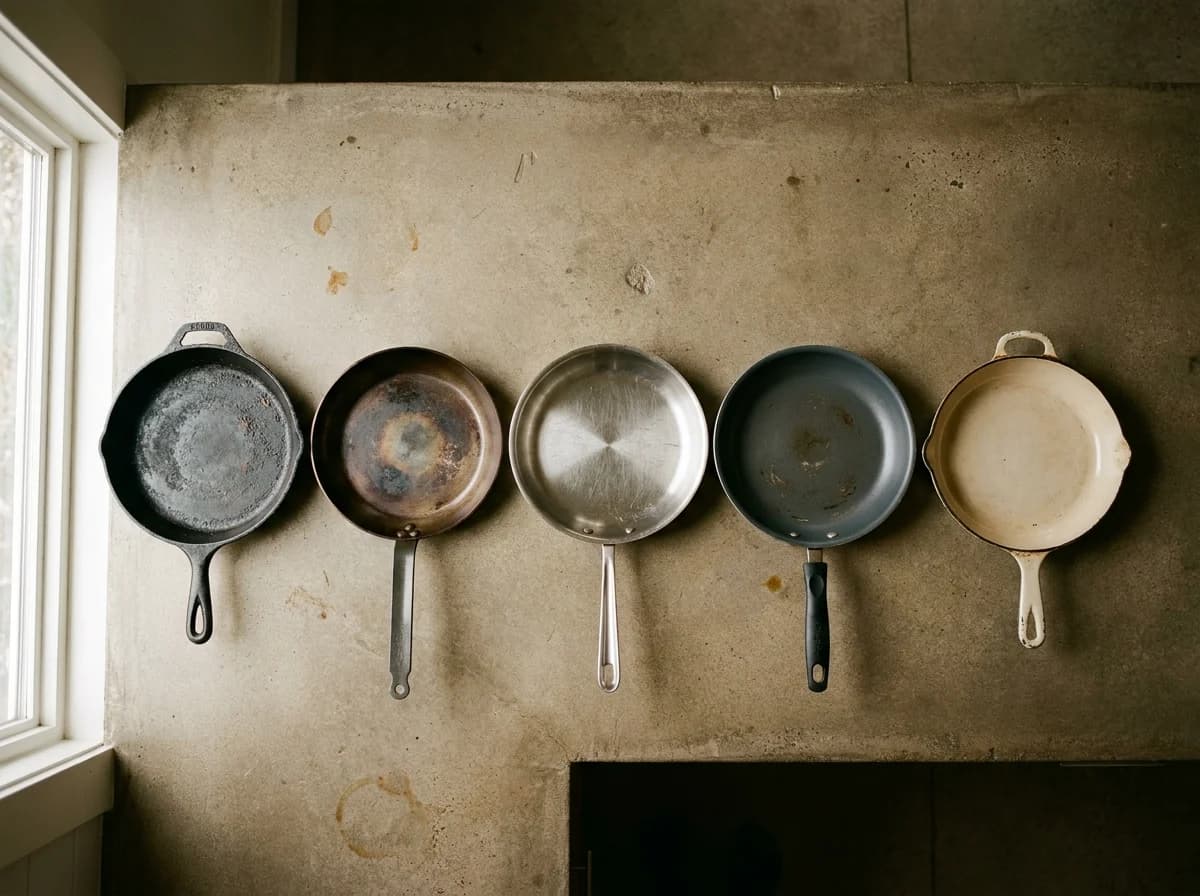
Why Food Sticks to Stainless Steel, and How to Stop It
Food sticking to stainless is not a defect. Protein bonds directly to bare metal and the bond gets stronger as the pan heats up, which means most of the popular advice is right for the wrong reason.
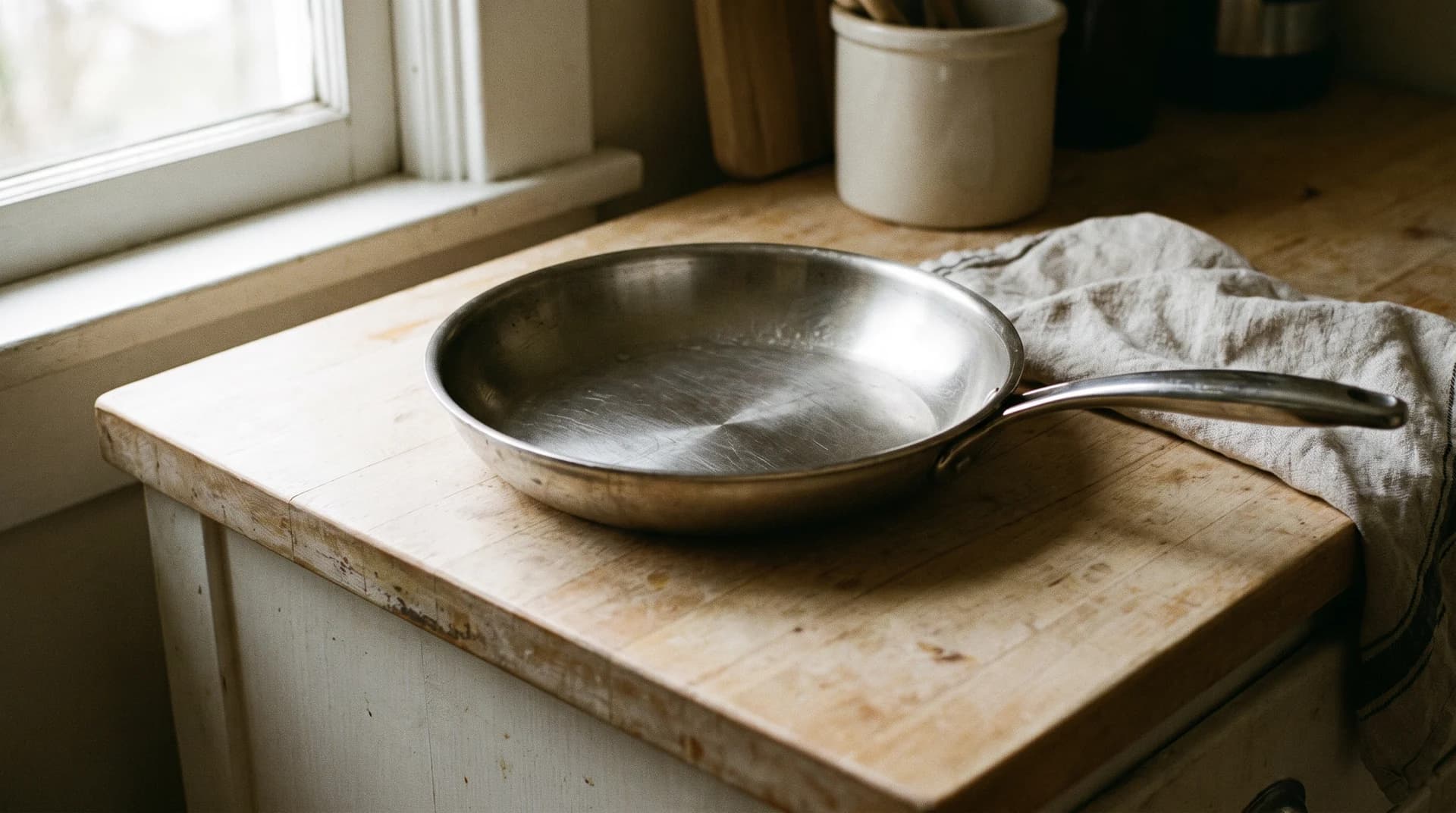
Food sticking to a stainless steel pan is not a defect, a sign you bought the wrong pan, or evidence that you have failed at cooking. It is what the surface does. Stainless has no coating and no seasoning layer, and proteins bond to bare metal on contact.
The good news is that the behavior is predictable once you know the mechanism — and that most of the popular advice about it is either right for the wrong reason, or simply wrong.
Why it sticks: the direction of the effect is backwards from what most people assume
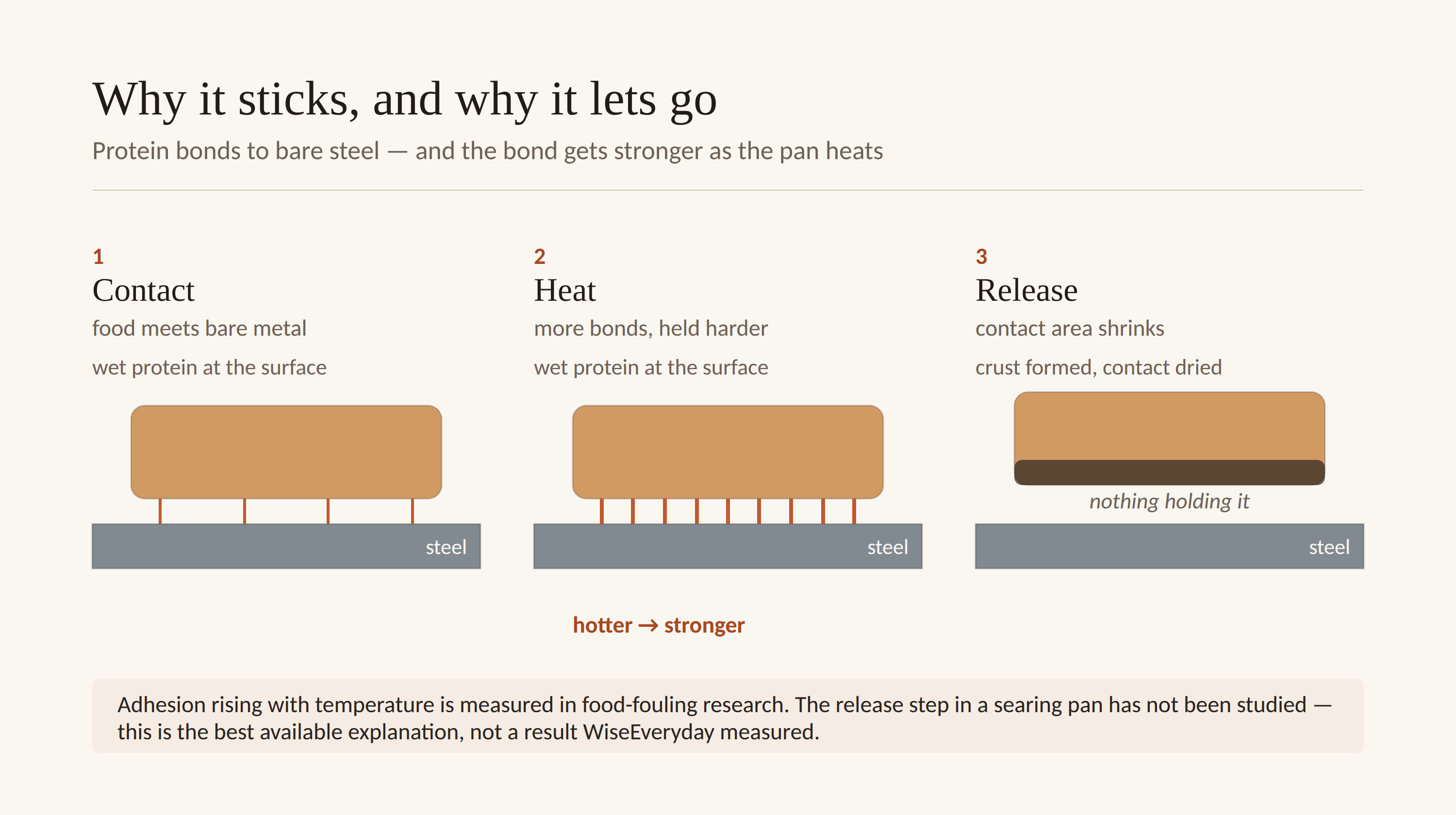
Proteins adsorb directly onto stainless steel, and the bond gets stronger as the surface gets hotter, not weaker.
Research on protein fouling in heat exchangers — the industrial version of this exact problem — found roughly seven times as much protein bound to stainless at 85 °C as at 25 °C. Heat denatures the protein, unfolding it and exposing more sites that can bind to the metal. Worse, at 85 °C the researchers observed no desorption at all: once stuck, it stayed stuck. Separate measurements of adhesion force between model foods and surfaces found the same rise at 90 °C.
So “the pan wasn't hot enough” cannot be the whole story, because a hotter surface binds protein harder. Something else is doing the releasing.
The second factor: surface energy
The cleanest explanation for why stainless sticks and a coated pan does not is surface free energy — roughly, how strongly a surface wants to bond with what touches it. Measurements across food-contact materials put stainless steel above 30 mN/m and PTFE around 5.5 mN/m, and found adhesion tracking surface energy almost linearly.
That is close to a sixfold difference, and it is a property of the material. No technique closes it. This is why a nonstick pan is genuinely the right tool for eggs, and why the honest advice for stainless is about managing the sticking rather than eliminating it.
The finding that surprises everyone: polishing makes it worse
A study comparing surfaces for contact frying — stainless, aluminum, PTFE and several ceramic coatings, tested with pancake batter at 160 °C and 200 °C — reported that smoother surfaces gave a higher force of adhesion. Electropolished samples took roughly three times the force to release compared with unpolished ones. PTFE required none.
Two other results from the same work are worth knowing: stainless steel outperformed aluminum on release, and every non-PTFE material stuck harder at 200 °C than at 160 °C — independent confirmation of the temperature effect above.
The practical upshot: buffing your pan to a mirror will not make it release better, and the fine scratch pattern a used pan develops is not why food sticks to it.
Why eggs and fish are the worst cases
This part is reasoning rather than measurement, and it follows from the fat story below. Egg white and lean white fish arrive at the pan surface with essentially no fat of their own. A well-marbled steak renders fat directly into the contact zone as it cooks — it brings its own release agent. Nothing in the egg does that.
What actually makes food let go
Here is an honest admission: we could not find a single published study of why a seared piece of meat eventually releases from a pan. It is one of those everyday phenomena that no one has apparently characterized. Anyone telling you confidently how it works is reasoning, not citing.
The best available explanation, assembled from adjacent research, has two parts:
Fat displaces the water that mediated the bond. This is the measured piece. Work on food release from baking surfaces found that shear force needed to detach food was “almost independent of surface composition, energy and roughness, but strongly related to the oil content,” and concluded that oil's ability to replace water from a surface is the key factor in adhesion. As fat renders out of meat at the contact face, it wedges into the interface.
The contact face stops being wet protein. Crust formation is a measurable dehydration front — the surface layer becomes a structurally distinct, dried material. A rigid crust no longer conforms to the pan's microscopic roughness the way soft wet protein did, so there is simply less real contact.
What you should not believe is the common line that the bonds “finish forming and then let go.” The fouling research says the opposite: nothing spontaneously desorbs at cooking temperatures.
Two pieces of standard advice, examined
The water droplet test tells you less than you think
Flick water into the pan; if it balls up and skitters like mercury, the pan is ready. This is the Leidenfrost effect — the droplet is riding on a cushion of its own vapor, insulated from the metal.
The number matters. For polished stainless steel, the Leidenfrost transition has been measured at 185 ± 5 °C (about 365 °F). And the threshold is not fixed: surface texture shifts it substantially, so a well-used pan and a new one will not behave identically.
Three consequences:
- It is a floor, not a target. A skittering droplet tells you the surface is above roughly 185 °C. It cannot distinguish that from 260 °C.
- It is too hot for most cooking. Fine before a hard sear on steak. Wrong for eggs, fish, or anything you want to cook gently.
- It reads one spot, and says nothing about whether the rest of the pan matches — which is the actual weakness of thin, unclad pans.
Manufacturers do not even agree on the endpoint. All-Clad tells owners to look for water that “dances” around the pan. Le Creuset, for its stainless line, says the pan is ready when a droplet sizzles. Those are different temperatures on opposite sides of the Leidenfrost point — sizzling means the droplet is still wetting the metal, well below 185 °C. Both are reasonable instructions for different jobs; neither is the universal readiness signal it is presented as.
“Hot pan, cold oil” — the sequence is fine, the explanation is invented
Preheat the pan, then add oil, then add food. This is manufacturer-endorsed practice; All-Clad's own instructions say to preheat for a minute or two and then pour in cold oil.
But every explanation offered for why — that cold oil spreads differently, that it seals the pores — comes from content farms and cooking blogs, not from any food-science or surface-chemistry source. The defensible reason is duller and more useful: oil sitting in a slowly heating pan spends far longer near its smoke point and degrades, and a fully preheated pan does not stall when cold food hits it.
Two related myths deserve retiring at the same time. Preheating does not “close the pores” in stainless — rolled stainless has surface roughness, not pores, and heating a metal expands it uniformly, which makes a groove wider rather than narrower. And you cannot season a stainless pan the way you season iron; no manufacturer of clad stainless instructs it, and both All-Clad and Le Creuset recommend a cleanser that would strip any such layer.
What actually works
Graded by how well supported each is:
- Preheat properly. Well supported, for the reasons above — not the pore story.
- Dry the food. Surface water must boil off before browning starts; until it does, the food steams against the metal.
- Use enough fat. The best-measured single factor. Fat displacing water at the interface is the mechanism with actual data behind it.
- Don't crowd the pan. Reasonable inference: more cold, wet food per unit area drops the surface temperature and floods the pan with steam.
- Leave it alone. The single most useful instruction. Food lifts when the crust has formed and the contact face has dried; poking at it beforehand tears it.
- Use a clad pan. Stainless conducts heat poorly on its own — about a fifteenth as well as aluminum — so the aluminum core is what stops the middle running far hotter than the edge.
The full picture of why construction matters is in our cookware materials guide.
Cleaning, and what the marks mean
The industry guidance here is unusually clear, and it comes from stainless steel bodies rather than cookware marketing.
Routine cleaning is soap or detergent and warm water, with a soft cloth, sponge, nylon brush or a stainless (not carbon steel) pad. Rub along the polish lines rather than across them.
Never use carbon steel wool. This is the one hard prohibition, and the reason is specific: it leaves iron particles embedded in the surface, and those particles rust. Which produces the most misdiagnosed problem in stainless cookware — the British Stainless Steel Association notes that rust marks on stainless are “unlikely to be the result of corrosion to the stainless steel itself,” and usually come from exactly this. Your pan is not fake; something ferrous was rubbed into it.
Burnt-on food: soak in hot water with detergent first, then a nylon brush. Deglazing with water while the pan is still warm does the same job faster; there is nothing chemically special about using wine or stock, it is hot liquid and agitation either way.
Oxalic-acid cleansers — the Bar Keepers Friend category — are endorsed by name by both All-Clad and Le Creuset, and the Nickel Institute's cleaning handbook confirms that acid cleaners of this class remove dirt, grease, heat tint and heavy discoloration and, used properly, “do not mar or harm stainless steel.”
Does scouring destroy the protective layer? Briefly, and it comes back on its own. The passive chromium-oxide film that makes stainless corrosion-resistant is a few nanometers thick and re-forms spontaneously in air. The lasting damage from a scouring pad is the scratch pattern and any embedded iron — not lost passivity.
The three marks, and which one is real damage
Rainbow tint — harmless. Blue, purple and gold sheens are an interference effect from the oxide layer thickening as the pan is heated. Published color-versus-temperature tables for Type 304 run from pale yellow around 290 °C through brown at 390 °C to blue at 540 °C, though the same sources caution that no single table fits every case. It is cosmetic, it means the pan got hot, and an oxalic-acid cleanser removes it.
White chalky spots — harmless. Mineral deposits from hard water. Vinegar or a dilute phosphoric-acid cleaner removes them; industry guidance describes a soak in roughly 25 percent vinegar as satisfactory for all finishes.
Pitting — permanent. Small pits you can feel are chloride attack: the passive film has been locally broken down and metal has been lost. Nothing removes them, because there is nothing left to polish. The common kitchen cause is salt sitting undissolved on the pan floor in water that has not yet boiled, and both All-Clad and Le Creuset warn about it in their own care documentation — All-Clad's instruction is to bring liquid to a boil before salting, then stir. That guidance rests on manufacturer statements plus textbook chloride corrosion chemistry rather than a published cookware study, but two independent makers give the same instruction and the mechanism is not in doubt.
A useful distinction: white marks that wipe away with vinegar are limescale. White marks that are pits are permanent.
The dishwasher: the makers disagree
All-Clad recommends handwashing, warning that high heat and harsh detergents can corrode and dry out the surface. Le Creuset says its stainless is dishwasher safe but that handwashing is ideal. We found no independent testing either way. Given that chloride is what pits stainless and dishwasher detergents are aggressive, All-Clad's caution is at least mechanically coherent — but it is manufacturer guidance, not a measured result.
What to stop believing
- “Preheating closes the pores.” Stainless has no pores, and heat widens surface features rather than closing them.
- “When water balls up, the pan is ready.” It means above roughly 185 °C, with no upper bound — too hot for eggs and fish, and two major manufacturers describe the test differently.
- “Season your stainless pan.” No manufacturer endorses this.
- “A mirror finish releases better.” The contact-frying data found the opposite.
- “Rainbow marks mean damage or leaching.” An oxide interference film. Cosmetic.
- “Rust spots mean it isn't real stainless.” Usually embedded particles from a scouring pad.
- “Bar Keepers Friend is too harsh.” Named by two major manufacturers; the chemistry class is endorsed by the Nickel Institute.
If the pan you are fighting with is coated rather than bare, the vocabulary problem is different — see what the labels on nonstick cookware actually mean. And if it is bare iron, seasoning is a different mechanism entirely.
Sources
- Heat Exchanger Fouling and Cleaning refereed proceedings, on dairy protein deposition on stainless
- Goode, Bowen, Akhtar, Robbins & Fryer, Journal of Food Engineering 118(4) (2013)
- Laukemper, Becker & Jekle, Food and Bioprocess Technology (2021), on surface energy and adhesion
- Ashokkumar & Adler-Nissen, Journal of Food Engineering (2011), on contact frying surfaces
- Magens, Liu, Hofmans, Nelisson & Wilson, Food and Bioproducts Processing (2015), on oil content and detachment
- Geraldi et al., Materials Letters (2016), on the Leidenfrost transition for stainless
- Bernardin & Mudawar, Journal of Heat Transfer 121 (1999)
- Nickel Institute, Cleaning and Descaling Stainless Steels
- British Stainless Steel Association, care and maintenance guidance and heat tint data
- All-Clad and Le Creuset care documentation