Nonstick Coatings Explained: What the Labels Mean
A nonstick box carries more claims than almost anything else in a kitchen store, and almost none of them is regulated. What each term actually means, and which ones tell you nothing at all.
A nonstick pan carries more words on its box than almost anything else in a kitchen store: PFOA-free, ceramic, titanium-reinforced, diamond-infused, toxin-free, 10x more durable, metal-utensil safe. Almost none of it is regulated, and several of the terms mean something different from what they appear to mean.
This is a decoder. Where a term has a real definition behind it, we say what it is. Where it does not, we say that too.
Start here: there are two families, not twenty
Nearly every nonstick pan sold for home use has one of two chemistries on its cooking surface.
Fluoropolymer coatings — the familiar dark, slick kind. Usually PTFE, sometimes blended with or layered under related resins called PFA and FEP. The FDA regulation that authorizes these for repeated food contact covers all three.
Sol-gel coatings — marketed as “ceramic.” A silica-based liquid that cures into a hard, glass-like network, with silicone components providing the actual release.
Everything else on the box — the mineral names, the gemstone names, the metal names — describes something added to one of those two, or describes nothing at all.
“Teflon” is a brand, not a chemistry
Chemours' own industrial coatings catalogue lists the Teflon brand spanning four different resins: PTFE, FEP, PFA and ETFE, each with different service temperatures.
On the consumer side, the brand is sold in six named tiers — Classic, Xtra, Select, Profile, Platinum and Platinum Plus. Those names describe a durability and price position. None of them states which resin is in the pan, how many coats it has, or what it is reinforced with. A buyer choosing “Teflon Platinum” is choosing a tier, not a chemistry.
The Teflon logo does mean something, but less than it looks: it indicates a licensing arrangement under which the coater uses Chemours coatings, follows application requirements, and meets performance specifications that are not published. It is supply-chain control, not a consumer certification with a disclosed threshold.
The “-free” claims
This is where most of the money and most of the confusion is. The relevant federal text is the Federal Trade Commission's Green Guides, which address free-of claims directly.
Two provisions matter. A free-of claim can be deceptive if the product “contains or uses substances that pose the same or similar environmental risks as the substance that is not present” — or if “the substance has not been associated with the product category” in the first place.
Read that second clause and then look at a nonstick pan again.
One essential caveat before going further: the Green Guides are FTC guidance, not a rule. There is no such thing as a Green Guides violation; enforcement runs through the FTC's general deception authority. And the Guides contain no cookware or PFAS example — their worked examples concern bleaching and insulation. Applying them to a frying pan is reasoning, not an FTC ruling, and we are not going to present it as one.
Term by term
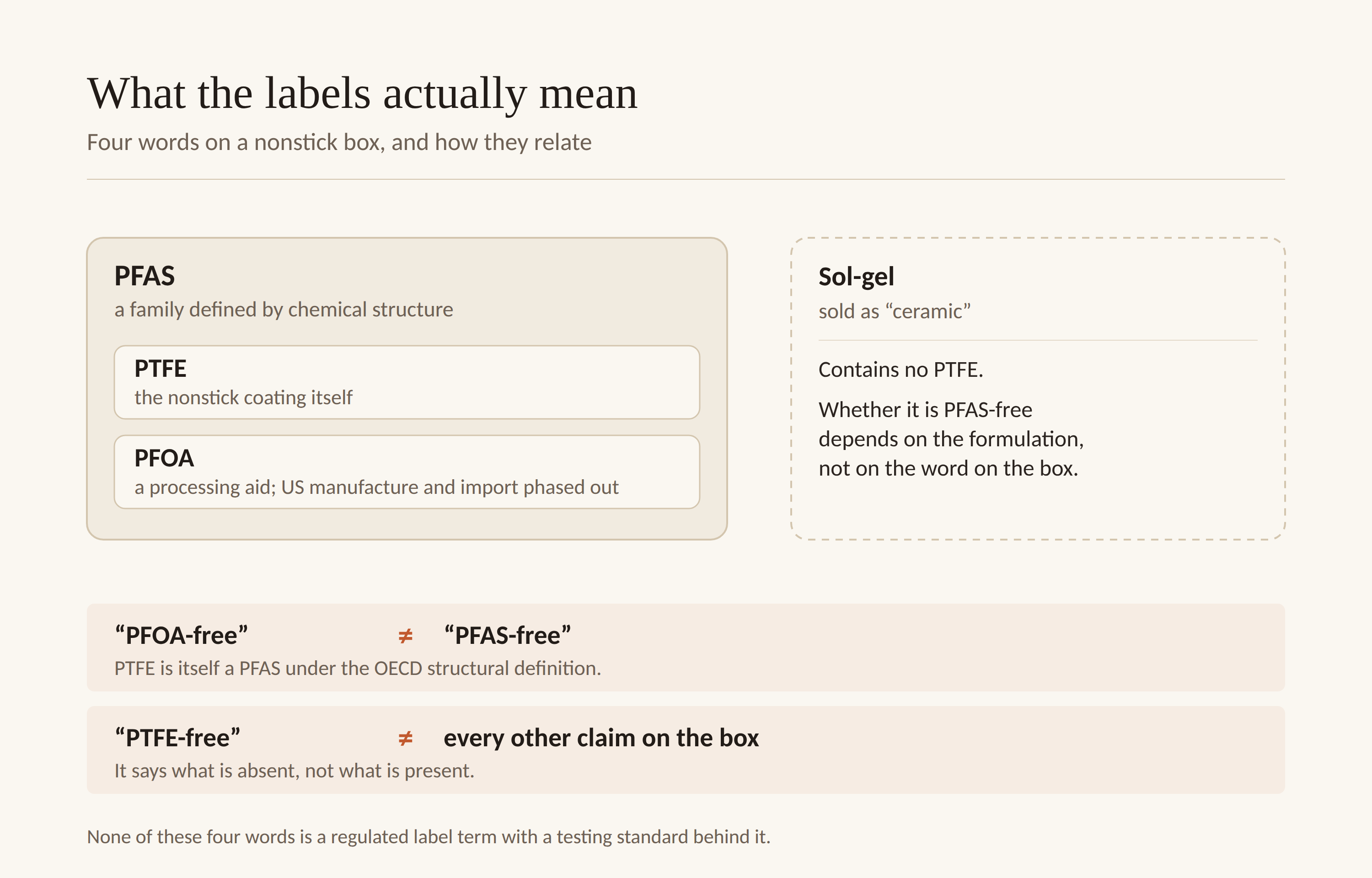
“PFOA-free” — true, and close to meaningless. PFOA was a processing aid used in manufacturing. Its US manufacture and import were phased out under an EPA program that concluded in 2015. So the claim is very likely accurate on any new pan sold here — which is exactly why it no longer distinguishes one pan from another. It is also, post-phase-out, close to the textbook case of advertising the absence of something no longer associated with the category. Worse, independent testing by the Ecology Center found “PFOA-free” routinely applied to pans that were PTFE-coated without disclosing it. The label tells you nothing about what is on the pan.
“PTFE-free” — unregulated, but empirically the most reliable of the set. The same Ecology Center testing found pans labeled PTFE-free to be genuinely free of fluorinated compounds. In practice it means a sol-gel coating. That reliability is an observed track record rather than a standard, and it says nothing about the primer underneath.
“PFAS-free” — unregulated and definitionally unstable. The answer depends on which definition you use. Under the OECD's 2021 structural definition, PTFE itself is a PFAS. A pan can be PFAS-free under a narrow statutory definition and PFAS-containing under the structural one. Note also that at least one granted patent for sol-gel cookware coatings specifies a fluorinated silane in the top layer to improve release — so PFAS-free is a property of the particular formulation, not of the “ceramic” category.
“Toxin-free,” “chemical-free,” “forever-chemical-free” — marketing. “Toxin” properly means a poison produced by a living organism. “Chemical-free” is false of all matter. “Forever chemical” is a journalistic coinage with no regulatory definition. The Green Guides separately warn that non-toxic claims imply safety for both people and the environment, which is a substantial burden to carry with no test behind it.
The bottom line: none of these six terms has a testing standard or a certification behind it. They differ in how likely they are to be true, not in how well they are policed.
“Ceramic” and its cousins
“Ceramic” is not fired ceramic, glaze or stoneware. It is sol-gel chemistry. The most telling detail is typographic: PPG, one of the largest cookware coating suppliers, puts 'ceramic' in quotation marks in its own product naming — describing one line as a “'ceramic'-like non-stick alternative to PTFE.” When the supplier flags the word as approximate, that is worth knowing.
“Titanium” and “titanium-reinforced” — this is a PTFE pan. PPG's QuanTanium is described in its own documentation as “an internally reinforced PTFE coating” with titanium as a dispersed reinforcing filler. The base chemistry is PTFE; the titanium is an additive for abrasion resistance. This is the single most useful correction on the list, because the name strongly implies a titanium cooking surface and there isn't one. What form the titanium takes, and how much, is not disclosed even by the supplier.
“Diamond” and “diamond-infused” — particles, not a surface. The relevant patent is titled, plainly, a “non-stick coating composition comprising diamond particles.” Diamond is an additive in a coating, usually justified on thermal conductivity and hardness. It is not a coating chemistry, and the pan is not diamond-surfaced. “Infused” has no technical definition at all.
“Granite,” “marble,” “stone,” “mineral” — nobody documents these as materials. We searched coating-supplier technical literature and patent databases specifically for these, and found nothing. PPG's kitchenware line describes no stone, granite or marble product. The only sources describing them are retailer copy and content farms.
So the honest statement is: no coating supplier documents a “granite coating” as a material class. These are appearance words.
But do not over-correct into assuming the speckles are always fake. Two things are documented. A Chemours patent covers decorative inks printed between coating layers on cookware, where the printed pattern carries no nonstick function — so a purely cosmetic speckle is established practice. And a separate patent from SEB claims a deliberately discontinuous patterned coat, covering 15–40 percent of the cooking surface, where the interruptions deflect forces from metal utensils and genuinely improve scratch resistance, using fillers including mica and coated silica flakes. A speckled pan might be decoration; it might be a functional pattern. The label does not distinguish them, and that is the point.
Durability and performance claims
PPG states the situation plainly: “Unlike many other industries, consumer cookware lacks standardized and widely adopted testing methods,” so manufacturers “develop proprietary testing protocols.” PPG's own is an internal method — an accelerated home-cooking test cycling through specified foods, heating and cooling, sponge and dishwasher cleaning, oils, acids and scraping utensils. Useful, and not a public standard.
There is a further complication that makes cross-brand comparison close to meaningless: the two chemistries fail differently. PPG notes that for sol-gel coatings, thermal and chemical stress, not abrasion and scratching, are the biggest cause of failure. An abrasion-cycle number measures the thing PTFE dies of. It does not measure the thing ceramic dies of.
- “10x more durable” — no standard, no disclosed comparator, no stated failure criterion. For scale, the strongest claim PPG makes for its own premium sol-gel is that lab testing shows it lasting twice as long as comparable sol-gel coatings. A box claiming ten times is not measuring the same thing as anyone else's box.
- “Metal utensil safe” — real numbers exist, but only upstream. PPG says QuanTanium withstands up to 25,000 cycles of wet abrasion testing. That number never reaches the packaging, and the phrase carries no threshold: it does not mean scratch-proof, and it does not survive a knife edge.
- “Scratch-resistant” — comparative-sounding, absolute-sounding, neither. No public pass mark exists.
- “Dishwasher safe” — a manufacturer's own durability assertion, and one that may cover the coating without covering handles, rivets or the exterior finish.
The standards that do exist — BS 7069, the nonstick requirements added to EN 12983-1 in 2023, and the Cookware Manufacturers Association's voluntary methods — measure cycles to failure, not years of use. No standard converts one into the other, which is why any lifespan in years printed on a box is a product claim rather than a property of the material.
Temperature labels
PTFE coatings carry a maximum recommended use temperature of about 500 °F (260 °C). Sol-gel figures vary enormously: GreenPan states 850 °F for its coating, while Le Creuset rates its own ceramic nonstick at 550 °F — dropping to 425 °F if you use a glass lid.
That last detail is the instructive one. A limit that changes when you add a lid is a whole-assembly limit, not a statement about the coating. The knob, the handle and the lid are frequently what caps the number.
And here is a genuine gap we went looking for and did not find: no manufacturer's consumer-facing material explains that its stated limit is a service limit rather than the point at which something hazardous begins. Chemours' consumer cookware pages carry no maximum use temperature at all. The distinction matters — the temperatures at which PTFE actually decomposes are considerably higher than 500 °F — and a reader who exceeds the number is left choosing between “the label is nonsense” and unnecessary alarm. We cover what those temperatures actually are, and the one household situation that matters, in our cookware materials guide.
Certification marks, and one phrase to distrust
“FDA-approved” is not a thing. The FDA does not approve pans, coatings or cookware. What exists is authorization of food-contact substances: PTFE, FEP and PFA are permitted for repeated food-contact use under a specific regulation, subject to limits on how much may migrate into food.
So the resin is authorized for this use, under conditions. The FDA has not reviewed the finished pan, the layer system, the primer, the fillers or the manufacturer's quality control. “FDA-compliant” is defensible; “FDA-approved” is not, and on a box it is a signal about how carefully the seller uses language generally. Even Chemours slips here, describing its coatings as “approved for food contact by global regulatory agencies.”
Proposition 65 warnings
California's Proposition 65 requires businesses with ten or more employees to warn when a product exposes people to a listed chemical above a safe-harbor level. California's own agency is explicit that a warning means the business believes a listed chemical is present — not that the product is unsafe or illegal.
Two things make the warning a poor safety signal on cookware. Because enforcement runs substantially through private lawsuits, there is a strong incentive to warn defensively rather than to measure. And on a pan, the trigger is frequently a handle, a rivet, an exterior enamel or a decorative finish — not the cooking surface at all.
The absence of a warning is even less informative: the seller may have fewer than ten employees, the exposure may fall below the safe-harbor level, or the product may simply be non-compliant. None of these is distinguishable by a shopper.
What the label cannot tell you
The genuinely useful information exists — it is just not printed where you can see it.
- Which resin is on the pan. Not disclosed by tier or brand.
- How many coats. Not on the box — but coating suppliers publish coat counts for every line in the brochures they give pan manufacturers.
- Coating thickness. Not disclosed anywhere we could find, consumer or trade.
- Primer chemistry. Patents indicate it is typically polyamide-imide rather than a fluoropolymer. Never stated to buyers.
- Reinforcement type and loading. A name only — “titanium,” “diamond” — with no form or quantity, even in supplier literature.
- Expected lifespan. Not knowable from existing tests, per the supplier's own account of the field.
That the coat count and chemistry appear in a business-to-business brochure but not on the consumer package is the clearest statement of the problem. The information is not unknown. It is simply not passed along.
What to stop believing
- “Teflon means PTFE.” The brand covers at least four resins.
- “A titanium pan is coated in titanium.” It is a PTFE pan with a filler.
- “Ceramic pans are ceramic.” Sol-gel silica chemistry; the supplier itself uses scare quotes.
- “PFOA-free means no PTFE.” Independent testing found it applied to undisclosed PTFE pans.
- “These -free claims are certified.” None has a testing standard behind it.
- “FDA-approved nonstick.” No such status exists.
- “Ceramic outlasts PTFE” or the reverse. A 2025 peer-reviewed comparison found PTFE held better release, but the spread between ceramic formulations exceeded the gap between the categories — so the word on the box predicts less than the specific product does.
- “A Prop 65 warning means the coating is dangerous.” Often it concerns the handle.
If you want the underlying safety picture rather than the vocabulary — what temperature actually matters, and why an empty pan is the case to avoid — that is in the materials guide. For the uncoated alternatives, see what seasoning actually is and why food sticks to stainless steel.
Sources
- FTC Green Guides, 16 CFR Part 260, particularly §260.9 on free-of claims and §260.10 on non-toxic claims
- FDA food-contact authorization at 21 CFR 177.1550
- Chemours Teflon industrial and consumer coating documentation
- PPG cookware coatings brochure (2023), product pages for Fusion, Fusion Pro and QuanTanium, and its published note on testing standards for sol-gel nonstick
- US patents on diamond-particle nonstick compositions, decorative inks for nonstick coatings, and SEB's discontinuous scratch-resistant coating
- OECD ENV/CBC/MONO(2021)25 on PFAS terminology
- EPA documentation of the PFOA Stewardship Program
- Ecology Center Healthy Stuff Lab cookware testing
- California OEHHA Proposition 65 guidance
- Guerrero Vacas et al. (2025), sol-gel ceramic versus PTFE comparison