How to Care for Enameled Cast Iron
Enameled cast iron is glass fused to iron, and nearly every care rule follows from that. What the manufacturers actually say, including the three places the popular advice has it backwards.
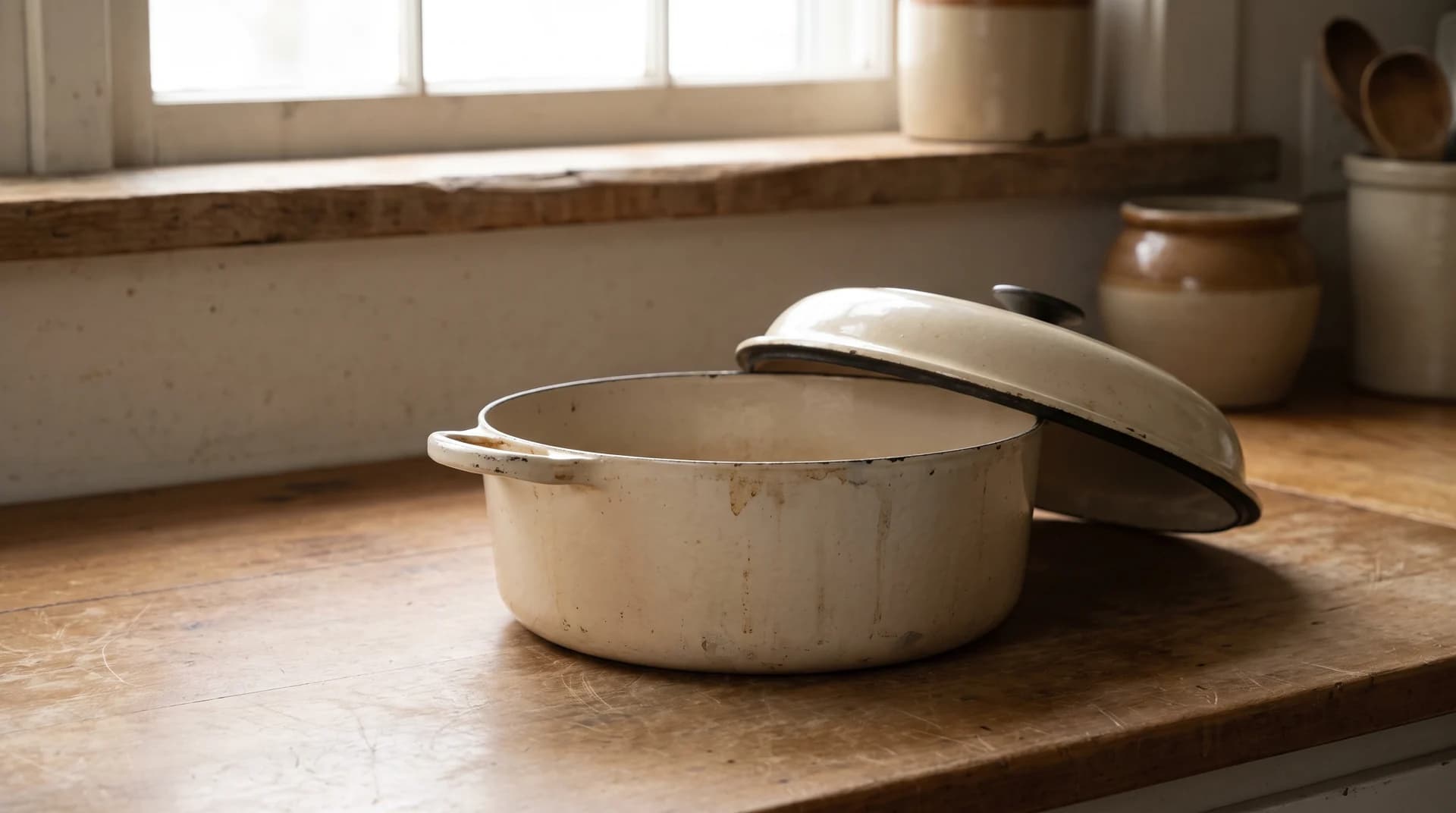
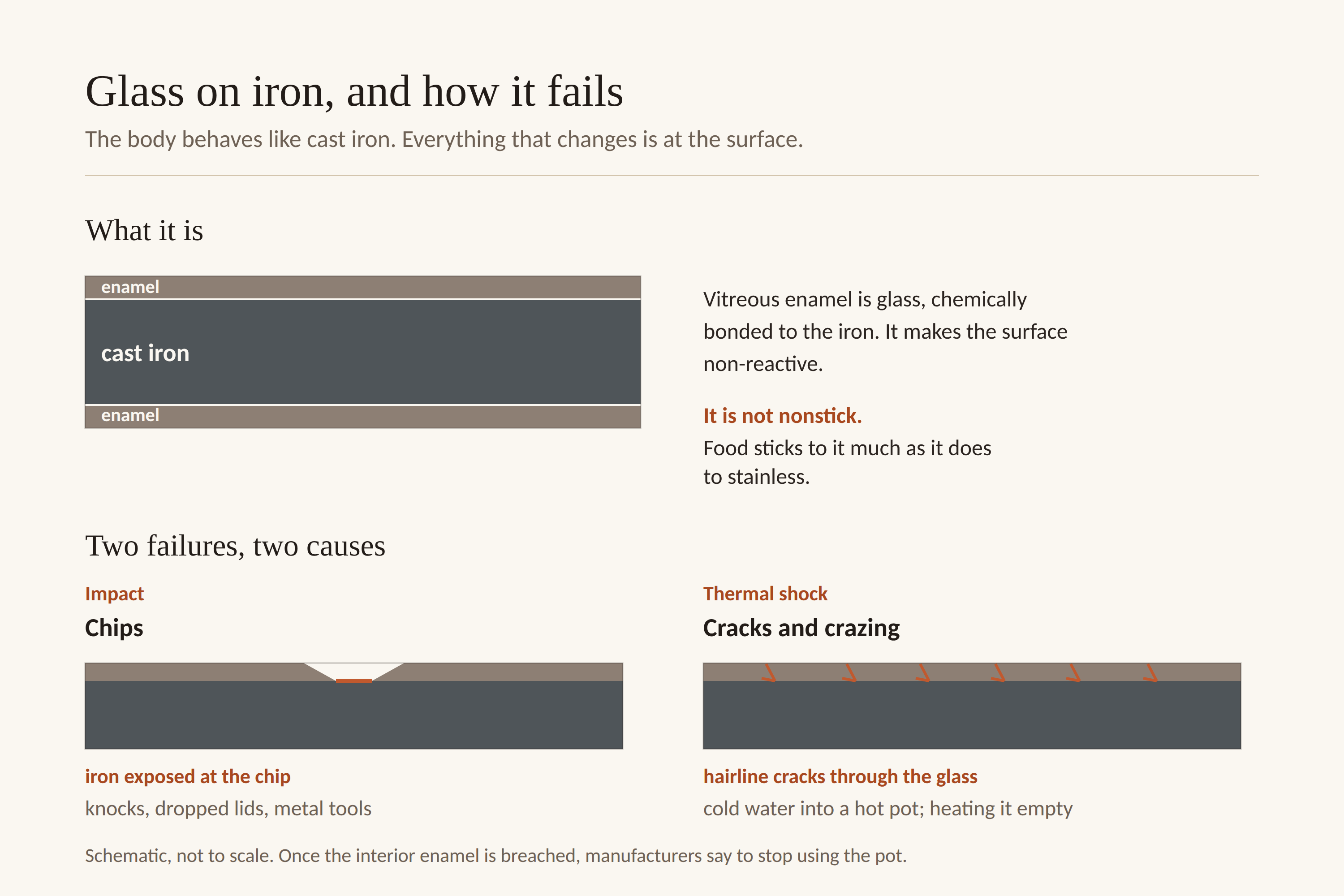
Enameled cast iron is two materials pretending to be one: a heavy iron casting for the heat, and a layer of glass fused to it for the surface. Almost every care rule follows from that second half. Glass does not rust, does not react with acid, and does not need seasoning — but it is brittle, it chips, and it does not much like sudden temperature changes.
Here is what the manufacturers actually say, including the three places where the popular advice has it backwards.
Before the first meal
Both major makers say the same thing, and it is short: remove all packaging, clips, labels and stickers, wash in warm soapy water, rinse and dry thoroughly. There is no factory coating to strip.
One real difference is worth knowing. Staub instructs an initial oiling — brush the inner surface with vegetable oil, heat gently, and wipe away the excess before first use. Le Creuset gives no such instruction. This is not an inconsistency so much as a difference in surface: Staub's black matte interior is designed to develop a patina over time, while Le Creuset's light sand interior is a smooth, glossy enamel that is not meant to.
Everyday cleaning
Let it cool first. Both makers lead with this, and it is the rule that prevents the most expensive failure. Le Creuset: always cool to room temperature before cleaning, and never plunge a hot pan into cold water or fill it with cold water. Staub says the same, and gives the reason plainly — sudden temperature extremes can crack the piece.
After that it is unremarkable: warm water, mild dish soap, and a soft sponge or nylon brush. For stuck-on residue, both makers recommend soaking rather than scrubbing — Staub explicitly sanctions an overnight soak in warm soapy water.
Dry it completely. Le Creuset ties this to a specific problem: rust on the rim, where the iron is not enameled.
What none of them permits: metal cleaning pads, scouring pads, or harsh abrasives. Lodge adds a warning the others do not — avoid citrus-based cleaners, which can dull the exterior gloss.
The dishwasher question, which is widely reported wrong
The common claim is that enameled cast iron must never go in a dishwasher. No manufacturer says that. All three permit it, and the exclusions are by component rather than by pot:
- Le Creuset: all products are dishwasher safe except those with wooden handles or accessories, enamel-on-steel lids, colored stainless steel knobs, and decals. Note the distinction — a plain stainless knob is fine; a colored one is not.
- Staub: dishwasher safe except cookware with wooden handles, though regular dishwasher use is not recommended.
- Lodge: technically dishwasher safe, but hand washing is preferred to preserve the finish.
The stated downside across all three is cosmetic dulling of the enamel, not structural failure. Hand washing keeps a pot looking better for longer. It is not the difference between a working pot and a ruined one.
Stains, and what actually removes them
Light-colored interiors stain. Le Creuset says so about its own sand enamel — which is a fair trade, because a light interior is also what lets you see the fond building on the bottom of the pot as you brown.
Staub is similarly matter-of-fact about interior discoloration: rings and brown marks are a natural reaction to foods and do not affect performance.
Baking soda is endorsed by all three manufacturers, with specific procedures. Le Creuset: fill with warm water and a tablespoon or two of baking soda and simmer for eight to ten minutes. Lodge: boil two cups of water with four tablespoons of baking soda for a few minutes, then loosen residue with a pan scraper. Staub: soak in boiling water with two or three spoonfuls of baking soda.
Oxalic-acid cleansers — the Bar Keepers Friend category — are named by both Le Creuset and Staub. Le Creuset also sells its own enameled cast iron cleaner, which it specifically recommends for removing metal marks.
Oven cleaner is prohibited. Staub says it twice, and says it will permanently damage the cookware. So are metal brushes and scouring pads, across all three makers.
One thing we will not tell you: neither Le Creuset nor Staub mentions bleach anywhere in their published care material. Advice that attributes a bleach prohibition to them is inventing it. That is not permission — it is an absence of guidance, and we would rather say so than fill the gap.
Metal utensils
Le Creuset takes a two-tier position that is more nuanced than most summaries allow. Sharp metal is an absolute no: never use knives or other sharp metal utensils, which will mark and scratch the enamel. Other metal tools are discouraged rather than banned — occasional use “may leave silver trail marks,” and those marks are treated as removable with their cleaner rather than as damage.
Staub does not recommend metal utensils or knives, as they could potentially damage the enamel. Lodge is strictest: wood, silicone or nylon only.
A myth worth killing: the claim that you can use metal utensils on Staub's black matte enamel because it is tougher. No manufacturer publishes a different utensil rule for dark enamel. Staub's matte interior is praised for durability and patina development, but nothing in their documentation licenses metal tools on it.
Heat: stricter than most people expect
This is the area where enameled cast iron differs most from bare cast iron, and where the instinct to treat it as indestructible causes trouble.
Le Creuset's general guidance is low to medium heat. Its UK care instructions go further, restricting high heat to boiling water for pasta or vegetables and reducing stocks and sauces — which is a direct restriction on dry high-heat searing. Staub's guidance is to heat slowly.
Never heat an empty pot, and never let one boil dry. Both makers state this explicitly, and Le Creuset warns it may cause permanent damage. An empty enameled pot on a hot burner has nothing absorbing the energy, and the enamel pays for it.
Oven limits depend on the fittings, not the pot. Le Creuset publishes 390 °F (200 °C) for phenolic knobs, 500 °F (260 °C) for stainless knobs, and 660 °F (350 °C) for cast iron handles and knobs. The phenolic-knob limit is the one that catches people out, because nothing about the pot suggests it. Staub also sets limits by fitting, but its published figures differ between its US and European documentation — so use the sheet that came with your pot rather than a number found online.
Many owners swap a phenolic knob for a stainless one specifically to raise the oven ceiling. That is a manufacturer-supported path, since the limits are published per knob.
Thermal shock, chips, and what ends a pot's life
Enamel fails in two distinct ways, and confusing them leads to the wrong precautions.
Chips come from impact. Knocks, dropped lids, careless metal tools at the rim, and pots stacked directly on each other. Staub notes that scratches and chips result from mishandling rather than manufacturing defects.
Cracks and crazing come from thermal shock. Cold water into a hot pot, or an empty pot preheated hard. The glass and the iron expand at different rates; force that difference and the glass loses.
What is cosmetic and what is terminal
The makers do draw a line, and it is clearer than most coverage suggests:
- Metal trail marks — cosmetic. Le Creuset sells a cleaner specifically for them.
- Brown rings and food staining inside — cosmetic. Staub calls it a natural reaction to foods that does not affect performance.
- Exterior scratches from stacking — cosmetic, and preventable.
- A chip in the interior enamel — terminal. Le Creuset's language is unambiguous: never use a product when the interior enamel has chipped, and stop using it immediately.
- A cracked body — terminal.
There is no manufacturer-endorsed home repair. Neither Le Creuset nor Staub nor Lodge sells a touch-up compound, a repair kit or a refinishing service. Le Creuset's UK guidance states plainly that a chipped piece cannot be accepted for repair, because the enamel is glass and glass chips when dropped. Every “how to repair chipped enamel” guide we found was a content farm.
And the warranty will not cover it. Le Creuset's lifetime warranty covers defects in material and workmanship at the time of purchase, under normal household use. Impact damage is classified as mishandling, not a defect. Dropping a pot is not a warranty claim.
One honest gap: neither maker addresses crazing — the fine hairline network that can appear in a glaze — anywhere in their published care material. The widely repeated reassurance that crazing is purely cosmetic and safe has no manufacturer backing that we could find. We are not going to assert safety on their behalf. If your pot develops it, that is a question for the manufacturer directly.
The iron underneath
Here is the finding that most surprises people, and it overturns the standard line that enameled cast iron never needs oil.
The rim is usually not enameled, and bare iron rusts. All three manufacturers publish the same remedy — and it involves oiling:
- Le Creuset: clean small rust areas with a nylon sponge and dish soap, dry thoroughly, then rub in a small amount of sunflower or vegetable oil “to create a seal and prevent any rust from reappearing.”
- Lodge: apply a small amount of cooking oil around the rim, in the same words, for the same reason.
- Staub: scrub light rust with baking soda and rub cooking oil on the affected area.
Rim rust is a drying-and-storage problem, not a defect, and it is fully reversible.
Keep this separate from an interior chip. Exposed iron on the rim is a maintenance item with a published fix. Exposed iron inside the pot, where food cooks, is the case Le Creuset says to stop using the pot over. Conflating the two is the most common error in this subject — in one direction it makes people throw away a perfectly good pot, and in the other it keeps a compromised one in service.
Storage
All three makers converge here, and the two failure modes are chipping and trapped moisture.
Use a cookware protector, a cloth or a towel between stacked pieces — Le Creuset and Staub both say not to stack bare. Store in a dry, airy place, never damp. Lodge makes the most specific point: a lid left on traps moisture against the rim, which is exactly where rust starts. Storing the lid slightly ajar, or with a protector between it and the rim, solves it.
What to stop believing
- “Never put it in the dishwasher.” All three makers permit it; the exclusions are wooden handles and, for Le Creuset, enamel-on-steel lids, colored knobs and decals. The cost is dulling, not destruction.
- “Metal utensils are fine on black matte enamel.” No maker publishes a different rule by enamel color.
- “Enameled cast iron never needs oil.” All three instruct oiling the unenameled rim; Staub instructs oiling the interior before first use.
- “You can repair a chip with enamel paint.” No manufacturer sells or endorses any such product.
- “Any chip means throw it away.” Le Creuset's prohibition is specific to the interior. Exterior scratches and rim wear are serviceable.
- “The lifetime warranty covers chips.” It covers manufacturing defects, not impact damage.
- “Baking soda is a folk remedy.” It is in the official care documentation of all three makers.
For where enameled cast iron sits among the other materials — and why it heats like bare iron while behaving nothing like it at the surface — see our cookware materials guide. If you also cook on bare iron, seasoning works on a completely different principle, and enamel needs none of it.
Sources
- Le Creuset care and use documentation (US and UK), enameled cast iron cleaning guidance, sand versus black satin enamel comparison, frequently asked questions and warranty terms
- Staub safety and use-and-care documentation and ZWILLING care guidance
- Lodge enameled cast iron care documentation
- MDPI Encyclopedia entry on porcelain enamel coatings
- King, Tripp & Duckworth, Battelle Memorial Institute (1959), on the nature of enamel adherence to metals
- ISO 6769 on Mohs scratch hardness of vitreous and porcelain enamels